
Advantage 1: Vertical Unidirectional Flow for More Reliable Sample Protection
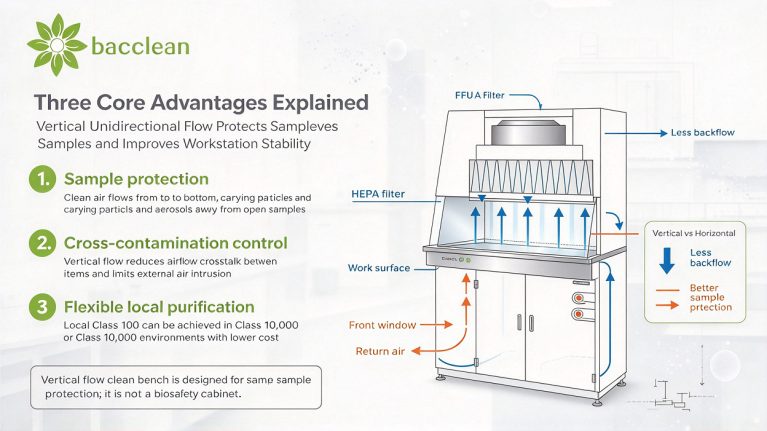
For vertical flow clean benches, clean air is evenly delivered downward from the top HEPA filter to form a top-to-bottom unidirectional laminar flow. After the clean air covers the work surface, it quickly carries away dust, microorganisms, aerosols and other pollutants generated during operation from the sample surface, preventing them from staying or spreading above the workbench.
Compared with horizontal flow, vertical flow is less likely to produce obvious backflow blocked by the operator’s arms, vessels or tools. Especially in scenarios such as cell culture, microbial inoculation, aseptic dispensing, pharmaceutical inspection and precision electronic assembly, samples are often placed open. The downward vertical airflow can protect the exposed surface more directly and reduce the risk of sample contamination.
Advantage 2: Reduced Cross-Contamination & Better Operating Experience
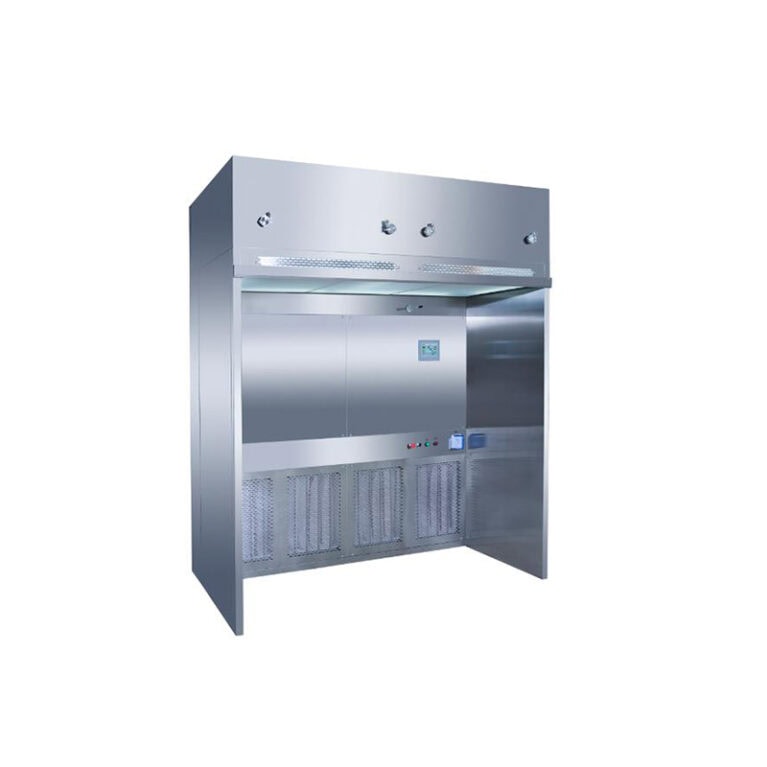
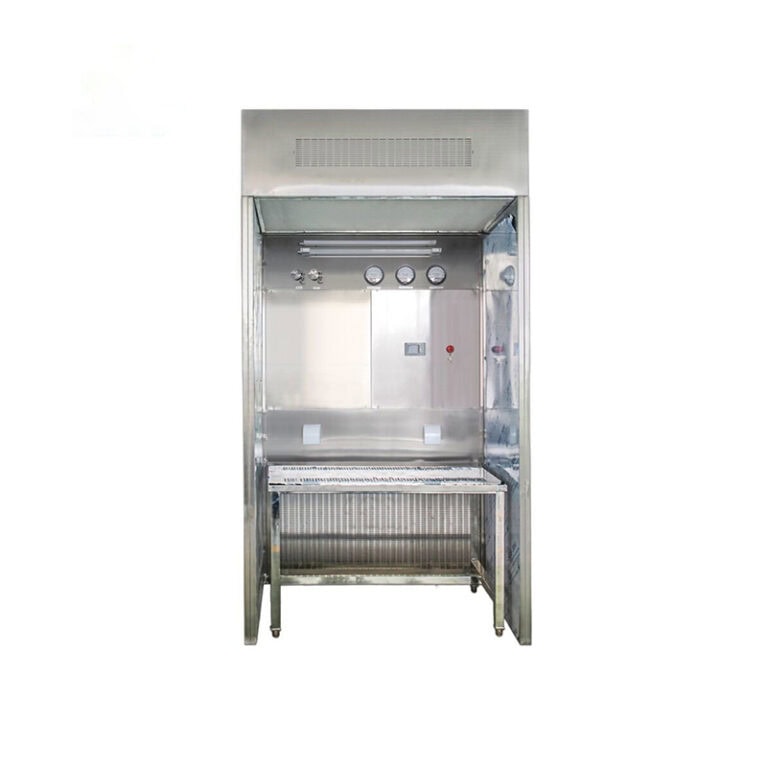
Vertical flow clean benches are usually equipped with a liftable front window. Combined with the descending airflow, it forms a quasi-enclosed operating area to reduce the backflow of external air and odor diffusion. The airflow moves from top to bottom, and the operator’s face is not directly in the main airflow, delivering better comfort during long-time operation.
Meanwhile, vertical flow can reduce airflow crosstalk between different samples. In horizontal flow, particles generated by items in the front may be blown toward items at the back; vertical flow tends to carry pollutants downward and discharge them from the bottom or side return air slots, which helps control cross-contamination.
Advantage 3: Local Class 100 Purification, Flexible Deployment & Controllable Cost
Not all areas of a clean workshop require an overall Class 100 environment. Vertical flow clean benches can provide ISO Class 5 (Class 100) local clean areas for key processes in Class 10,000, Class 100,000 or even ordinary clean environments. Compared with upgrading the whole workshop to a higher clean class, this “local enhancement” method features shorter construction cycle, lower energy consumption and renovation cost.

Vertical flow clean benches can be used individually, or multiple units can be connected in series to form an ultra-clean production line. They are suitable for workstation scenarios such as assembly, inspection, dispensing and testing. With relatively compact structure, they impose few restrictions on workshop layout, and it is convenient for later capacity expansion or process route adjustment.
Selection & Usage Reminders
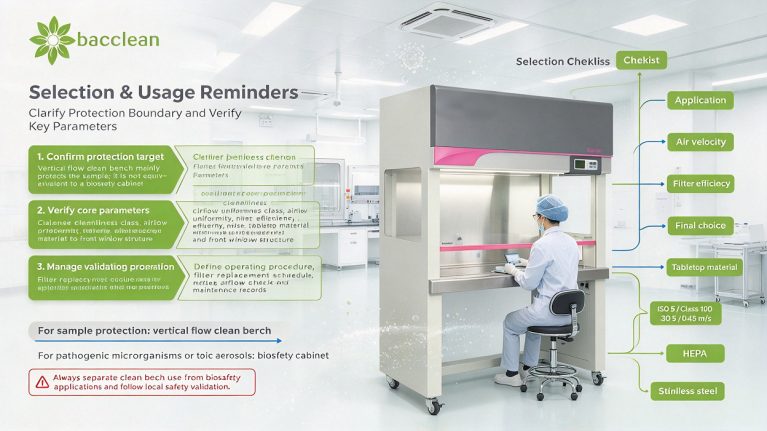
- Prioritize application scenarios: Vertical flow is more suitable for workstations with high requirements for sample protection, many open operations and high cross-contamination risk.
- Focus on core parameters: Cleanliness class, wind speed uniformity, filter efficiency, noise, tabletop material and front window structure should all be included in evaluation.
- Clarify protection boundary: Vertical flow clean bench mainly protects samples and is not equivalent to a biosafety cabinet. When handling pathogenic microorganisms, toxic chemicals or high-risk aerosols, a corresponding level of biosafety cabinet shall be selected.
From the perspective of overall clean workshop planning, the value of vertical flow clean bench is to convert “full-room Class 100” into “Class 100 at key workstations”, which not only ensures process cleanliness, but also improves space utilization and operating economy.
