
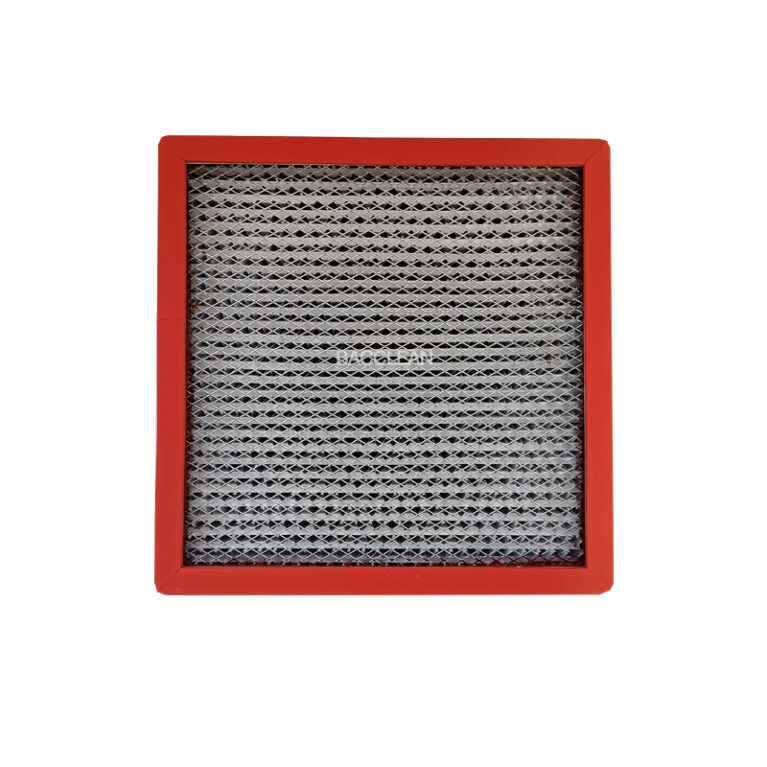
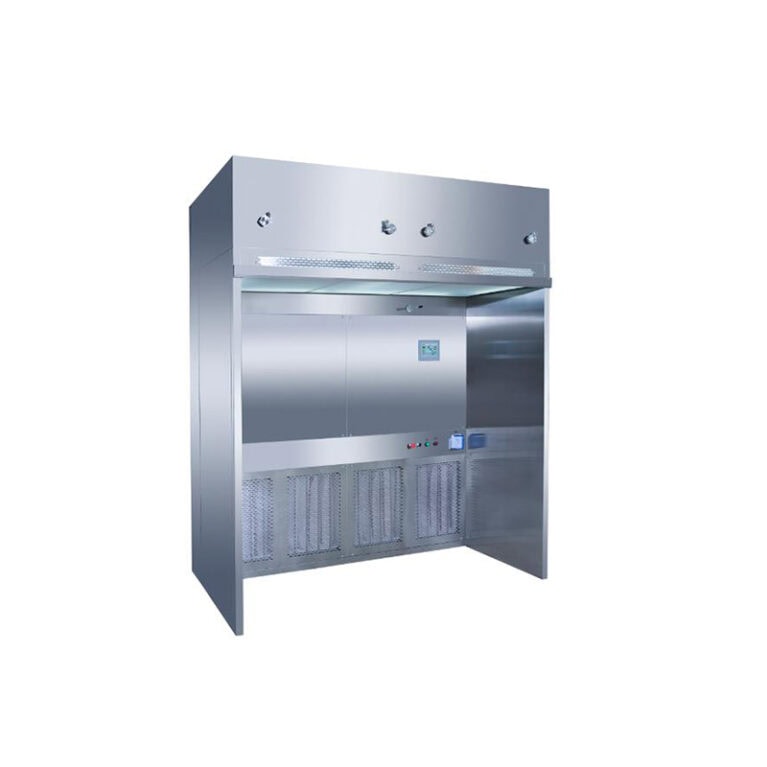
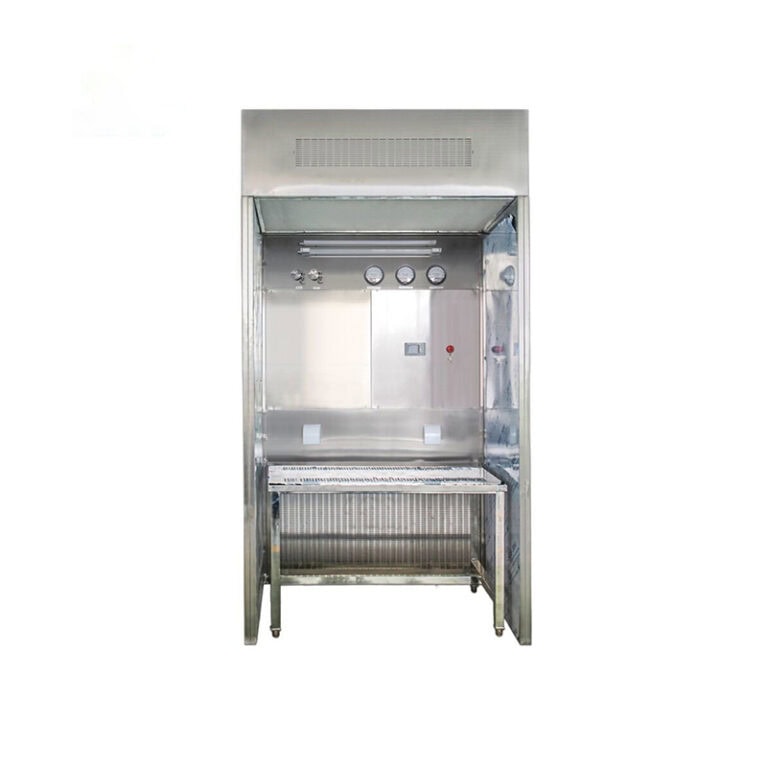
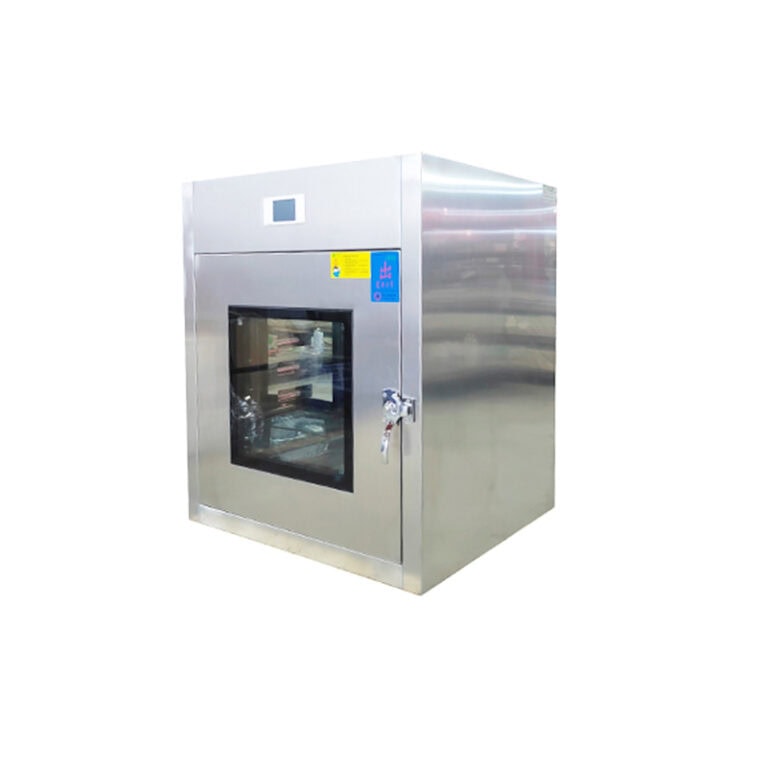

The core principle of the horizontal laminar flow clean bench is that clean air is delivered horizontally and uniformly forward from the plenum chamber at the rear of the equipment through the HEPA filter to form unidirectional parallel laminar flow. The airflow flows forward along the bench surface toward the operation opening, continuously carrying away dust and debris generated in the working area and preventing contaminants from swirling and depositing on the bench. Different from the top-down airflow path of vertical flow models, the horizontal flow bench has no return grilles or holes on the surface. The continuous and smooth surface is not prone to accumulating solder slag, welding powder and tiny component debris, which well matches the material characteristics of electronic processes. This is the core reason why horizontal flow solutions are widely adopted in the electronics industry.
In electronic workshops, different sub-processes carry different contamination risks, and horizontal laminar flow clean benches can be flexibly deployed at key points of the production line. For assembly stations of optical lenses, optical filters and optical communication devices with strict control over particles and oil stains, workpieces shall not be contaminated by condensed water or foreign objects falling from above driven by top-down airflow. The horizontal airflow continuously purges from the rear of the workpiece, and the rear area is isolated by the filter, making it difficult for external particles to flow backward and attach to the optical surface. For PCB rework, BGA ball placement and manual chip packaging stations, soldering will produce solder balls, flux dust and resin debris. The flat bench surface facilitates slag cleaning, and contaminants are directly discharged outward with horizontal airflow without accumulating in return holes to form long-term pollution sources. For inspection, sorting and packaging stations of semiconductor discrete devices, resistors, capacitors, precision sensors and MEMS devices, most materials are flat and thin. Vertical airflow tends to blow thin and light components away or overturn them, while the stable forward horizontal airflow causes less disturbance, reducing the risk of material displacement and dropping. For AMC control processes such as precision component inspection of lithium batteries and photovoltaics, FPC soft board cutting and module assembly, silicon-free sealing versions can be upgraded to avoid product contamination by silicon precipitates and meet the molecular pollution control requirements of high-end electronic manufacturing.
In terms of cleanliness performance, the equipment relies on H14 HEPA filters to achieve stable high cleanliness. The operating area reaches ISO Class 5 under static conditions, and suspended particles ≥0.5μm are controlled within standard limits. The laminar velocity is generally set at 0.30~0.40 m/s, and the velocity uniformity is controlled within ±20% of the set value. If the velocity is too low, the unidirectional flow barrier is easily broken by transverse airflow in the workshop and external dust invades. Excessively high velocity will increase noise and blow up lightweight components and disturb flux fume. PAO aerosol leak test is carried out during factory delivery and on-site acceptance to fully scan the filter medium, sealing frame and sealing surface of the plenum chamber and eliminate bypass leakage, which is a mandatory verification step for high cleanliness requirements in the electronics industry. Combined with smoke flow pattern test, the smoke shall flow straight forward at a constant speed without vortex, backflow or local stagnation zone, ensuring that particles generated at any position can be taken away by airflow in time and avoiding secondary deposition on the workpiece surface.

The operating environment of electronic workshops has its own characteristics. There are often disturbances from air-conditioning outlets, assembly line transmission airflow and personnel movement around the production line. Therefore, the equipment shall be placed away from main air outlets and passage entrances of the workshop. The inner cavity of the whole machine adopts SUS304 stainless steel with integrally bent bench surface, no dead corners and dust hiding gaps, resistant to repeated wiping with alcohol, dust-free wipes and flux cleaning agents. The outer shell is made of electrostatic powder-coated steel plate. Anti-static structures can be configured as required, with anti-static mat and grounding terminal on the bench surface to control static accumulation and adapt to the processing of electrostatic-sensitive devices. Flicker-free LED soft light is preferred for lighting, with stable illuminance above 300lx to meet the lighting requirements of visual inspection and microscopic recheck. The fan adopts variable frequency speed regulation scheme to fine-tune the airflow velocity according to working conditions. It is equipped with a differential pressure monitoring module to monitor the resistance change of HEPA filters in real time. An audible and visual alarm will be triggered when the resistance exceeds the standard, reminding maintenance personnel to replace the filter material in time and prevent cleanliness degradation due to reduced filtration performance.
In terms of production line layout, horizontal laminar flow clean benches are highly flexible. A single unit can be arranged independently, or multiple units can be connected in series to form a continuous clean workstation section to connect the loading and unloading of the assembly line. Compared with large clean booths and full Class 100 clean production lines, it has lower investment cost and shorter deployment cycle, without large-scale renovation of the workshop HVAC system. It is suitable for single-point high-cleanliness workstation renovation, local upgrade of production lines and small-batch precision sample trial production. At the same time, its application boundary shall be clearly defined: the horizontal airflow blows directly toward operators. When the process produces toxic flux fume and heavy metal dust, an external exhaust collection device shall be equipped. It is not suitable for working conditions with infectious or highly toxic materials. For precision assembly and inspection processes in the electronics industry that only require particulate foreign matter control and have no high-risk volatiles, horizontal flow solutions have outstanding advantages in comprehensive cleanliness performance, operation convenience and operation & maintenance cost.
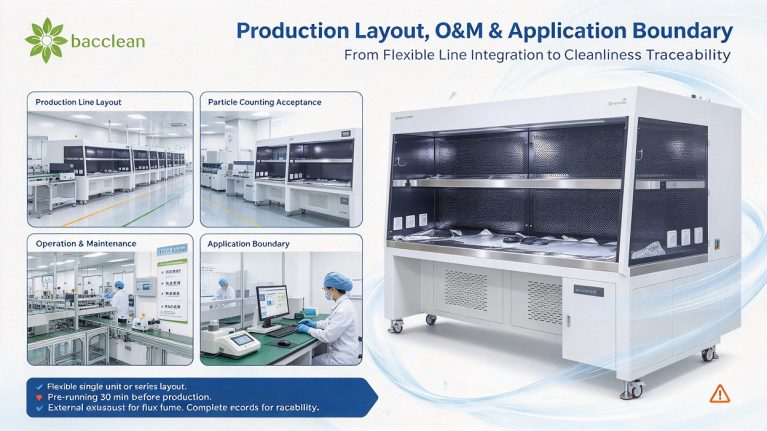
Daily maintenance is the key to maintaining stable high cleanliness for a long time. The equipment needs to be turned on for self-purification in advance, and production can start after running for 30 minutes. Keep the bench surface clean. Do not place tooling and materials behind the return air and in front of the filter to avoid blocking airflow. Record filter differential pressure data regularly. PAO leak test must be re-completed after filter replacement. Re-test the airflow velocity and suspended particles on the working surface regularly and keep test records for quality traceability. The differential pressure, temperature and humidity of the clean area of the workshop also need coordinated control, and the humidity shall be controlled within an appropriate range to balance dust suppression and anti-static requirements.
In conclusion, the horizontal laminar flow clean bench adapts to the process pain points of precision manufacturing in the electronics industry. The smooth bench surface facilitates the cleaning of solder slag and debris, the straight unidirectional airflow stably protects workpieces from rear-side contamination, and it causes little disturbance to thin and light components. It realizes local ISO Class 5 high cleanliness environment in a modular and low-cost way. It is a very important local purification solution besides vertical flow clean benches in scenarios such as optics, optical communication, chip packaging, PCB rework and inspection & packaging of precision components. Bacclean horizontal laminar flow clean benches can provide customized configurations such as anti-static, silicon-free sealing, external smoke and dust collection and variable frequency monitoring, together with verification services including PAO leak test and suspended particle test, to match different cleanliness control standards of electronic manufacturing.
