
1. Larger Clear Passage for Oversized, Tall and Irregular Materials
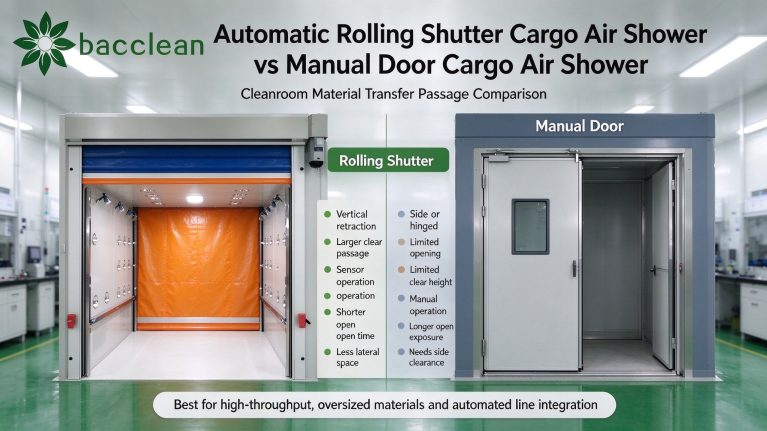
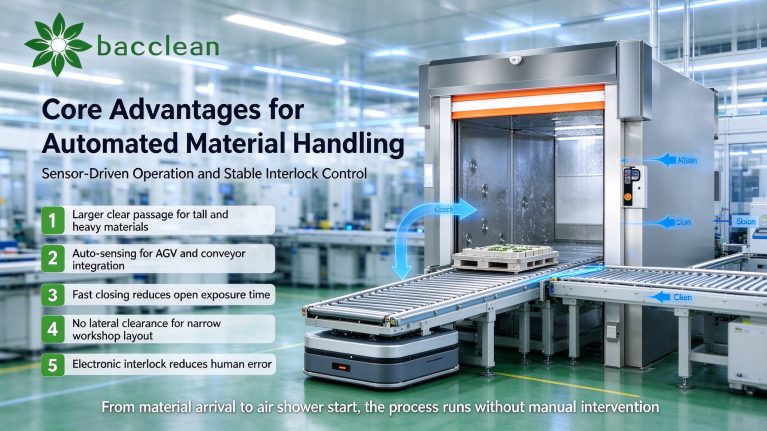
Manual sliding doors are restricted by door frames and travel space; the door leaf slides sideways, imposing hard limits on the usable height and width of the passage. Tall pallets, large modules, turnover crates, rolled materials and heavy tooling fixtures often cannot pass smoothly and are prone to colliding with door panels. The shutter of an automatic rolling shutter air shower retracts upward into the top housing and occupies no lateral travel space. The clear width can match the full width of the cabin, and the passage height can be customised easily. It is ideal for high pallets, full-stack cargo, long workpieces and heavy jigs, greatly reducing the risk of scratching materials and door structures — a key benefit for automated production lines and large-module workshops.
2. Sensor‑Triggered Operation for High Throughput and Line Integration
Manual doors require manual pushing. Operators carrying materials with both hands find this inconvenient, and it is common for doors to be left open or incompletely closed. Frequent door operation consumes time and slows production rhythm. Rolling shutter air showers can be interfaced with ground induction coils, microwave radar, photoelectric beams and dry contact signals from conveyor lines. When forklifts, AGVs or roller conveyors arrive at the sensing zone, the shutter rises automatically. Once materials are fully inside the cabin, the shutter drops, activating interlock and air shower cycles with no manual intervention. They integrate seamlessly with automatic conveying and AGV handling systems to stabilise line tact time and achieve substantially higher throughput at busy material transfer points.
3. Fast Opening and Closing Reduces Exposure and Contamination Risk
Manual doors rely on door closers, which shut slowly. After forklifts or personnel pass through, the opening remains exposed for a long time, causing massive air exchange, fluctuating cleanroom differential pressure and ingress of ambient dust, while increasing the load on cleanroom air‑conditioning systems. Rolling shutters have adjustable high lifting and lowering speeds, far faster than the closing action of manual door closers. The duration of open exposure is minimised, limiting uncontrolled cross‑airflow and helping preserve the cleanroom pressure gradient to reduce particulate infiltration. This advantage depends on well‑tuned sensing logic and reliable fully‑closed feedback; the air shower will not start unless the shutter is properly seated, and interlock functions remain intact.
4. No Lateral Clearance Required, Flexible Layout in Narrow Aisles
Sliding manual doors need reserved side space for door leaf travel. Equipment, racks and conveyors cannot be placed adjacent to the doorway, making installation impossible in many narrow workshop passages. Since rolling shutters retract vertically, no side clearance is needed. The unit occupies only the footprint of the passage itself and can be installed against partition walls or at the end of production lines. This layout flexibility makes it suitable for corner locations and inline insertion into existing lines, solving space constraints during workshop retrofits.
5. Minimised Human Error with Robust Electronic Interlocking
A frequent compliance risk of manual doors occurs during rushed production: operators leave doors open, force both doors open simultaneously or prop doors ajar to bypass interlocks, breaking the contamination barrier. This is a recurring quality hazard in GMP and high‑grade electronics cleanrooms. Rolling shutter systems are governed by electronic interlock logic: the air shower cannot start until the shutter is fully closed, and one shutter cannot open unless the opposite shutter is fully seated. This mechanically and electronically prevents forced opening and forgotten closure. In fully automatic AGV transfer applications, human intervention is eliminated entirely to avoid unregulated operation.
6. Better Impact Tolerance for Frequent Forklift and Heavy Pallet Traffic
Hard metal door leaves and frames of manual doors deform easily upon forklift or pallet impact, resulting in misaligned frames, broken hinges and torn sealing gaskets, with high repair costs and long downtime. The main body of a rolling shutter is flexible PVC or anti‑static fabric. Minor collisions usually only scratch the curtain rather than destroying the frame or drive assembly. Combined with crash edges and bottom photoelectric safety protection, the shutter will reverse immediately if an obstacle is detected during descent, protecting materials, vehicles and the door assembly. Severe impacts can still damage reels and guide rails, so operating discipline remains necessary.
7. Support for Continuous Through‑Type Long Passage Layout
Multiple rolling shutter air showers can be connected in series, or a single extra‑long cabin can be built for continuous roller conveyor lines running straight through the chamber. The upward‑retracting shutter will not obstruct the space above or below the conveyor. Manual sliding doors are difficult to implement in such continuous through‑feed layouts because the door structure interrupts the conveying path.
8. Rich Cleanroom‑Grade Options for Lithium Battery and Electronic Applications
Anti‑static PVC shutter fabric with controlled surface resistance can be selected to suppress electrostatic discharge for static‑sensitive components and lithium battery materials. Low‑outgassing, silicone‑free curtain materials are also available for AMC‑controlled environments. Compared with rubber gaskets on manual doors, side and bottom brush seals of rolling shutters maintain consistent contact for stable cabin sealing and reduce bypass air leakage.
9. Limitations for Proper Selection
-
Higher upfront cost than standard manual door cargo air showers, owing to additional motors, sensors, limit switches and electronic control assemblies.
-
More routine maintenance items: curtain abrasion, dust accumulation in guide rails, motor brakes, limit sensors and detectors require periodic inspection.
-
The shutter curtain is a consumable and will need replacement after prolonged friction or hard scratching.
-
Not cost‑effective for low‑traffic points with only small, infrequently moved materials, where manual doors are preferable.
-
Stable power supply is required; most units are fitted with a manual release for emergency opening during power failure.
10. Application Selection Guide
Prioritise automatic rolling shutter cargo air showers for these scenarios:
✅ Automated material transfer via AGVs and roller conveyor lines
✅ Oversized pallets, tall crates, long workpieces and frequent heavy forklift access
✅ Narrow passages lacking side clearance for sliding manual doors
✅ Lithium battery and electronics zones requiring anti‑static protection with high throughput
✅ GMP facilities seeking to reduce human error and enforce reliable interlocking
Manual door cargo air showers are suitable for:
✅ Manual transfer of small turnover boxes with low passage frequency
✅ Budget‑limited simple stations without automation requirements
✅ Sites with ample space and no need to pass extra‑tall or oversized cargo
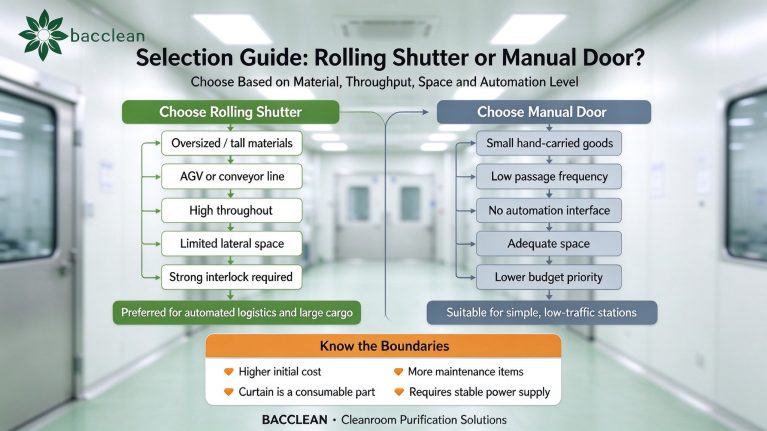
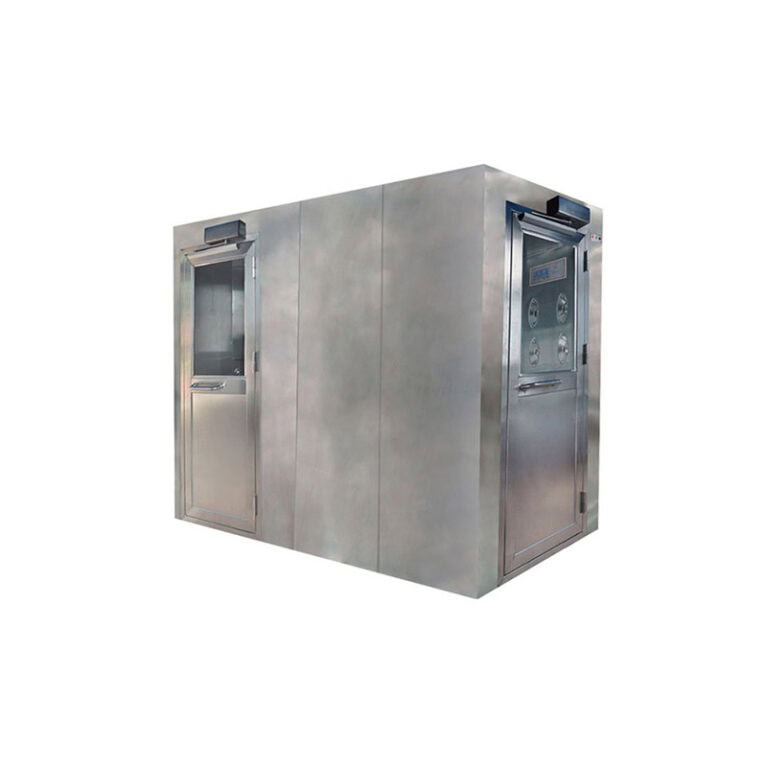
In summary, the core strengths of rolling shutter cargo air showers lie in large clear openings, vertical retraction to save lateral space, sensor‑driven compatibility with automated lines, shorter open exposure time and reduced unauthorised manual operation. They represent the preferred decontamination passage solution for cleanroom logistics retrofits and large‑material handling. Bacclean automatic rolling shutter cargo air showers support anti‑static curtains, ground/radar sensing, AGV signal interfacing and custom lengthening or heightening, equipped with dependable shutter and air‑shower interlock control systems.
