
1. Classification Standard and Filtration Principle
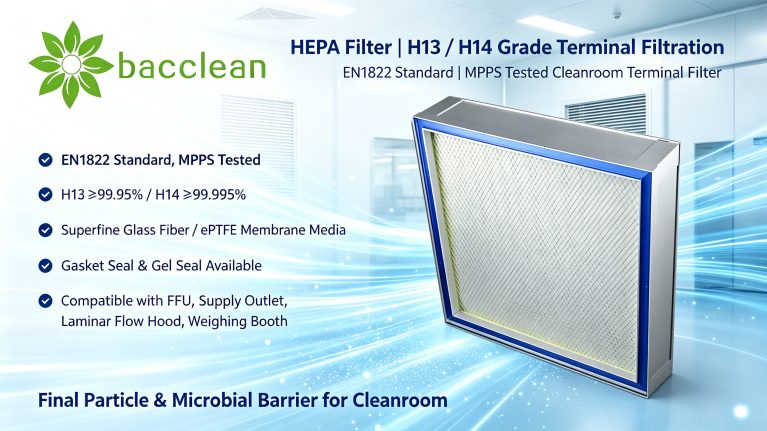
In accordance with EN1822, the performance of H13 and H14 is evaluated by both total efficiency and local efficiency via particle scanning method, different from the old oil mist test method.
-
H13: Total efficiency ≥99.95% at MPPS, local efficiency ≥99.9%
-
H14: Total efficiency ≥99.995% at MPPS, local efficiency ≥99.99%
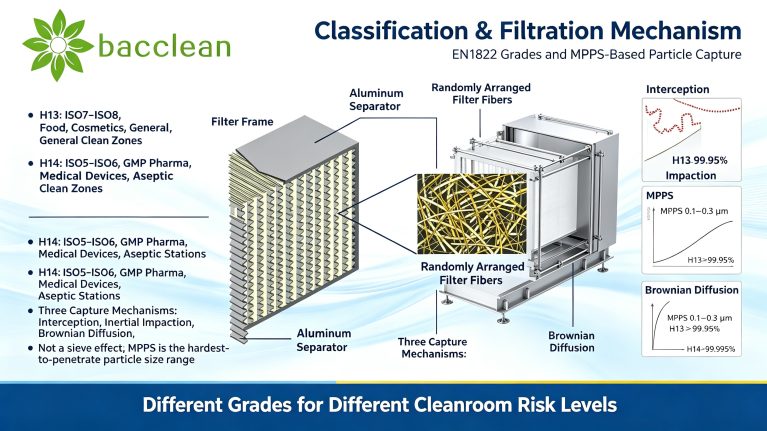
The filtration mechanism of HEPA relies on the combined effects of interception, inertial impaction and Brownian diffusion. Particles larger than the filter media pores are directly intercepted. Larger, fast-moving particles break away from the airflow and collide with filter fibers due to inertia. Tiny particles ranging from 0.1μm to 0.3μm are captured by collision and adsorption with fibers through Brownian motion. The filter media does not work like a sieve relying purely on pore size. Therefore, a smaller pore size does not always guarantee better filtration. Air velocity and fiber arrangement of the media directly affect capture efficiency. Superfine glass fiber is the mainstream filter media, featuring large dust holding capacity and stable filtration performance, which is the preferred option for GMP projects. ePTFE membrane media delivers lower resistance with surface filtration, suitable for electronic production lines sensitive to pressure drop and low particle generation requirements.
2. Structural Forms and Sealing Schemes
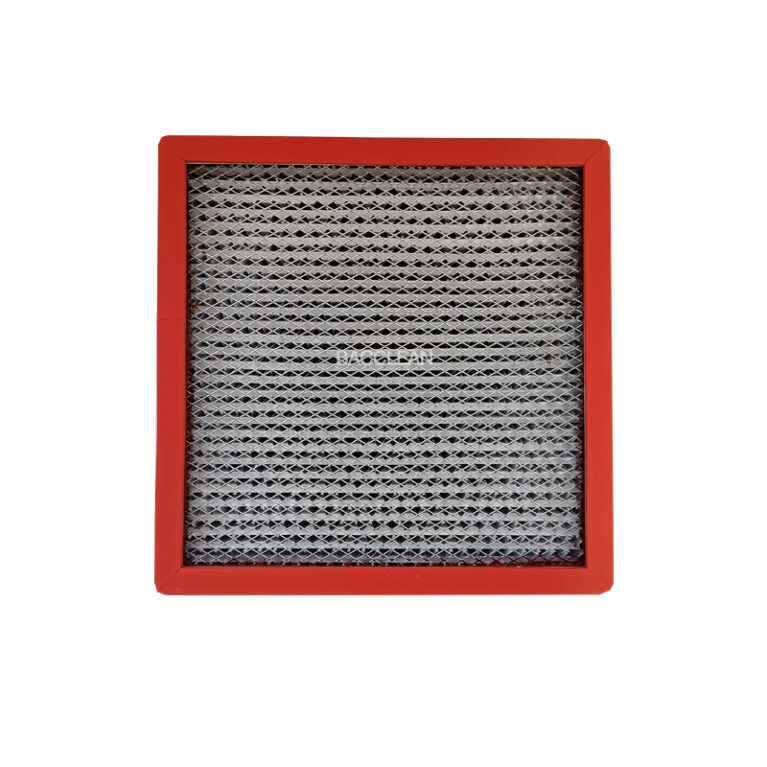
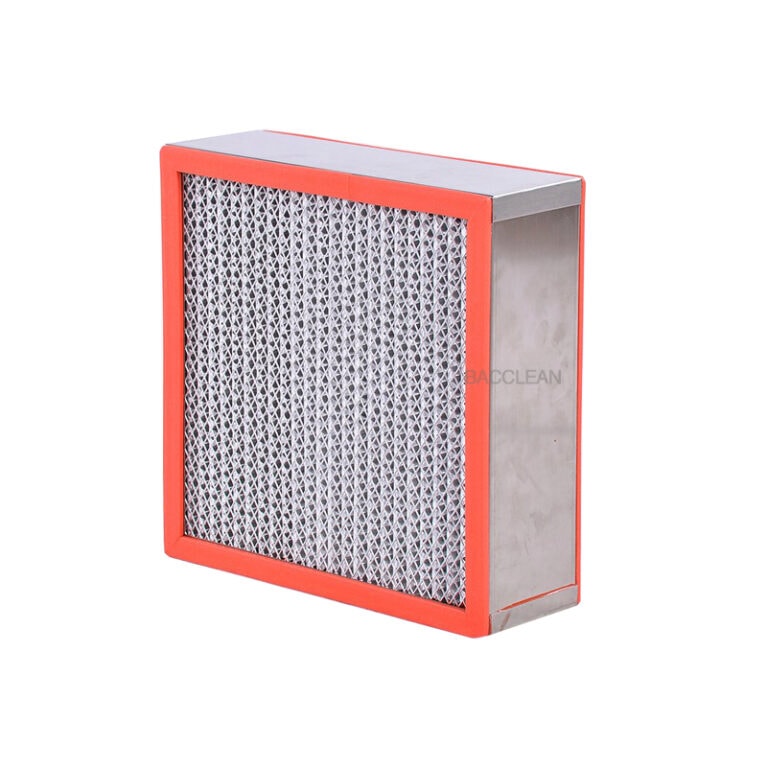
Two mainstream types are available on the market: separator HEPA filters and separatorless HEPA filters. Separatorless HEPA filters adopt hot-melt adhesive to separate filter media, featuring compact size and light weight. They are widely used in FFUs, laminar flow hoods and gel-sealed air supply outlets. Separator HEPA filters use aluminum foil or paper separators to support the media, capable of handling higher airflow, and are mostly applied in high-airflow centralized air supply systems. Sealing performance directly determines on-site operation results and is a key focus of cleanroom validation.
-
Gasket Seal: Sealed by compressed rubber gaskets with moderate cost. It is commonly used for Grade D clean zones, auxiliary corridors and terminal positions of ordinary workshops. The drawback is that the rubber strips tend to age and deform after repeated disinfection and temperature cycling, leading to bypass air leakage.
-
Gel Seal: A knife-edge frame matched with gel sealant with strong self-healing performance and low leakage risk. It is the preferred choice for pharmaceutical Grade B/C zones and aseptic auxiliary areas, convenient for on-site PAO scanning leak testing, and widely adopted in GMP validation projects.
Anodized aluminum frames are commonly used. For environments with frequent disinfection and corrosive humidity, 304 or 316L stainless steel frames are available. Silicon-free auxiliary materials can be specified for semiconductor and optical production lines to avoid AMC contamination caused by siloxane precipitation.
3. Application Scenarios and Grade Selection
There is no absolute superiority between H13 and H14. Selection shall match cleanliness class, process risk and validation requirements.
-
H13: Suitable for ISO7~ISO8 clean zones. It is used in food, cosmetic workshops, general changing rooms, buffer rooms, outsourcing auxiliary areas, and conventional Class 10,000 / Class 100,000 electronic clean workshops. It delivers reliable basic particle control with high cost performance.
-
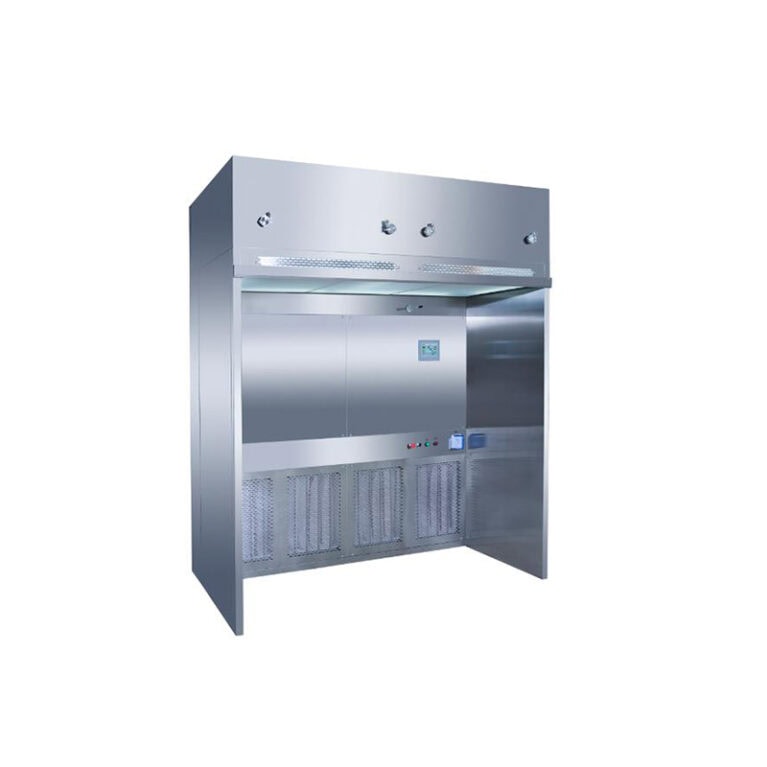
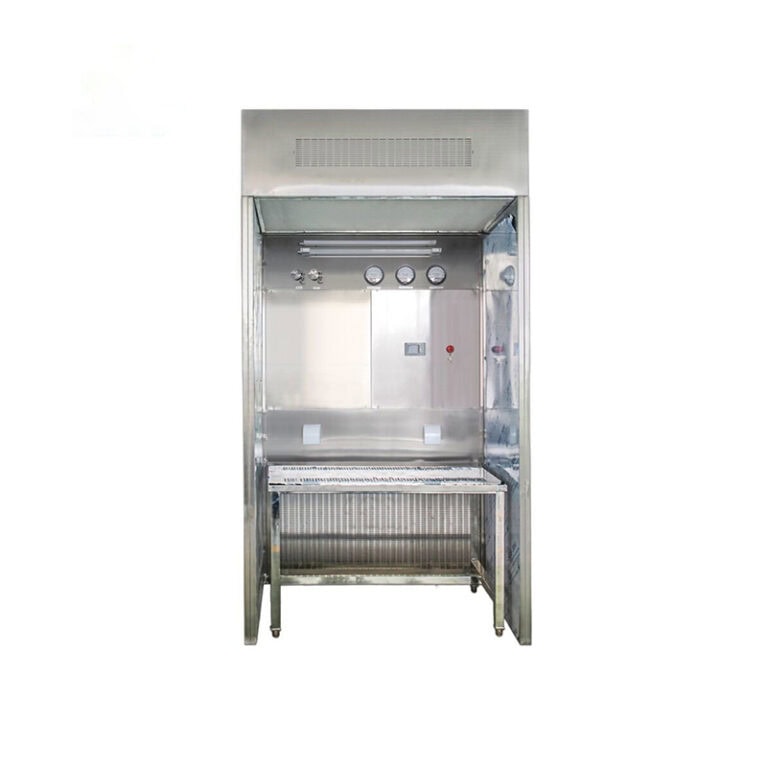
H14: Suitable for ISO5~ISO6 clean zones, including pharmaceutical Grade B/C clean zones, aseptic auxiliary stations, medical device inner packaging, clean benches and negative pressure weighing booths. It is the most widely used grade in domestic GMP projects, stably controlling airborne and settleable microorganisms to meet aseptic validation requirements.
It should be noted that H14 HEPA filters are mostly adopted for conventional GMP Grade A unidirectional flow zones. For advanced semiconductor lithography and high-end optical scenarios with extreme sensitivity to nano-particles, H14 cannot meet requirements, and an upgrade to U15 or higher ULPA filters is necessary.
4. Core Selection Parameters
-
Filtration Grade: Confirm H13 or H14, verify that testing complies with EN1822. Prioritize filters with individual scanning test reports instead of batch sampling only.
-
Rated Airflow and Initial Resistance: Resistance is the core indicator for filter replacement. Higher airflow under the same specification leads to higher resistance. The fan pressure margin of the upstream system shall be calculated in advance to avoid insufficient airflow which undermines room air change rate and laminar flow performance.
-
Sealing Type: Gasket seal is acceptable for ordinary auxiliary zones; gel seal is preferred for GMP validation projects.
-
Filter Media and Auxiliary Requirements: Glass fiber media is preferred for pharmaceutical applications. Low-resistance ePTFE versions can be selected for electronics and lithium battery projects, with control of particle generation and precipitates.
-
Leak Detection Compatibility: The filter structure shall support PAO aerosol integrity scanning to satisfy IQ/OQ validation and periodic revalidation.
-
Chemical Resistance: For zones with long-term exposure to disinfectants such as alcohol and hydrogen peroxide, confirm that sealant and separating materials are oxidation-resistant and non-powdering.
5. Common Misconceptions in Design and Operation & Maintenance
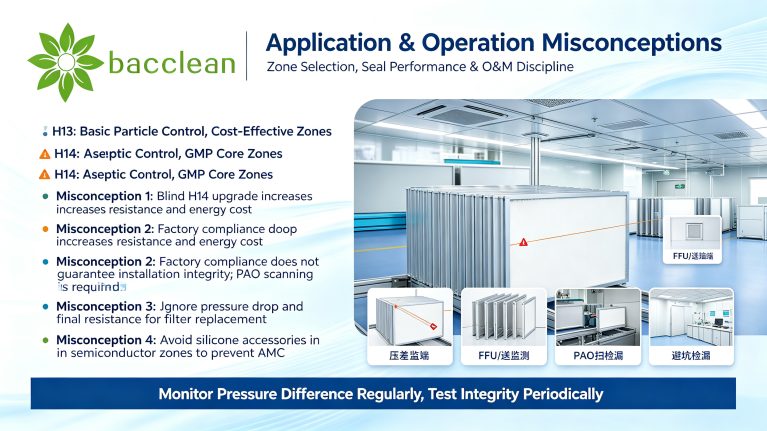
Misconception 1: Higher grade always means better performance. Blindly replacing H13 with H14 increases system resistance and fan energy consumption. It is over-specification for ordinary auxiliary zones.
Misconception 2: No post-installation leak test is required if the filter passes factory inspection. The filter media is vulnerable to collision damage during transportation, hoisting and installation. Leakage at frame gaps or poor sealing will result in excessive particle concentration in cleanrooms even if the filter itself is qualified. PAO leak testing after installation is mandatory for GMP projects.
Misconception 3: Only focus on efficiency while ignoring resistance. As dust accumulates gradually, resistance rises continuously. Once exceeding the final resistance, airflow drops sharply and cleanliness cannot be guaranteed. Contamination degree cannot be judged merely by visual inspection.
Misconception 4: Mixing silicon-containing sealant. Even qualified filters will cause product defects in semiconductor and optical workshops, as siloxane precipitated from silicon-containing accessories forms molecular contamination.
Daily O&M Guidelines: Continuously record filter pressure difference and replace the filter once the final resistance is reached. Filter replacement shall be performed in a clean environment with proper protection to avoid secondary contamination. Conduct regular PAO integrity tests. Handle filters gently during storage and transportation; squeezing or tapping the pleated media surface is prohibited.
Conclusion
H13 and H14 HEPA filters are the most widely used terminal filtration components in purification systems. They capture submicron particles and microorganisms with superfine filter media to supply clean air for cleanrooms and various purification equipment. H13 is oriented to conventional clean auxiliary zones, while H14 fits medium and high-grade GMP clean zones. Selection shall be comprehensively determined by cleanliness class, process risk, validation requirements and system air pressure. With proper sealing structure, regular leak testing and pressure difference monitoring, the filters can maintain stable filtration performance and continuously control suspended particles and microbial contamination.
