
1. Classification Standard and Filtration Principle
In accordance with EN779 standard, the mainstream grades of pre-filters are G1, G2, G3, G4, and G4 is the most widely used in domestic projects.
-
G1: Average efficiency below 40% for particles ≥5μm
-
G2: Average efficiency 40%~60% for particles ≥5μm
-
G3: Average efficiency 60%~80% for particles ≥5μm
-
G4: Average efficiency 80%~90% for particles ≥5μm
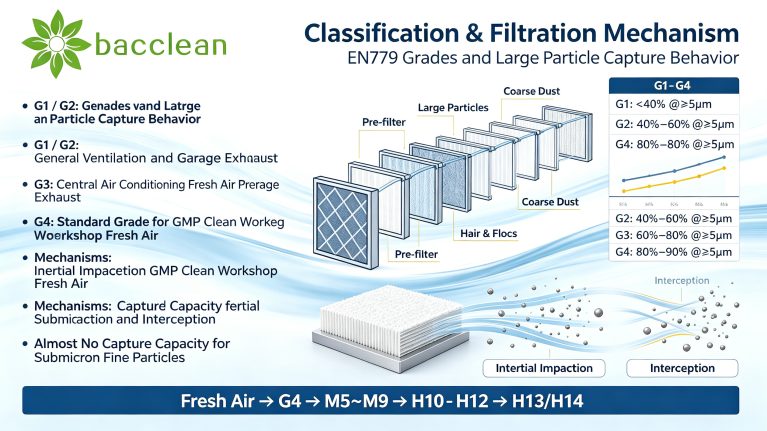
The filtration mechanism of pre-filters is mainly inertial impaction and interception. Impurities such as hair, cotton flocs, coarse dust and insects with large volume and high weight in the airflow will be blocked and captured when passing through the filter media. The fiber gap of filter media is relatively large, the Brownian diffusion effect hardly works, and fine particles below 0.5μm can almost pass through directly. Classic purification filtration sequence: Fresh air → Pre-filter G4 → Medium filter M5-M9 → Sub-HEPA H10-H12 → HEPA H13/H14. The pre-filter guards the inlet to prevent large sundries from entering the air conditioning unit directly and scratching or blocking downstream filter media.
2. Structural Forms and Installation Methods
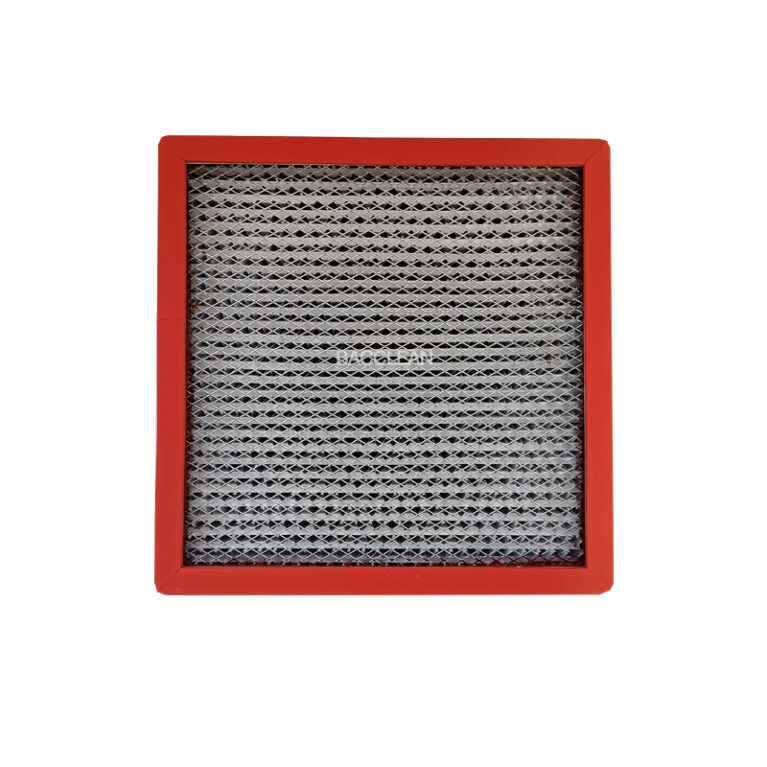
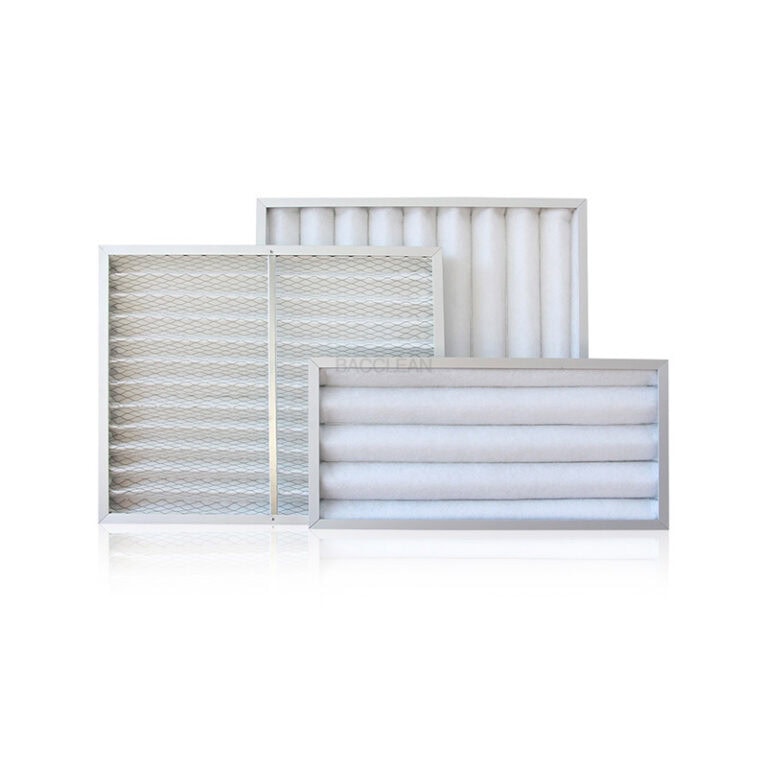
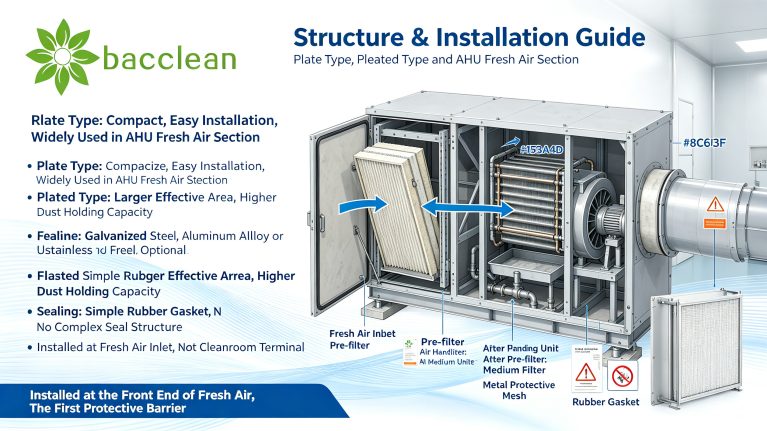
Common types of pre-filters include plate type, pleated type and bag type pre-filters, among which plate type and pleated type are the most frequently used. Plate pre-filter: Simple structure, mostly non-woven fabric or chemical fiber filter material, shaped with metal protective mesh, small space occupation and easy disassembly and replacement, standard configuration for the fresh air section of air conditioning units. Pleated pre-filter: The filter media is folded to form pleats, with larger effective filtration area, higher dust holding capacity and lower resistance. It is preferred for fresh air points with high dust load. Bag pre-filter: With filter bag structure and large filtration area, it is mostly used in large-air-volume fresh air systems and relatively less adopted in clean projects. Frame materials include galvanized sheet, aluminum alloy and plastic frame; 304 stainless steel frame is optional for working conditions with high humidity and corrosive gas. Sealing mainly relies on simple rubber gaskets, and complex sealing structures are generally not adopted. They are mostly installed at the fresh air inlet of combined air handling units, fresh air cabinets and fan inlets, and some return air systems are also equipped with pre-filters at the front end.
3. Application Scenarios and Grade Selection
-
G1, G2: Ordinary ventilation, underground parking garages, exhaust of ordinary workshops, ventilation systems with low dust concentration and no downstream high-grade filtration.
-
G3: Fresh air pretreatment of general central air conditioning, ventilation of office buildings and ordinary workshops.
-
G4: The preferred grade for clean workshops, the first filtration for air conditioning fresh air in pharmaceutical, medical device, food, cosmetic and electronic clean workshops, and the general standard grade for GMP projects.
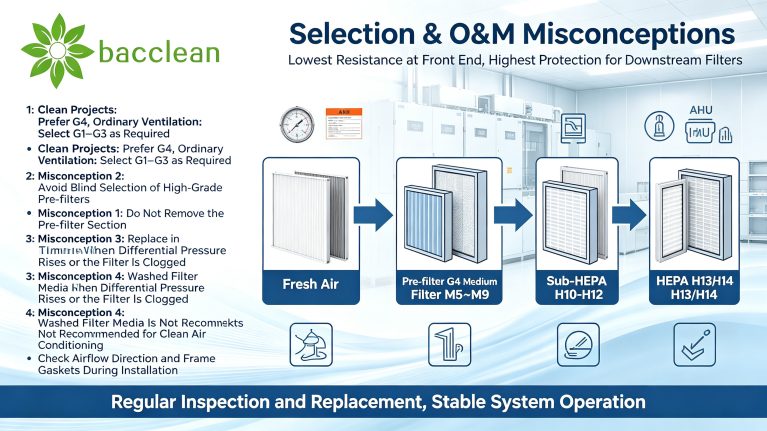
It is necessary to clarify the boundary: pre-filters only intercept large particles above 5μm, cannot control airborne bacteria and submicron dust, and cannot be used as filter units for clean rooms. If the pre-filter section is omitted, catkins, fibers and large dust particles will directly impact the medium filter media, causing rapid clogging or even rupture of filter bags.
4. Core Selection Parameters
-
Filtration Grade: G4 is preferred for clean projects, and G1-G3 can be selected for ordinary ventilation according to demands.
-
Rated Airflow and Initial Resistance: Under the same specification, the larger the filter media area, the lower the resistance, the longer the dust holding cycle and the smaller the fan load.
-
Filter Media Characteristics: Mainly chemical fiber non-woven fabric. Some models are washable, suitable for ordinary ventilation with heavy dust and frequent replacement; repeated washing is not recommended for clean projects, as washing will deform the filter media structure and reduce efficiency.
-
Protective Mesh Structure: Double-sided metal protective mesh can prevent the filter media from being blown apart by airflow and resist impact from hard objects. Models with protective mesh are preferred for clean air conditioning units.
-
Frame Material: Galvanized sheet and aluminum alloy are sufficient for conventional working conditions; stainless steel is selected for high-humidity and disinfection steam environments.
-
Flame Retardant Requirements: Flame-retardant filter media shall be selected for exhaust air and fire protection related systems as required.
5. Common Misconceptions in Design and Operation & Maintenance
Misconception 1: Cancel the pre-filter section directly. Cotton flocs, insects and large dust in fresh air enter the medium filter directly, resulting in rapid clogging of medium filter bags or even being scratched by foreign objects. The downstream HEPA filter loses protection, and the operation and maintenance cost increases greatly.
Misconception 2: Excessively select high-grade pre-filters. The positioning of pre-filters is pre-filtration. Blindly selecting high-grade models will increase resistance and fan energy consumption with little benefit.
Misconception 3: No replacement for a long time. After the pre-filter is clogged, the system air volume decreases, the air exchange times of the whole air conditioning unit are insufficient, and the room pressure difference, temperature, humidity and cleanliness are affected simultaneously.
Misconception 4: Continue to use after washing in clean air conditioning. Washing will loosen the filter fibers and enlarge pores, reducing the filtration efficiency. It cannot play the pre-protection role and bring hidden risks.
Daily O&M Guidelines: Check regularly according to pressure difference or visual status, replace in time when reaching the final resistance; clean up sundries accumulated in the fresh air section of the unit during replacement; confirm the front and back sides of filter media during installation to ensure the airflow direction is correct; check frame gaskets to avoid bypass air leakage.
Conclusion
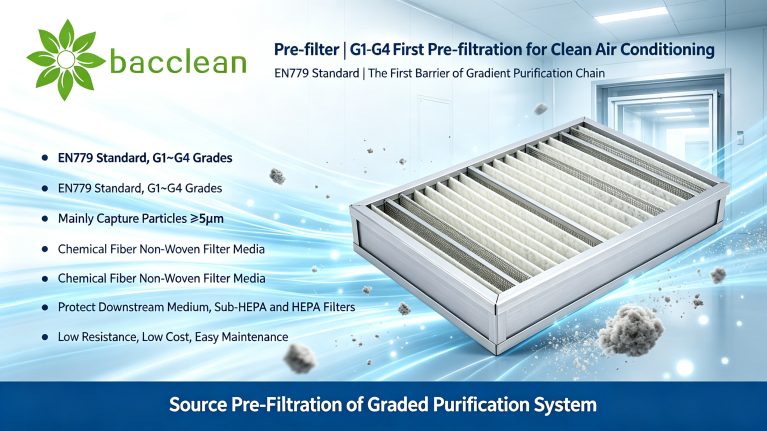
Pre-filters are the first pre-filtration defense line of clean air conditioning systems, specially intercepting hair, flocs, large dust particles and other impurities, and protecting downstream medium filters, HEPA filters and other high-end filter elements. It features low resistance, low cost and convenient disassembly and replacement. G4 is the standard configuration of most clean workshops. Select the appropriate grade according to the dust condition of fresh air environment, carry out regular inspection and replacement, so that the whole purification system can reduce the impact of impurities from the source and ensure the stable operation of downstream filters.
