
Many purchasers and engineering teams want to understand the real differences between domestic and imported gel-seal HEPA filters, how to objectively assess product quality, and how to avoid traps set by low-cost inferior products. This article conducts a multi-dimensional comparative analysis covering raw materials, manufacturing processes, inspection systems, documentation, delivery lead time, after-sales service and procurement risks, and provides practical recommendations for the procurement phase of gel-seal HEPA filters.
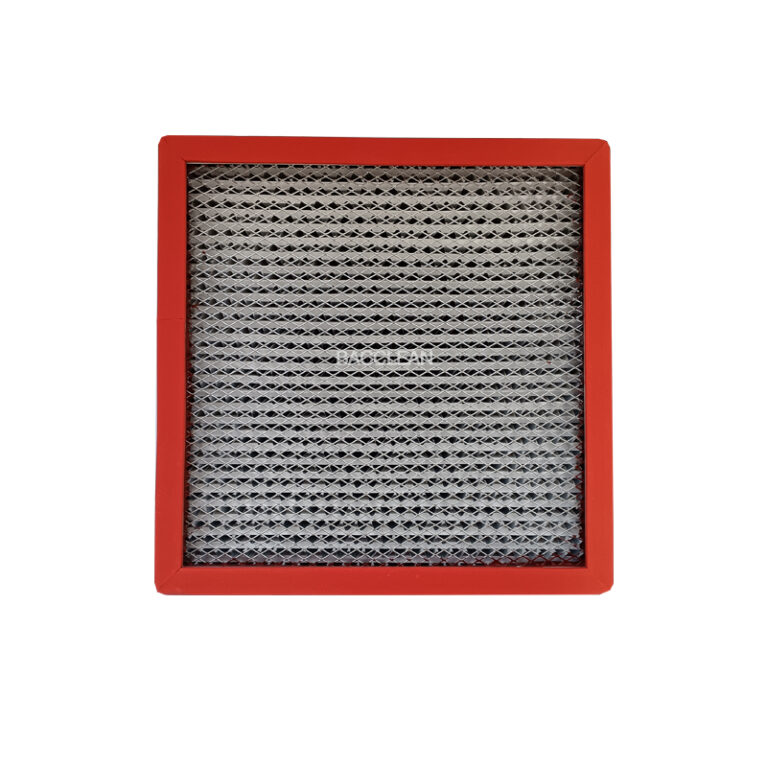
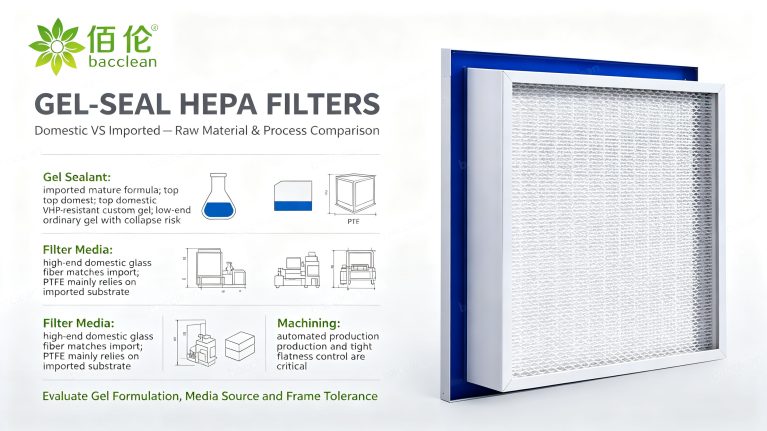
In terms of core raw materials, the two key components of gel-seal HEPA filters are gel sealant and HEPA filter media. Most imported brands adopt well-proven gel formulations with stable overall performance in VHP aging resistance and chemical corrosion resistance. Leading domestic manufacturers such as bacclean, which has deep expertise in cleanroom filtration, can adopt special gel formulations benchmarked against imported performance. Custom formulas are developed for VHP disinfection scenarios, enabling gel performance to reach equivalent application levels. Nevertheless, the domestic market also contains many low-end products using low-cost ordinary gel sealant, which can only support short-term operation. Such gel tends to collapse and crack under long-term operation and cannot withstand repeated VHP fumigation. This is the biggest performance divergence among domestic products. Domestic filters cannot be generalized as being of the same quality.
For high-efficiency glass fiber filter media, high-end domestic media has achieved localization with performance comparable to imported counterparts. PTFE filter media still mainly relies on imported substrates. Both domestic and imported products have high and low-grade filter media options. During procurement, buyers should not only check H13 or H14 efficiency classes. It is necessary to confirm the source of filter media substrates, as well as fiber shedding and extractable substance indicators. Control of particle release is especially critical for semiconductor and high-grade sterile cleanrooms.
Regarding manufacturing processes, gel-seal HEPA filters impose strict requirements on the machining precision of aluminum frames. The flatness of the frame directly determines the evenness of the bottom gel trough, which further affects sealing performance. Imported brands adopt highly automated production lines with tight control over profile cutting and trough machining tolerances. Top domestic manufacturers are also equipped with automatic cutting and processing equipment and implement strict flatness tolerance control to achieve high machining accuracy. In contrast, many small manufacturers use simple cutting equipment, resulting in warped frames and excessive tolerances. Even with high-quality gel raw materials, reliable sealing cannot be achieved. Gel-seal HEPA filters are highly sensitive to machining tolerances, so automated processing capability serves as a vital evaluation indicator.
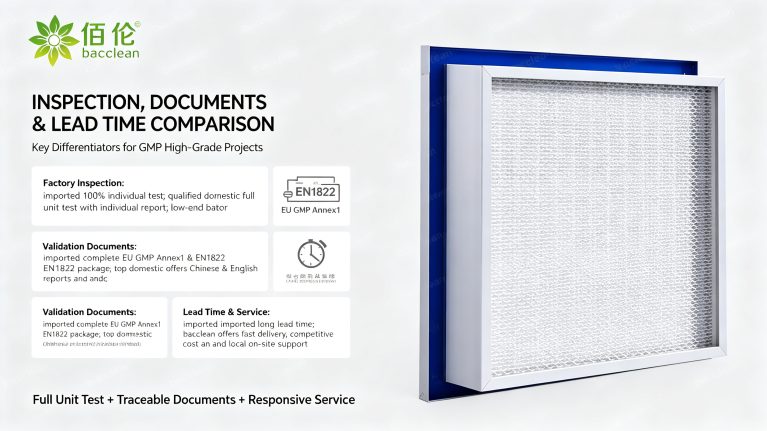
The factory inspection system is a key factor widening product gaps. Imported brands generally implement full individual unit testing. Every filter undergoes efficiency and resistance testing, plus visual inspection of the gel surface. Some domestic manufacturers only conduct sampling tests instead of 100% unit inspection, leading to large performance dispersion within one batch. Individual units may have hidden risks during bulk supply. Domestic gel-seal HEPA filters intended for GMP high-grade projects must complete efficiency & resistance testing and full visual inspection of gel surfaces for every finished unit, with individual test reports issued. Sampling inspection alone cannot meet the validation requirements of Grade A/B cleanrooms.
In terms of project documents and validation materials, traditional imported brands have the advantage of standardized complete document packages. Material certificates, test reports and compliance statements are well-organized, compatible with EU GMP Annex1 and EN1822 international standards, convenient for document archiving of overseas projects and high-end domestic GMP projects. In recent years, leading domestic purification enterprises have continuously improved their full document output capacity, able to provide Chinese & English test reports, raw material certificates, gel safety statements and other complete documents. However, many small manufacturers can only supply simple paper reports without complete traceability data, which hardly meets strict GMP archiving requirements. This is the main reason why many projects hesitate to select ordinary domestic products.
Domestic products have obvious advantages in delivery lead time and procurement cost. Imported gel-seal HEPA filters have long order cycles. Affected by overseas production and sea customs clearance, lead times often stretch for several weeks or longer. Lead times will be further extended for custom-sized products, bringing high risks to project schedules. Leading domestic manufacturers maintain sufficient stock for standard specifications and short production cycles for custom sizes, delivering fast response for domestic projects. Meanwhile, procurement costs are significantly lower than imported alternatives, effectively controlling overall project investment. Caution must be taken for domestic gel-seal HEPA filters priced far below the normal market range; low prices usually come from cost reduction in gel, filter media, processing and inspection links, which brings high risks for later project validation.
After-sales service and on-site technical support form another difference. On-site technical support of imported brands is restricted by geographical factors. When problems such as on-site leak testing and installation commissioning occur, engineers can hardly arrive at the site quickly; most support is provided remotely via email. Local domestic manufacturers can offer rapid online technical consultation, and arrange engineers to the project site when necessary for installation handover, fault troubleshooting and other technical services, delivering higher response efficiency for renovation and problematic projects.
Objectively evaluating their practical application performance, high-quality domestic gel-seal HEPA filters have been successfully deployed in numerous biopharmaceutical renovation and expansion projects in China, passing PAO leak tests and GMP validation in one go with stable sealing performance over long-term operation. Still, the domestic market shows severe polarization. Top manufacturers can match imported product performance while low-end small factory products carry numerous hidden risks. Imported products generally have a higher minimum quality standard, yet they are more expensive with long lead times. They may also encounter situations where gel is incompatible with high-frequency VHP disinfection conditions in domestic workshops and are not entirely free of application risks.
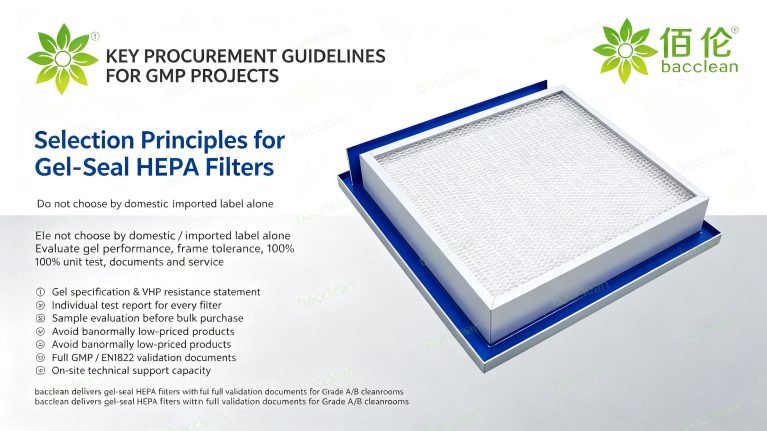
Here are practical procurement recommendations for purchasers and engineering teams.
- Do not select products merely based on whether they are domestic or imported. Focus assessment on gel formulation performance, frame machining control, 100% individual unit inspection capability, validation document output capacity and technical service support.
- Require suppliers to provide gel material specifications and VHP resistance statements. For workshops with frequent vaporized hydrogen peroxide disinfection, confirm that the gel is compatible with working conditions.
- Clearly require individual factory test reports for every filter unit. Reject suppliers that only provide batch sampling reports.
- Request product samples from suppliers at the early project stage for performance evaluation to verify gel quality, appearance and workmanship.
- Avoid products with prices far below reasonable market levels. The sealing performance of gel-seal HEPA filters relates to GMP compliance; excessive cost cutting is not advisable.
- Confirm the complete set of technical documents that suppliers can provide in advance, and verify whether documents satisfy GMP archiving or overseas EN1822 standard requirements.
- Evaluate suppliers’ on-site technical support capacity. Especially for complex renovation projects, technical service capability is as important as product quality itself.
Looking to industry development, domestic substitution of gel-seal HEPA filters is not only about matching parameter indicators, but the synchronous upgrade of the whole system including raw material formulation, precision machining, full inspection quality control, validation documents and technical services. bacclean keeps benchmarking international product standards, optimizing product craftsmanship and complete validation documents, balancing lead time, cost and performance, and providing reliable gel-seal high-efficiency filtration solutions for high-grade cleanroom projects at home and abroad.
