1. Ultraviolet UV-C irradiation (General basic physical disinfection) Applicable scenarios
Various electronic dust-free workshops (100,000-level, 10,000-level): daily transfer and disinfection of plastic, hardware, packaging materials, and tooling equipment;
General food clean workshops, packaging workshops: transfer of raw materials packages, consumables, and finished products;
Hospital laboratory, pharmacy, general clean operating rooms: transfer of test samples, medical consumables, and small instruments;
Non-sterile clean areas of medical devices: daily transfer of spare parts and testing tools;
General physical and chemical laboratories, physical and chemical inspection rooms: transfer of glassware and routine samples;
Daily pre-treatment of sterile pharmaceuticals / sterile instrument workshops: as a basic disinfection measure, combined with chemical wiping, and regular VHP deep sterilization.
Not suitable
Materials with many pores, folds, and severe stacking; areas with high-risk spore contamination cannot achieve sterility requirements solely by ultraviolet light.
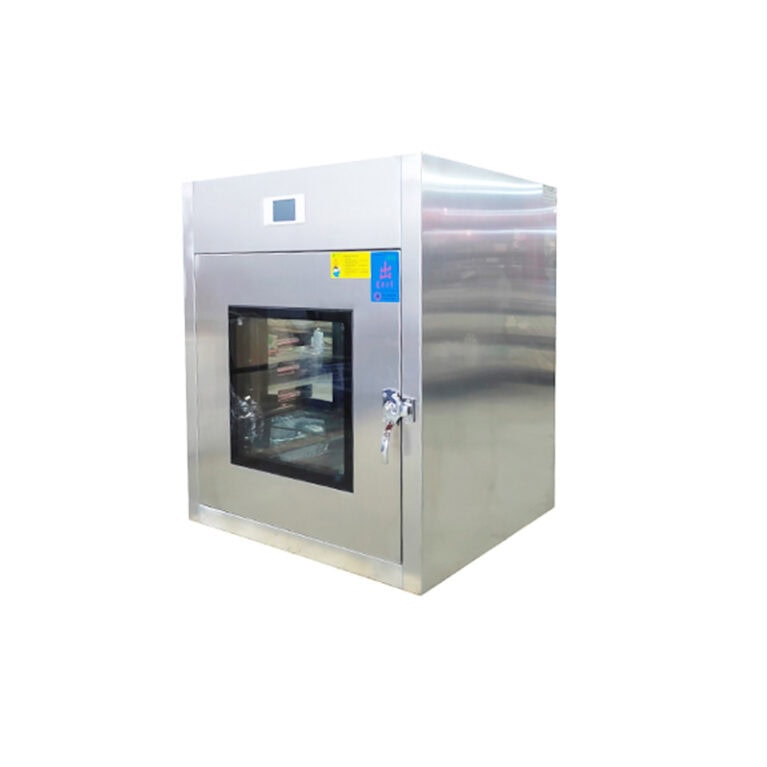
II. laminar flow FFU self-cleaning blow-off (special for laminar flow transfer windows) Applicable scenarios
High-grade clean workshops (thousand-level, hundred-level): for semiconductors, optical lenses, and precision lithium batteries, strict control of dust particles;
Sterile raw drug products, implantable medical devices clean area: control dust and suspended bacteria simultaneously to prevent aerosol contamination;
Cell rooms, ordinary biological laboratories: reduce floating microorganisms and reduce cross-contamination;
Precise testing laboratories sensitive to dust and particles.
Not suitable
Low-clean-grade simple workshops, only simple material transfer, no additional laminar flow function required.
III. Dry dust wiping, clean compressed air blowing (preliminary physical dust removal) Applicable scenarios
Machine processing, injection molding, and hardware supporting clean workshop: There is a lot of dust on the workpieces. Before entering the clean area, physical dust removal should be carried out first;
Transfer of materials with cartons and foam packaging: Remove floating dust in advance to reduce contaminants in the boxes;
End-of-shift cleaning for all production lines: Wipe the inner walls, sealing strips, and glass of the transfer window to eliminate ultraviolet shielding;
Food and plastic packaging workshops with large amounts of dust on the production lines.
Not suitable
Materials with oil stains and sticky stains cannot be removed by simple dry dust removal, and chemical disinfectants need to be combined. Applicable scenarios
Only transfer windows specifically for transporting stainless steel molds, metal tooling, and heat-resistant glassware;
Special passage for high-temperature equipment in small physical chemistry laboratories.
Not suitable
Most standard transfer windows (including rubber seals, plastic parts, and ultraviolet lamps) are not suitable. High temperatures will accelerate the aging of the sealing components, and their use is prohibited for frequent daily use.
V. Ozone disinfection (regular deep physical disinfection, not as a daily routine) Applicable scenarios
Small and medium-sized food factories, ordinary purification workshops, without VHP equipment, conduct deep cavity sterilization once a week;
Emergency thorough disinfection after material leakage and box contamination.
Not suitable
GMP workshops for sterile pharmaceuticals and implantable devices; cannot be used daily, long-term oxidation will corrode the sealing strips.
Summary of industry-specific standards and scenarios
100,000 / 10,000 grade electronic factories: dry dust removal wiping + ultraviolet irradiation
10,000 / 100 grade precision electronics: compressed air blowing + laminar self-cleaning + ultraviolet
Food packaging clean room: dry wiping dust removal + ultraviolet; weekly ozone deep disinfection
Sterile pharmaceuticals / sterile medical devices: dry wiping dust removal + ultraviolet for 30 minutes (daily), monthly use VHP fumigation instead of ozone
Hospital laboratory, ordinary operating rooms: dust-free dry wiping + short-time ultraviolet disinfection
General biological laboratories: blowing dust removal + laminar self-cleaning + ultraviolet, additional chemical auxiliary disinfection for high-risk samples