
1. Wall & Installation Conditions – The Most Commonly Overlooked Item Leading to On-site Installation Failure
Most buyers only focus on internal cavity size while ignoring pre-embedded wall conditions, which becomes the top on-site problem.
-
Confirm wall thickness, wall type and prefabricated frame size: Installation solutions differ drastically for color steel partition walls, concrete walls and rock wool panels. You must provide wall thickness to the manufacturer and verify the outer frame dimension for pre-embedding. Concrete walls require pre-cut openings plus embedded reinforced steel plates; color steel walls need matching reinforced flanges to prevent deformation and air leakage caused by the equipment weight pulling the panel. Pitfall: Only reserving the inner cavity size without leaving space for mounting flanges and sealing gaps. On-site forced cutting of color steel plates leads to dust leakage and out-of-control pressure differentials, which will trigger non-conformities during GMP audits.
-
Confirm pressure differential direction and cleanliness grade on both sides: Clarify the classification (Grade D/C/B/A) and positive pressure direction between adjacent rooms; the higher-grade zone maintains positive pressure relative to the lower-grade zone. If a pass box without self-cleaning function is selected, air backflow the moment the door opens will contaminate the high-grade area. Cross-grade transfer (D→C, C→B) shall prioritize FFU self-cleaning versions; same-grade material transfer can adopt basic isolation models.
-
Check on-site access and hoisting space: Integrated lifting pass boxes are heavy. Confirm that staircases, doorways and elevators can accommodate the whole unit. If integral delivery is impossible, require split construction for field assembly and sealing in advance.
2. Internal Size, Load Capacity & Door Drive – Decisive for Long-term Stable Operation
-
Take the net inner cavity dimension as the benchmark and reserve sufficient clearance for materials: The overall dimension on quotations is not equal to the net inner size. Leave 50~80mm extra space in length, width and height for material turnover bins to avoid jamming and rubber seal abrasion. Select wider and deeper cavities for heavy-duty pallets.
-
Match load capacity with drive configuration – do not judge only by motor power: Lifting doors carry their own dead weight with frequent start-stop and impact. Do not select under-sized motors. For heavy metal tooling and frequent heavy bin transfer, require reinforced guide rails, upgraded timing belts/chains and overload protection. Standard configurations suffice for light samples and reagent consumables. Pitfall: Low-cost models are equipped with insufficient motor margin. They work well initially but develop lifting jitter, abnormal noise, door sagging and inaccurate position detection after 3~6 months, with frequent photoelectric limit alarms.
-
Avoid excessive lifting speed: Recommended stable speed: around 100mm/s with speed regulation function. High speed causes heavy door impact and rapid aging of sealing strips; rapid opening and closing also disturbs room airflow and triggers sharp fluctuations in cleanroom pressure differentials.
-
Adopt redundant dual-limit protection: Equip both photoelectric limit switches and mechanical hard stops to prevent over-travel, derailment and top collision if photoelectric sensors fail.
3. Interlock & Electric Control System – Core Audit Item in GMP Inspections
The core value of a lifting pass box is to prevent both doors from opening simultaneously; interlock failure constitutes a major compliance risk.
-
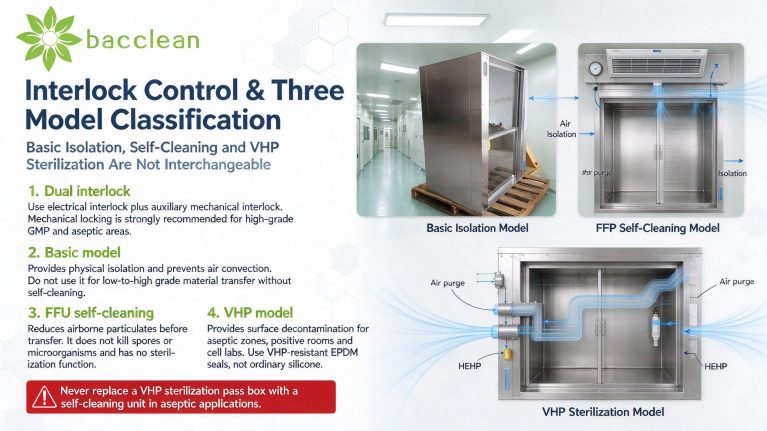
Prioritize dual protection: electrical interlock + auxiliary mechanical interlock. Low-end products only adopt pure electrical interlock. Once PLC or relays break down, simultaneous opening of both doors becomes possible. For high-grade GMP workshops and aseptic areas, mechanical locking is mandatory as secondary safeguard.
-
Match control modes to operation needs while ensuring traceability:
-
Ordinary auxiliary material workshops: Button control for cost-effectiveness;
-
Frequent transfer with both hands occupied: Foot switches to free operators’ hands;
-
Automated production lines & BMS linkage: Dry contact signal output to connect SCADA and PLC systems;
-
Aseptic & VHP decontamination projects: Touchscreen control with operation logs, fault records and audit trails, supporting USB data export.
-
-
Power failure manual release is a must: Confirm the device is fitted with a manual unlocking mechanism for power outages. Locked doors will trap materials, culture media and samples inside, leading to material scrapping and experiment interruption. The manual release structure must not compromise chamber airtightness.
-
Electric cabinet IP rating matches cleaning conditions: For areas frequently wiped with water and disinfectants, the electric cabinet shall reach IP54; upgrade to IP65 for humid wash zones to avoid short circuits and circuit board corrosion caused by moisture ingress. Pitfall: Only requiring interlock without status feedback. Operators cannot judge door open/closed status or fault signals on the central control system, which hinders workshop management.
4. Three Types: Basic Isolation / Self-Cleaning / VHP Sterilization – No Interchangeable Use (Top Audit Non-Conformity)
This is the most frequent misunderstanding in pharmaceutical projects: many buyers confuse dust removal self-cleaning with microbial sterilization.
-
Basic Isolation Model: Only dual-door interlock without fan filtration. Applicable scenarios: Material transfer between rooms of identical cleanliness grade, only blocking air convection. ❌ Not allowed: Transferring materials from low-grade zones to high-grade clean areas.
-
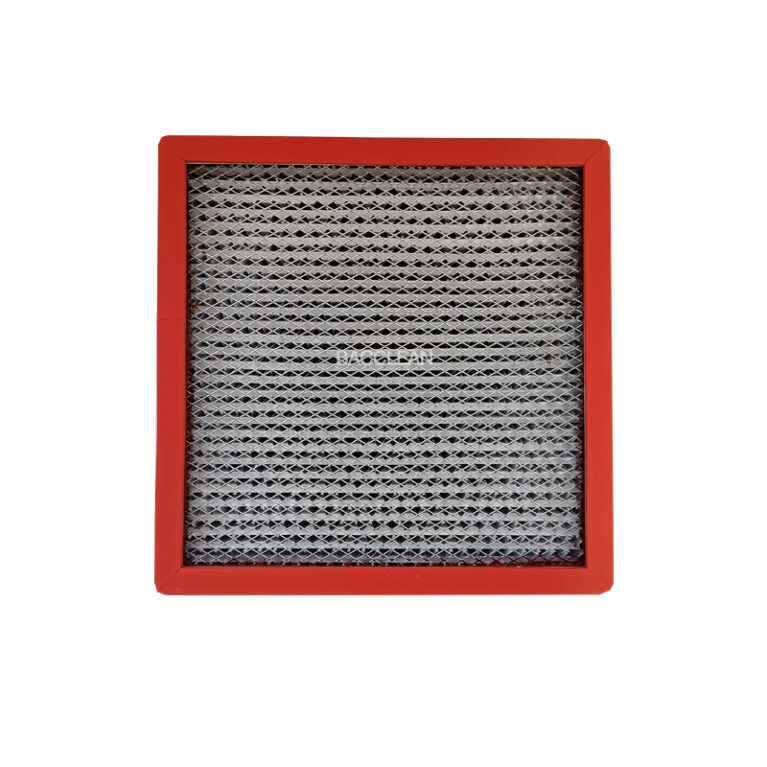
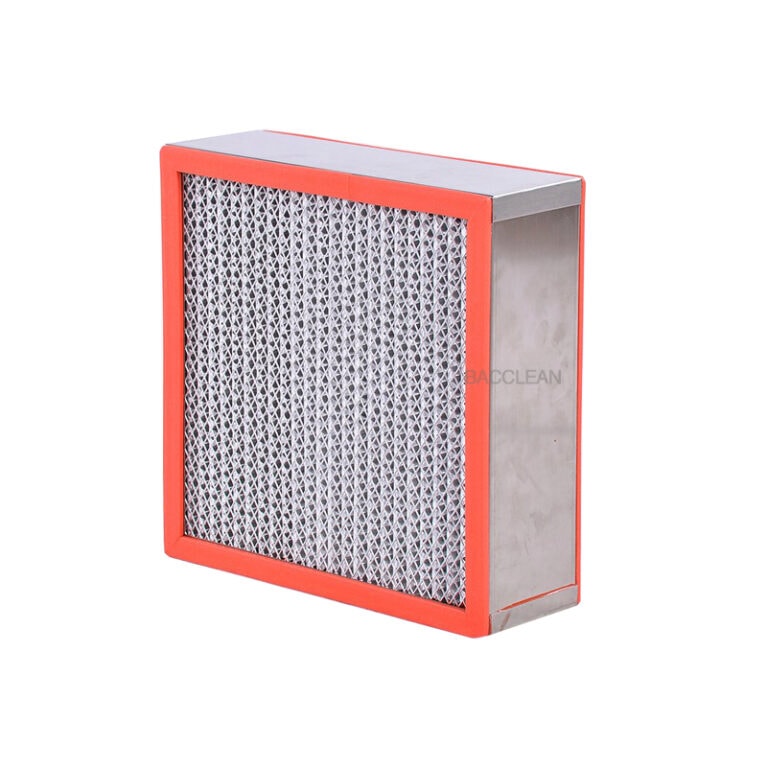
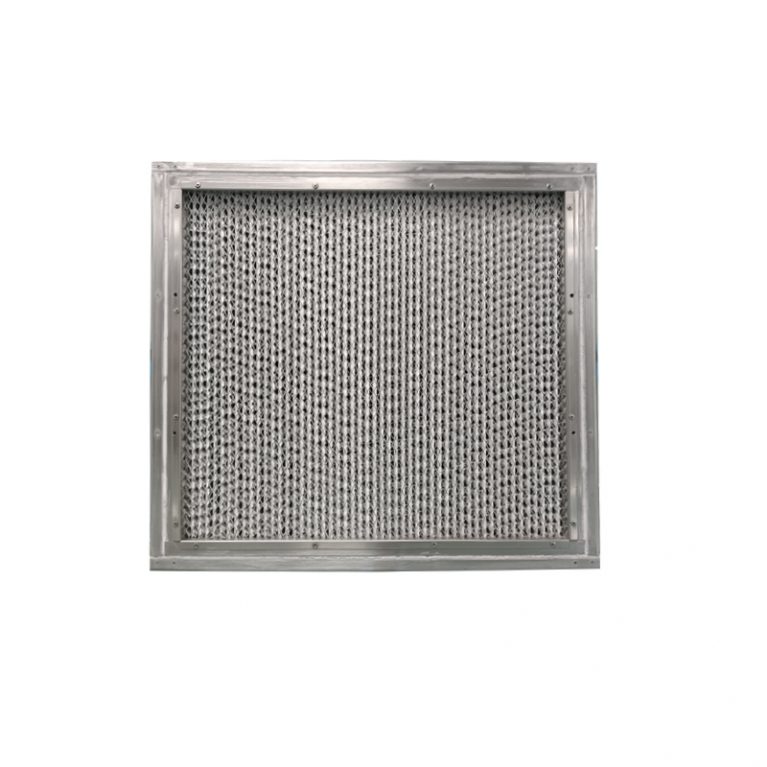
FFU Self-Cleaning Model: Built-in laminar air purge plus HEPA filtration. The chamber automatically purges airborne particulates before door opening to reduce particle contamination into high-grade areas. Standard filter grade is H13; H14 is selected for stricter requirements, with factory PAO leak testing as mandatory. ⚠️ Critical note: Self-cleaning only removes suspended particles; it cannot kill spores or microorganisms and has no sterilization function.
-
Vaporized Hydrogen Peroxide (VHP) Sterilization Model: Equipped with fully sealed chamber, VHP inlet & exhaust ports, circulating air ducts and exhaust HEPA filters, plus optional temperature/humidity and H₂O₂ concentration sensors. It runs automatic cycles: sealing → chemical dosing → dwell → aeration & residue removal. ✅ Applicable scenarios: Aseptic zones, positive control rooms and cell laboratories for surface decontamination of incoming materials. ⚠️ Material and sealing must adopt VHP-resistant formulations. Ordinary silicone strips will crack rapidly after repeated VHP exposure and cause air leakage. Real Case Pitfall: Clients saved costs by purchasing self-cleaning units instead of VHP pass boxes for consumable transfer in aseptic areas, resulting in a major non-conformity during GMP audits.
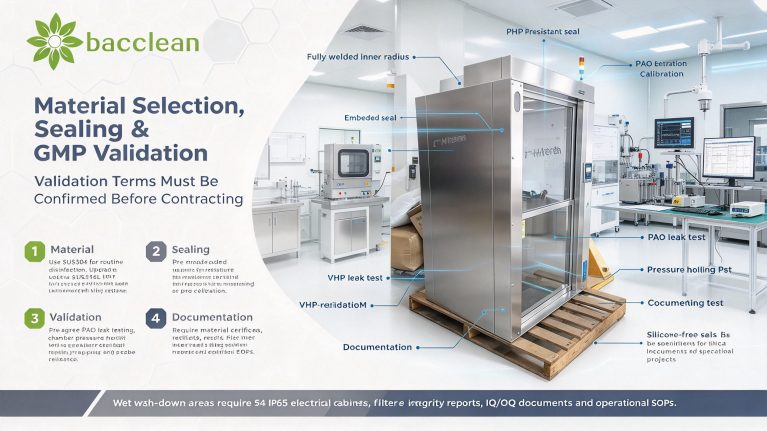
5. Material, Sealing & Surface Treatment – Adapted to Disinfection Conditions
Stainless Steel Selection
-
Routine alcohol & quaternary ammonium salt wiping: SUS304 stainless steel with fully welded internal arcs and polished coved corners (no dead corners for dust accumulation).
-
Long-term VHP circulation and strong corrosive disinfectants: Upgrade to SUS316L stainless steel.
-
Lithium battery, optical, semiconductor and AMC-controlled projects: Specify silicone-free sealing to prevent silicon precipitation from contaminating products.
Sealing Strip Selection (No Universal Option)
-
Standard cleanroom models: Food-grade silicone rubber.
-
VHP sterilization versions: Special EPDM or VHP-resistant rubber strips; manufacturers must provide aging resistance test reports for VHP exposure.
-
Adopt embedded installation instead of simple pasting. Pasted strips easily fall off after repeated lifting friction. Observation window: Tempered explosion-proof glass with smooth sealant joints without dust-trapping gaps.
6. Filtration, Validation & Acceptance – GMP Projects Must Agree Terms in Advance
-
For self-cleaning versions: Write factory PAO leak testing into the contract and require on-site retesting after delivery.
-
For VHP versions: Pre-agree chamber pressure holding tightness test, sterilization distribution mapping and calibration plans for concentration probes.
-
Deliverables to be stipulated in the contract in advance: Material certificates, welding records, filter integrity test reports, IQ/OQ validation documents and operational SOPs. Pitfall: Low-cost suppliers only deliver hardware without supporting validation documents. On-site rectification costs will be extremely high when validation work starts.
7. Operation, Maintenance & Spare Part Considerations
-
Easy filter replacement: FFU units on self-cleaning models shall be easy to disassemble; high-potency VHP exhaust HEPA can adopt BIBO (Bag-In/Bag-Out) structure for safe filter replacement.
-
Spare part availability: Ensure long-term supply of motors, sensors and sealing strips; non-standard customized structures risk discontinued spare parts.
-
Noise control: The overall running noise shall be ≤60dB(A) to avoid exceeding occupational noise limits for long-term on-site operation.
8. Quick Pre-Purchase Checklist for Avoiding Pitfalls
✅ Verify wall thickness and reinforced pre-embedded structure
✅ Reserve sufficient clearance for internal cavity dimensions, no tight fit for materials
✅ Match load capacity with reinforced guide rails and motor power for heavy-duty use
✅ Adopt electrical + mechanical dual interlock (mandatory for high-risk zones)
✅ Mandatory power-failure manual release without breaking airtightness
✅ Strictly distinguish basic / self-cleaning / VHP models; never replace VHP sterilization with self-cleaning units
✅ VHP versions must be fitted with VHP-resistant sealing instead of ordinary silicone
✅ Upgrade electric cabinet IP rating for frequent wash-down areas
✅ Pre-contract PAO leak tests, tightness checks and complete GMP validation documents
✅ Specify silicone-free sealing separately for lithium battery & optical cleanrooms
Conclusion
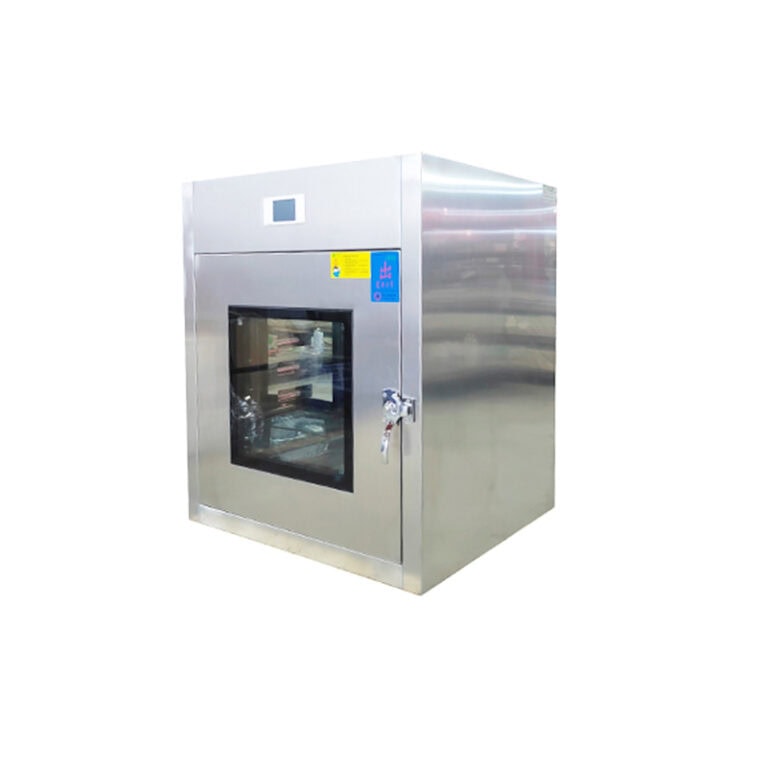
When selecting an automatic lifting pass box, price and dimension are not the only criteria. The core is matching the pressure differential, risk grade and disinfection method of the two connected rooms. Basic models realize physical isolation between rooms; self-cleaning models control particulate cross-contamination; VHP models deliver microbial surface decontamination. The three categories have completely different positioning. Redundant drive design, dual interlocks, power-failure release and chemically compatible sealing materials are the key to stable long-term operation and smooth GMP audit passing.
Bacclean provides customized automatic lifting pass boxes with non-standard dimensions, silicone-free construction, VHP linkage and explosion-proof options. We support on-site commissioning, filter integrity testing and full-set validation document delivery.
