
1. Difference in Airflow and Cleanliness Assurance
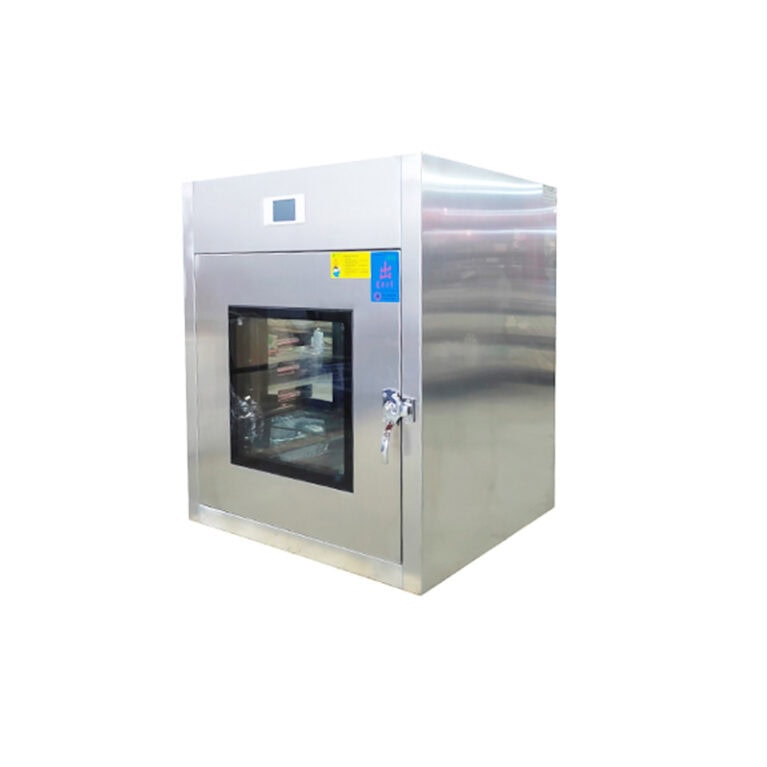
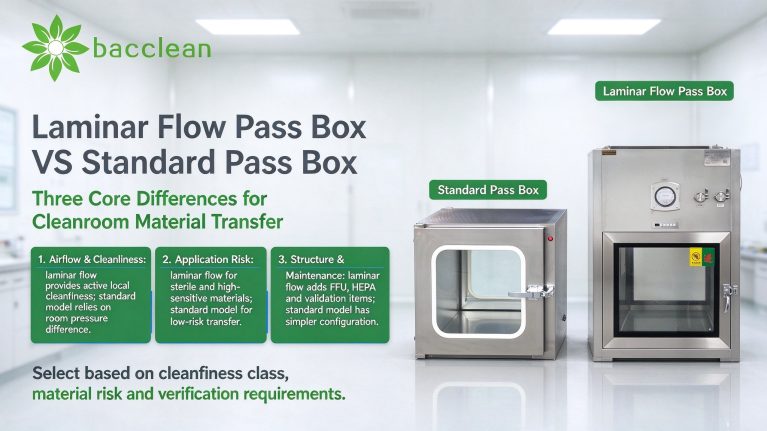
Standard Pass Box It has no independent air supply and filtration system, and relies on the pressure difference of the two connected cleanrooms to maintain internal cleanliness. The interior of the cabinet is a static space; surface disinfection is completed only by UV sterilization and inner wall wiping. When doors are opened or closed and materials are transferred, airflow disturbance can easily introduce particles. It only achieves physical isolation between zones and cannot maintain continuous high cleanliness inside the cabinet. Suitable for material transfer between non-high-risk clean areas such as Grade B, C and D cleanrooms, mostly used for outer-packaged materials and ordinary tools transfer.
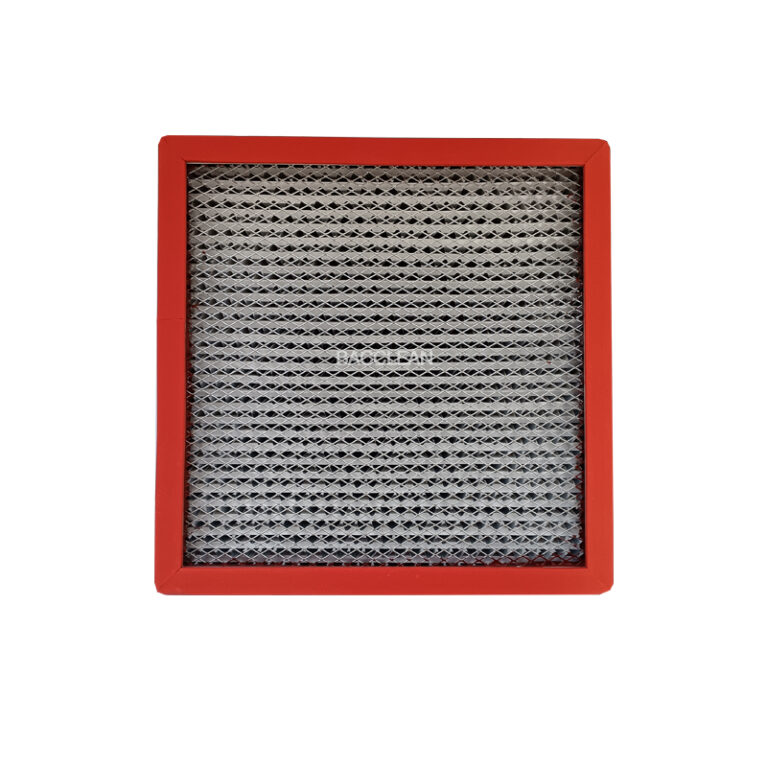
Boîte de passage à flux laminaire Equipped with FFU fan filter units and HEPA filters. During operation, a stable unidirectional laminar flow is formed inside the cabinet to continuously carry away suspended particles. Grade A local cleanliness can be maintained inside the cabinet throughout the material transfer process. Combined with VHP vaporized hydrogen peroxide or UV disinfection, both surface microorganisms and airborne particles can be controlled. It can greatly reduce the contamination risk brought by airflow disturbance during door opening when transferring materials. It is widely used in high-cleanliness areas, such as material transfer between Grade A/B clean zones in sterile pharmaceutical workshops and biological laboratories, semiconductor chip workshops.
Key Takeaway: A standard pass box only provides physical isolation; a laminar flow pass box can independently build a local high-cleanliness environment inside the cabinet.
2. Difference in Applicable Scenarios and Risk Levels
Standard Pass Box Applicable scenarios: Transfer of ordinary materials between rooms of different cleanliness grades, low-contamination-risk processes. Typical uses: Transfer of outer-packaged materials and general consumables between clean areas and non-clean areas, or Grade D cleanrooms. Features: Simple structure and easy operation; it only blocks macroscopic contaminants and has limited control over airborne suspended particles. Not suitable for the transfer of sterile or highly sensitive products.
Boîte de passage à flux laminaire Applicable scenarios: Material access for high-cleanliness and high-contamination-risk processes, transfer of sterile raw materials, samples, semi-finished products and precision components. Typical uses: Sterile preparation workshops, cell laboratories, lithium battery cathode material workshops, semiconductor wafer material transfer. Features: The independent laminar flow system offsets airflow disturbance during door opening and reduces cross-contamination probability. It is equipped with leak test ports for PAO aerosol leak testing in compliance with GMP verification requirements.
Key Takeaway: Choose a standard pass box for low-risk material transfer; prioritize laminar flow pass boxes for cross-zone transfer of sterile, high-value sensitive materials.
3. Difference in Structural Composition, Validation and Maintenance
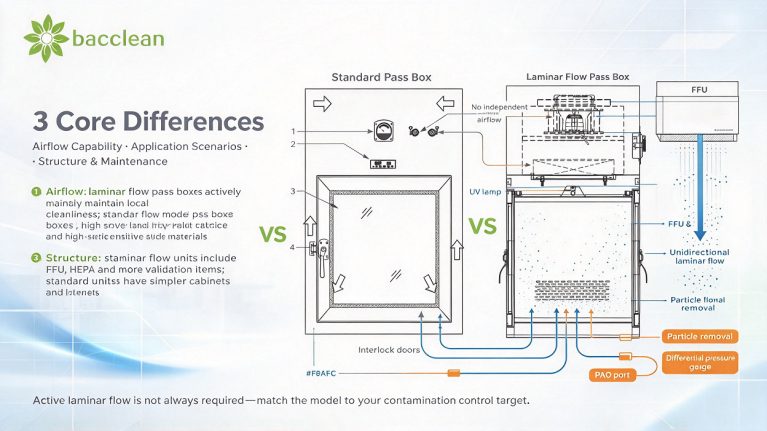
Standard Pass Box Structure: Cabinet body, interlock doors, UV germicidal lamps and observation windows. Some optional models have powder-coated or stainless steel inner walls. No fans or HEPA filter assemblies. Validation & Maintenance: Validation items mainly include surface microbial swab test and interlock function test. Routine maintenance is simple, requiring only regular cabinet cleaning and UV lamp replacement. The procurement, installation and long-term operation costs are lower.
Boîte de passage à flux laminaire Structure: Built on the standard pass box, with additional FFU fans, HEPA filters, plenum chambers. Some models are fitted with differential pressure gauges, PAO test ports, VHP-compatible inner walls and automatic control systems. Validation & Maintenance: In addition to interlock and surface disinfection verification, air velocity testing, airflow pattern testing and PAO leak testing for HEPA filters are required. Fans and filter media are consumables; regular air velocity inspection and filter replacement are needed. The equipment cost and daily maintenance workload are relatively higher.
Key Takeaway: Standard pass boxes feature simple structure and low validation & maintenance costs; laminar flow pass boxes have more components, comprehensive validation items and higher maintenance requirements.
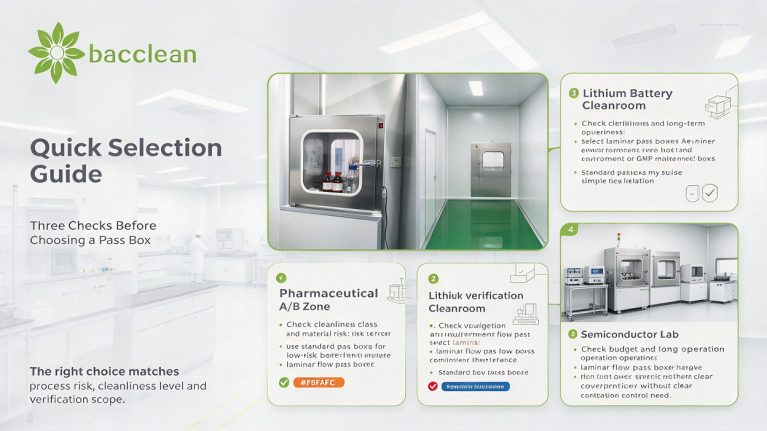
Quick Selection Checklist
-
Confirm the cleanliness grade of the two connected rooms and material risk: use standard pass boxes for ordinary cross-zone material transfer; select laminar flow pass boxes for the transfer of sterile and high-value sensitive materials between zones with different cleanliness levels.
-
Evaluate verification requirements: choose laminar flow pass boxes if the project requires GMP compliance verification and local Grade A environment; a standard pass box is sufficient for simple physical isolation only.
-
Consider budget and long-term operation: laminar flow pass boxes have higher upfront investment and maintenance costs. Do not select them blindly for scenarios without laminar flow requirements to avoid resource waste.
Conclusion
There is no absolute superiority or inferiority between laminar flow pass boxes and standard pass boxes. The core principle is matching the equipment with the project’s clean process requirements. Instead of simply pursuing higher equipment configuration during selection, comprehensively judge according to material type, cleanliness grade, pollution control targets and verification plans, so as to select the proper pass box and optimize project investment while meeting cleanroom contamination control requirements.
