
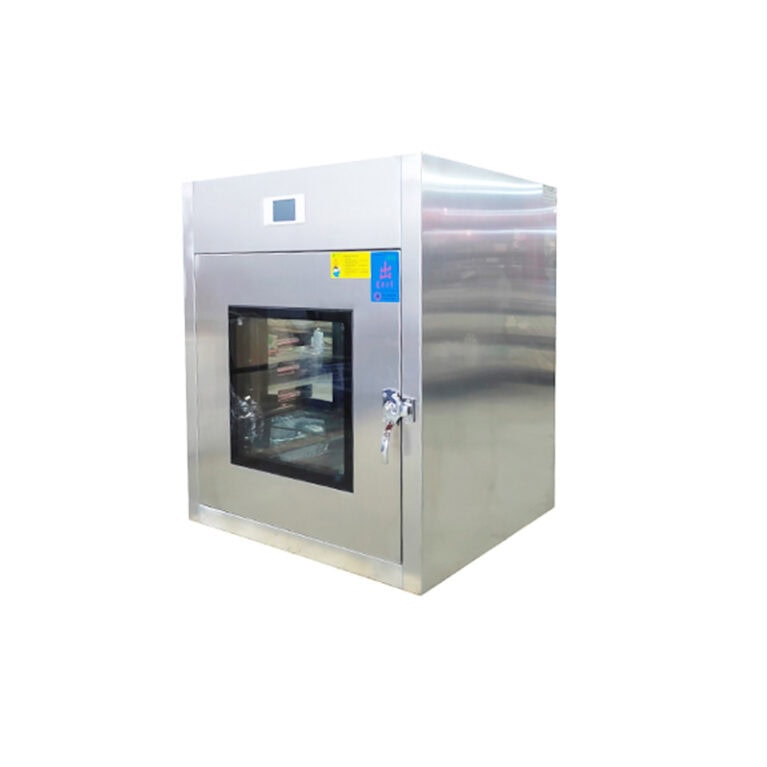
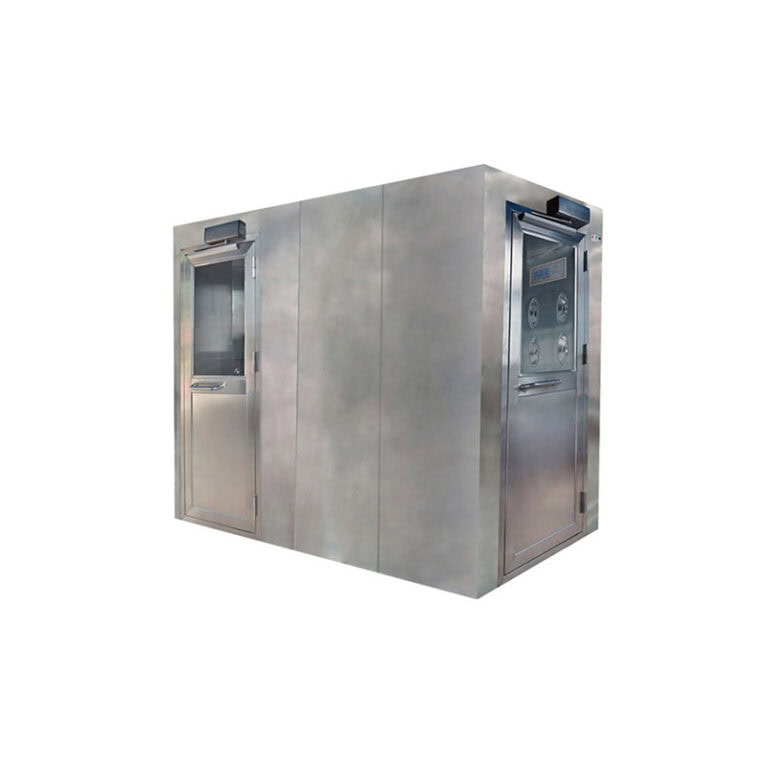
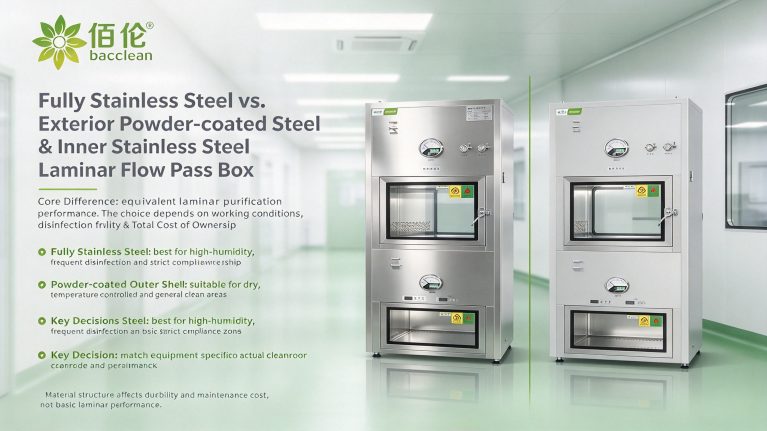
Both types share basically the same laminar purification structure, filter configuration, interlock function and clean air output standard. There is no gap in purification performance. Their core differences lie in shell material, corrosion resistance, service life, operation & maintenance cost and appearance adaptability. Many projects suffer from improper selection: low-spec equipment fails to adapt to working conditions, while over-spec equipment leads to unnecessary budget waste. This article objectively analyzes the pros and cons of both types, and provides practical selection schemes combined with cleanroom grades and workshop operating conditions, helping projects balance compliance and cost performance.
1. Material Structure Introduction of the Two Pass Boxes
1.1 Fully Stainless Steel Boîte de passage à flux laminaire
All structural components including the outer shell, inner cavity, door frame, corners and access panels are made of stainless steel. 304 stainless steel is the standard option in the industry, and medical-grade 316L stainless steel can be upgraded for high-corrosion and frequent disinfection scenarios. The whole equipment adopts integrated bending and seamless welding process with matte brushed surface, no coating. The unified material delivers better structural tightness and integrity.
1.2 Laminar Flow Pass Box with Powder-coated Steel Outer Shell & Stainless Steel Interior
It is a composite material structure and a common economical option in the industry. The inner cavity, work surface and door frame which directly contact the clean zone are made of stainless steel to meet basic cleaning requirements. The outer shell adopts high-quality cold-rolled steel plate treated with electrostatic powder coating. The surface is smooth and flat, and the color can be customized to match the decoration style of conventional cleanrooms.
2. Comprehensive Comparison of Advantages and Disadvantages in Core Dimensions
2.1 Corrosion Resistance and Environmental Adaptability
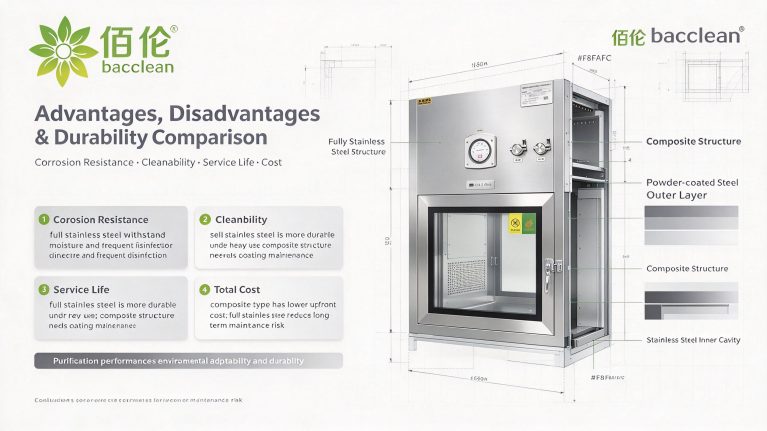
Fully Stainless Steel Laminar Flow Pass Box Advantages: The metal material itself resists moisture and chemical reagent corrosion. It withstands frequent wiping and spraying disinfection with alcohol, hydrogen peroxide, sodium hypochlorite and other disinfectants. It will not rust, oxidize or peel under long-term humid, large temperature fluctuation, or slightly acidic/alkaline mist conditions, supporting a wide range of working environments. The integrated seamless structure leaves no dust accumulation dead corners, compatible with high-standard disinfection processes such as VHP room sterilization.
Disadvantages: Higher raw material cost, the purchase price is higher than composite type, resulting in larger upfront investment.
Powder-coated Steel Outer Shell & Inner Stainless Steel Laminar Flow Pass Box Advantages: The stainless steel inner cavity meets routine dust removal and disinfection requirements. It can maintain stable performance long-term in dry, constant-temperature standard clean environments with qualified basic anti-corrosion and dust-proof capacity.
Disadvantages: The outer powder coating is a protective layer rather than permanent protection. In long-term high-humidity, frequent disinfection and large temperature fluctuation environments, the coating is prone to wear, cracking and peeling. Once the coating is damaged, the internal cold-rolled steel will quickly get damp and rust, and rust debris may affect the cleanliness of the workshop. The weather resistance of the equipment has obvious limitations.
2.2 Cleaning Difficulty and Cleanroom Compliance
Fully Stainless Steel Laminar Flow Pass Box Integrated seamless welding and rounded corner design, no gaps or dead corners. The dense surface does not adsorb dust and microorganisms, suitable for high-intensity and frequent cleaning & sterilization operations. There is no risk of coating peeling, fully complying with refined cleanliness control standards of GMP, sterile workshops and biological laboratories, with no secondary pollution risk during long-term operation.
Powder-coated Steel Outer Shell & Inner Stainless Steel Laminar Flow Pass Box The inner cavity has the same cleaning capacity as the full stainless steel version, satisfying routine cleaning and disinfection requirements for ordinary cleanrooms. However, the adhesion of outer powder coating is limited. Frequent heavy wiping and chemical reagent spraying will accelerate coating aging and wear. Damaged areas tend to trap dust and dirt, which is unfavorable for compliance management of high-grade clean zones in long-term operation.
2.3 Service Life and Operation & Maintenance Cost
Fully Stainless Steel Laminar Flow Pass Box Robust and wear-resistant structure, anti-collision and scratch-resistant. It has a longer service life under normal working conditions. Daily maintenance only includes regular filter replacement and sealing part inspection. No maintenance is required for the outer shell structure, resulting in low maintenance frequency, low comprehensive maintenance cost and stronger long-term stability.
Powder-coated Steel Outer Shell & Inner Stainless Steel Laminar Flow Pass Box The service life remains stable under standard dry working conditions. However, the outer shell coating tends to age and get damaged after long-term use, requiring regular inspection, repainting and renovation. The later maintenance workload and cost are higher. If the coating damage is not handled in time, rust spread will affect the structural stability of the equipment and shorten its overall service life.
2.4 Appearance Adaptability and Impact Resistance
Fully Stainless Steel Laminar Flow Pass Box Uniform full-metal texture, simple and neat. It resists collision and scratches without peeling or fading. The appearance consistency remains good for long-term use, matching the decoration style of high-standard clean workshops with outstanding high-end compatibility.
Powder-coated Steel Outer Shell & Inner Stainless Steel Laminar Flow Pass Box Customizable outer shell color with neat appearance, matching the decoration style of most conventional cleanrooms. But the outer shell has weak impact resistance. Minor impact can cause scratches and peeling on the coating, which is hard to repair. Color difference will easily appear after long-term use, damaging the integrity of appearance.
2.5 Purchase Cost Performance
Fully Stainless Steel Laminar Flow Pass Box Higher initial purchase cost. Nevertheless, benefiting from long service life and extremely low maintenance cost, it achieves better comprehensive cost performance in long-term operation. Suitable for long-running continuous production high-standard projects.
Powder-coated Steel Outer Shell & Inner Stainless Steel Laminar Flow Pass Box Lower raw material and processing cost with affordable purchase price. It has obvious advantages in upfront cost control for short-term production and budget-limited conventional clean projects.
3. Scenario-based Precise Selection Guide
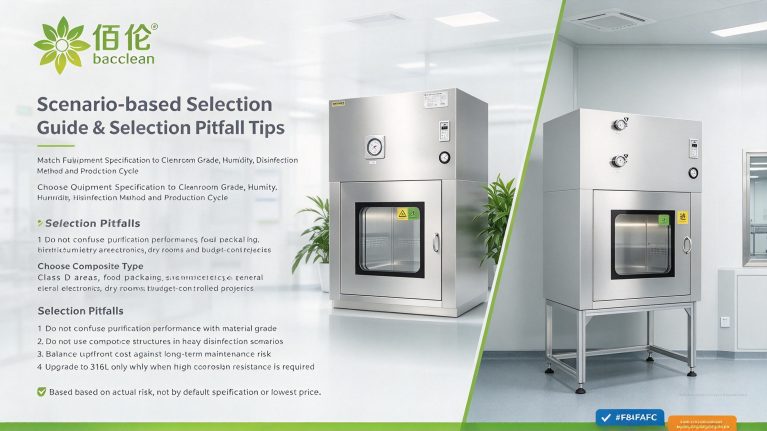
3.1 Scenarios Where Fully Stainless Steel Laminar Flow Pass Box Is Preferred
For high cleanliness grade, high humidity, frequent disinfection, corrosive working conditions and long-term continuous production strict scenarios, full stainless steel type is preferred to avoid later compliance and maintenance risks:
- Pharmaceutical industry: GMP Grade A/B/C sterile clean zones, formulation workshops, solution preparation workshops, transfer processes requiring VHP overall sterilization;
- Biomedical field: P2/P3 laboratories, sterile operating rooms, reagent R&D clean zones, medical device clean workshops;
- Special working condition workshops: clean environments with slight acid and alkali water vapor such as lithium battery and fine chemical industry, high-humidity workshops for cold chain and food disinfection;
- High-frequency operation scenarios: processes with high material transfer frequency, non-stop long-term operation, requiring equipment to remain maintenance-free and GMP-compliant stably.
3.2 Scenarios Where Powder-coated Steel Outer Shell & Inner Stainless Steel Laminar Flow Pass Box Is Preferred
For conventional cleanliness grade, dry constant temperature, budget-controlled and short-term production general working conditions, this type can fully meet the usage requirements with higher cost performance:
- Ordinary light industry clean zones: D-class conventional clean workshops such as food packaging, cosmetics and daily necessities;
- General electronics industry: ordinary electronic assembly and precision hardware dust-free workshops with dry, non-corrosive environment and no high-intensity disinfection requirements;
- Auxiliary clean areas: ordinary research laboratories, clean warehouses, workshop buffer auxiliary areas, non-core sterile production processes;
- Budget-limited projects: short-term or phased production, clean projects with stable non-corrosive working conditions and priority on upfront cost control.
4. Key Pitfall Avoidance Points for Selection
- No difference in purification performance: The laminar filtration efficiency, sealing performance, interlock function and clean air output standard of the two types of equipment are completely consistent. They only differ in material durability and environmental adaptability. There is no need to blindly choose the high-spec full stainless steel version.
- Do not use low-spec equipment for disinfection scenarios: Workshops requiring frequent disinfection with chemical reagents or VHP sterilization must not adopt powder-coated steel type, to prevent cleanliness hazards caused by coating aging and damage.
- Balance short-term cost and long-term value: Temporary workshops and short-term projects can choose composite materials to control costs. For long-term operation projects requiring continuous GMP compliance, full stainless steel type is preferred to reduce long-term maintenance and rectification costs.
- Upgrade for strong corrosion working conditions: For special environments with high salt spray and strong acid and alkali, 316L stainless steel can be upgraded on the basis of full stainless steel type to further improve the corrosion resistance of equipment.
5. Summary
The laminar flow pass box with powder-coated steel outer shell & inner stainless steel is an economical general selection. It meets the material transfer demands of conventional dry clean zones at lower purchase cost, suitable for D-class ordinary clean workshops, light industry, general electronics and other industries, acting as a cost-effective basic configuration.
The fully stainless steel laminar flow pass box is a high-standard durable selection. With the advantages of full-range corrosion resistance, disinfection resistance, no dead corners and low maintenance, it adapts to Grade A/B/C high clean zones, pharmaceutical & medical industry, biological laboratories, high humidity and corrosive harsh working conditions. It can guarantee long-term cleanroom compliance with higher long-term comprehensive value.
For clean project selection, there is no need to blindly upgrade specification or cut costs. Comprehensive evaluation combining cleanroom grade, working environment, disinfection method, production cycle and maintenance requirements will achieve the optimal balance of equipment adaptability, compliance and cost performance.
