
1. Classification Standard and Filtration Principle
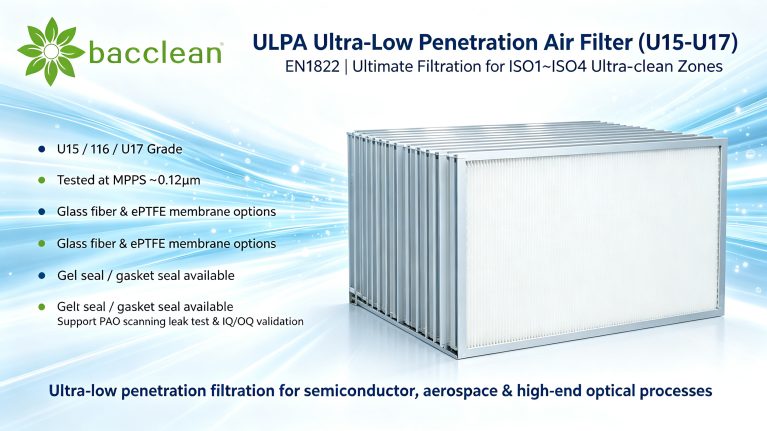
ULPA grades are strictly defined in accordance with EN1822-1:2019, judged by dual indicators of total efficiency and local efficiency under MPPS. Only particle counting method is adopted for testing, different from the traditional DOP sodium flame method. It imposes drastically higher requirements on filter media, pleating, sealing and scanning leak detection.
-
U15: Total efficiency ≥99.9995% at MPPS, local efficiency ≥99.9975%, penetration rate ≤0.0005%
-
U16: Total efficiency ≥99.99995% at MPPS, local efficiency ≥99.99975%, penetration rate ≤0.00005%
-
U17: Total efficiency ≥99.999995% at MPPS, local efficiency ≥99.999975%, penetration rate ≤0.000005%
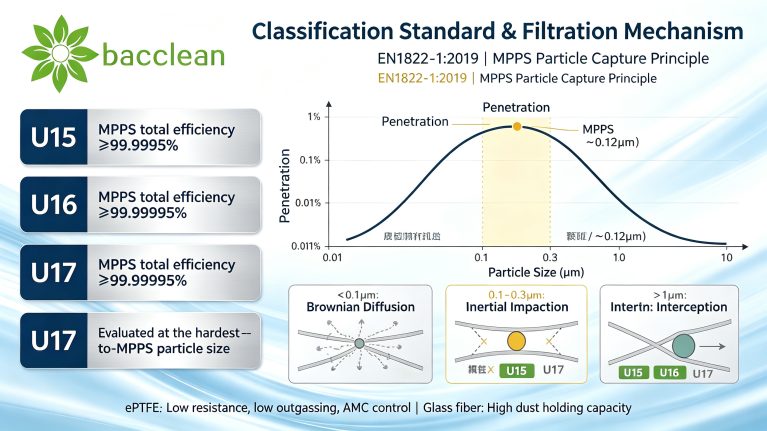
The filtration mechanism relies on the synergistic effect of Brownian diffusion, inertial impaction and interception. For the MPPS range of 0.1~0.2μm, where particles are hardest to capture, the particles are extremely tiny in mass and mainly captured by filter fiber via Brownian diffusion. Two mainstream filter media types are available: superfine glass fiber media and ePTFE membrane-coated media. Glass fiber media features dense pleats and high dust holding capacity, yet comes with relatively high resistance under the same efficiency. ePTFE adopts surface filtration, with particles retained on the surface layer of the media. It delivers lower resistance and is less prone to deep blockage, making it suitable for EUV lithography and other semiconductor production lines sensitive to pressure difference and AMC molecular contamination. It also has advantages of low particle generation and low outgassing.
Key point to note: Although the efficiency figures seem to differ only by several decimal places when upgrading from H14 to U15, the filter media pore structure, pleating process and sealing tolerance are improved by an order of magnitude. Any tiny defect in the media or leakage at the glue joint will directly cause local penetration failure. Therefore, every ULPA filter must undergo laser scanning leak testing instead of sampling inspection only.
2. Structural Forms and Sealing Schemes
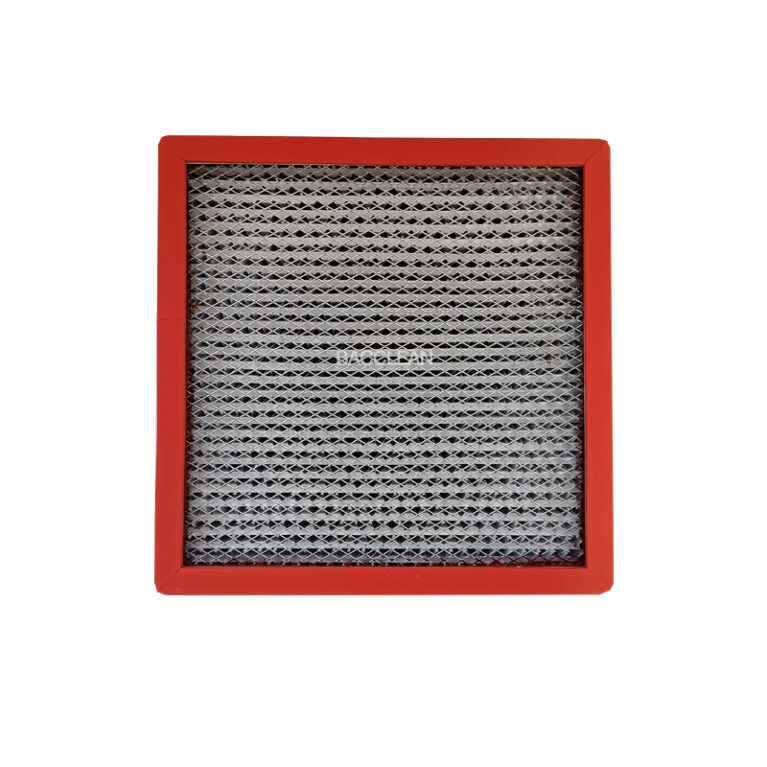
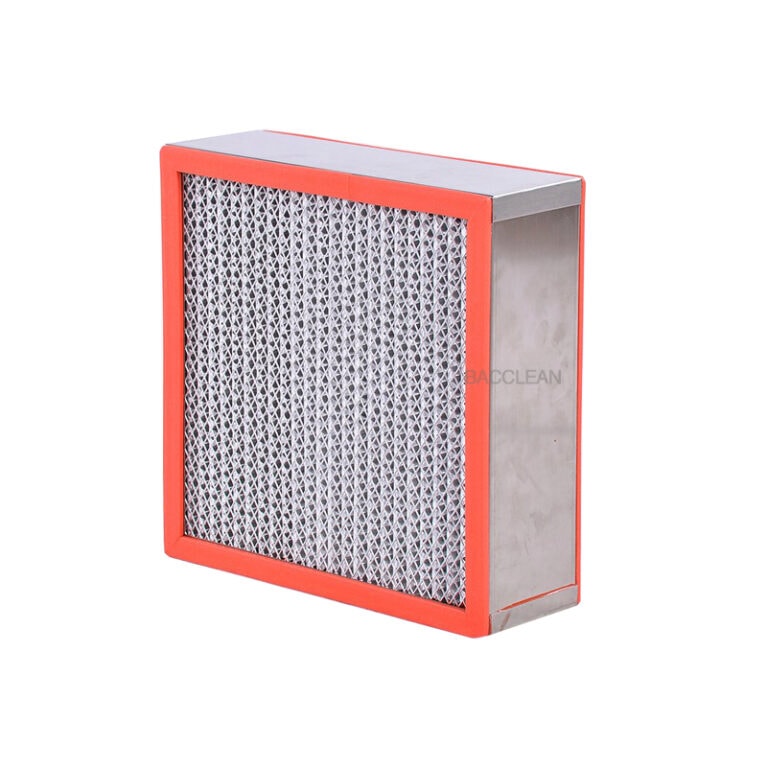
Most ULPA filters adopt the mainstream separatorless hot-melt adhesive structure. A small number of heavy-duty and high-airflow applications use the separator type. The complete filter element consists of filter media, separating adhesive, frame and sealing interface. The sealing scheme directly determines whether the nominal grade can be stably achieved on site.
-
Gel Seal: The preferred option for high-end ultra-clean scenarios. The knife-edge frame cooperates with gel sealant, offering strong self-healing performance and extremely low air leakage risk. It is compatible with laminar flow ceiling, FFU and ultra-efficient air supply outlets, facilitating on-site PAO scanning leak testing. It is the standard configuration for semiconductor lithography and EUV zones.
-
Gasket Seal: Lower in cost, mostly used for U15 auxiliary ultra-clean stations with good background cleanliness. The disadvantage is that rubber gaskets tend to age and leak after long-term thermal expansion, contraction and disinfectant corrosion.
-
Frame Material: Anodized aluminum frame is commonly used. For scenarios with frequent disinfection, acid/alkali steam exposure and silicon-free control requirements, 304/316L stainless steel frames are selected to control precipitates.
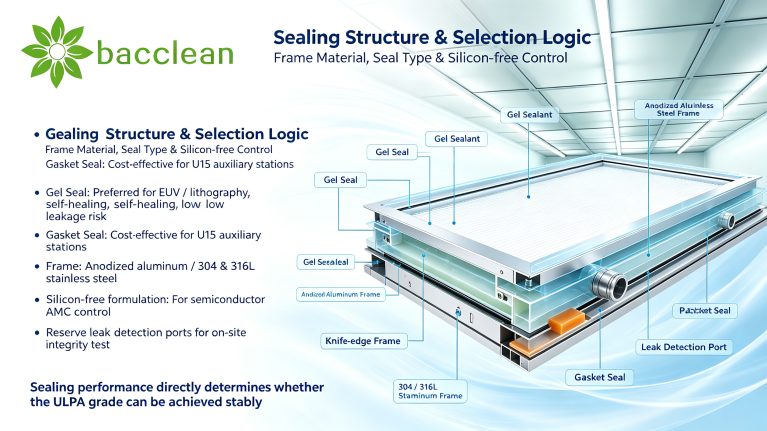
Meanwhile, ULPA has strict control over particle generation. For semiconductor and display panel projects, silicon-free formulations must be specified. All sealing adhesives, hot-melt separating materials and lubricating accessories are controlled for siloxane to avoid AMC molecular contamination forming hard-to-remove sediment films on wafers and optical lenses.
3. Application Scenarios & Selection Guidance
ULPA filters are not universally used in the whole cleanroom. Zonal configuration is widely adopted in the industry: H13/H14 filters are deployed in ordinary areas, while U15~U17 filters are arranged only at core sensitive process points to balance purification performance and operating energy consumption.
-
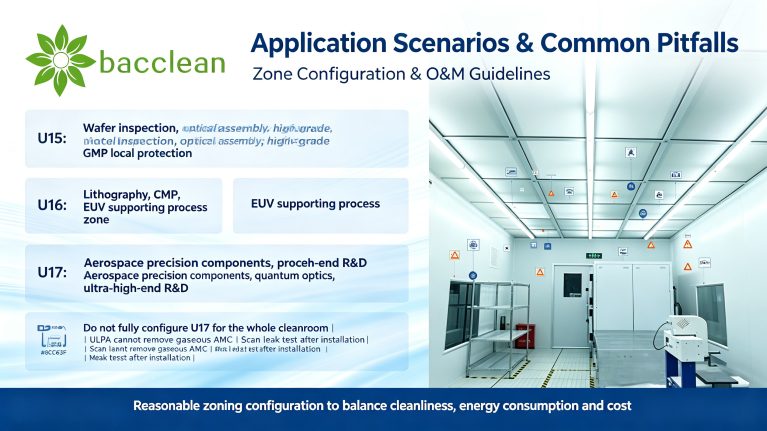
U15: ISO4~ISO5, wafer inspection, optical lens assembly, hard disk head assembly, nanomaterial laboratories, and some high-demand GMP aseptic local protection stations. It is the most widely used ULPA grade.
-
U16: ISO3~ISO4, semiconductor lithography, CMP, supporting zones for EUV exposure, chip manufacturing processes with zero tolerance for nano-particle defects.
-
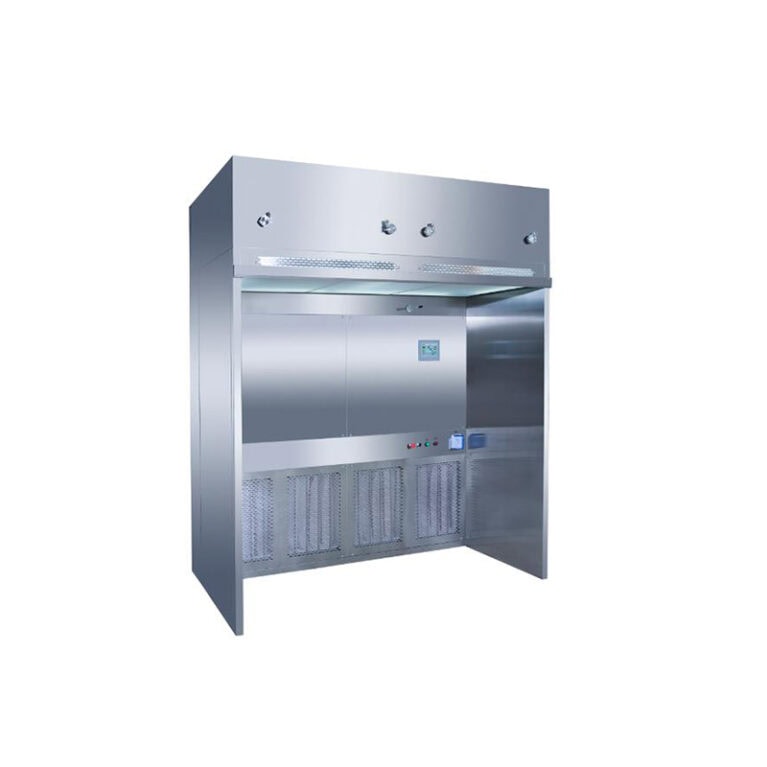
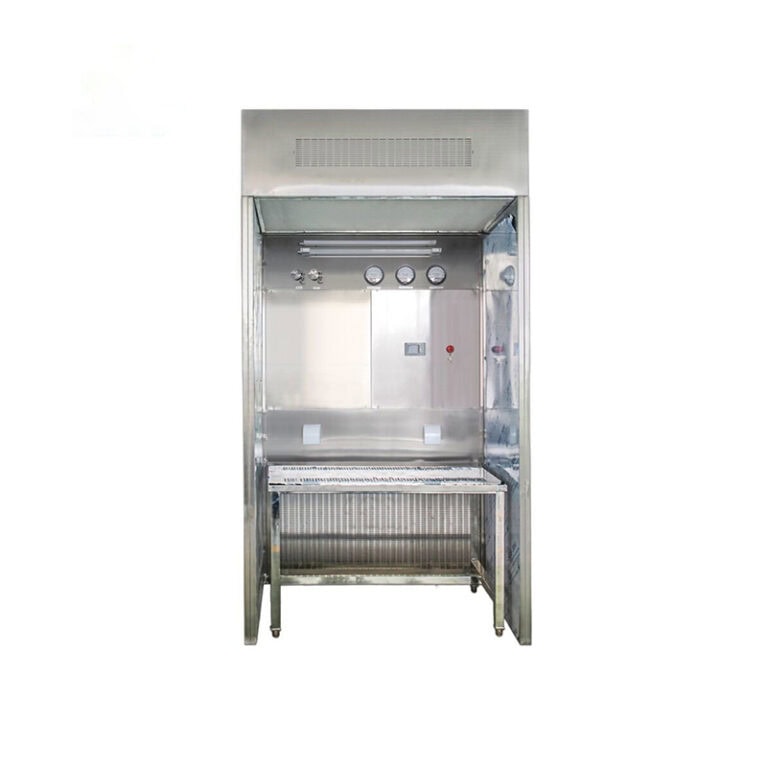
U17: ISO1~ISO3, aerospace precision components, quantum optical experiments, ultra-high-end semiconductor R&D platforms. It represents the ultimate cleanliness grade with the highest cost, resistance and operation & maintenance cost, generally used on a small scale in independent laminar flow hoods and dedicated FFU units.
In the pharmaceutical industry, H14 filters are sufficient for most GMP Grade A/B zones. U15 will only be evaluated for a small number of ultra-high cleanliness isolation zones for cell therapy and gene drug R&D, and U16/U17 are rarely adopted.
4. Core Selection Parameters
-
MPPS Efficiency Grade: Distinguish U15/U16/U17, and confirm that the test report is based on EN1822 particle counting scanning method rather than traditional 0.3μm efficiency.
-
Initial Resistance and Dust Holding Property: Glass fiber media has high initial resistance; low-resistance ePTFE versions are more suitable for FFU systems with limited fan pressure margin. Resistance serves as the core criterion for filter replacement.
-
Sealing Structure: Gel seal is preferred for subsequent verification and leak testing.
-
Filter Media and Precipitate Control: Silicon-free and low-outgassing requirements must be clarified for semiconductor projects; chemical corrosion-resistant media are preferred for frequently disinfected zones.
-
Matching Leak Detection Ports: Reserve scanning leak detection points to support post-installation PAO integrity test and meet project IQ/OQ validation.
-
Airflow and Wind Speed Matching: ULPA has higher resistance than HEPA. The air pressure margin of front-end fans and air ducts needs to be calculated in advance to avoid insufficient airflow and laminar flow failure.
5. Common Misconceptions in Design and Operation & Maintenance
Misconception 1: Blindly deploying U17 across the whole cleanroom. Higher grade means greater resistance, significantly increased fan energy consumption and shortened dust holding cycle. Over-specification in most scenarios will raise long-term operation and maintenance costs.
Misconception 2: Treating U-grade filters as universal anti-contamination devices. ULPA only intercepts solid particulate aerosols and cannot remove gaseous molecular contaminants (AMC). For production lines with molecular contamination risks, additional chemical filtration modules are required.
Misconception 3: Only checking factory test reports and skipping post-installation scanning leak testing. ULPA filters are extremely sensitive to installation gaps and bumps on filter media. Slight collision during transportation and installation may lead to excessive local penetration. Scanning leak testing must be performed on every unit after installation.
Misconception 4: Mixing ordinary sealant and silicon-containing accessories. Even if the filter itself is qualified, siloxane precipitated from silicon-containing sealant will directly cause wafer defects, which is a frequent pitfall in semiconductor projects.
Daily O&M Guidelines: Continuously monitor the pressure difference of the filter and replace the filter when reaching the final resistance; filter replacement shall be completed in a clean environment to avoid secondary contamination during replacement; conduct regular integrity scanning; protect the filter properly during storage and transportation, and avoid squeezing or bumping the pleated surface of filter media.
Conclusion
ULPA ultra-low penetration air filters (U15/U16/U17) deliver an ultimate filtration solution targeting nano-scale MPPS particles, forming a clear grade ladder with H14 HEPA filters. Its core value is to further reduce particle penetration in the 0.1~0.2μm ultrafine particle range that cannot be controlled by conventional HEPA filters, supporting ISO1~ISO4 ultra-clean processes. For selection, comprehensive judgment shall be made combining cleanliness grade, process requirements for particles and AMC, as well as fan air pressure conditions. Gel seal and supporting scanning leak testing are preferred, and silicon-free & low-outgassing material control shall be implemented. Over-specification that brings unnecessary energy consumption and cost burden shall be avoided while meeting contamination control objectives.
