
NOTICIAS

Inicio / Structural Technology, Air‑flow Principle and Core Advantages of Leak‑proof Laminar Air‑supply Ceiling for Medical Scenarios
Centro de información
Elija sus visitas especiales
Solución
Productos recomendados
Últimas noticias
Póngase en contacto con nosotros
Structural Technology, Air‑flow Principle and Core Advantages of Leak‑proof Laminar Air‑supply Ceiling for Medical Scenarios
Air‑supply ceilings represent core air‑supply and purification equipment for high‑grade clean spaces, widely deployed in hospital clean operating rooms, sterile wards, pharmaceutical aseptic workshops and precision‑manufacturing cleanrooms. Among these products, leak‑proof laminar air‑supply ceilings, featuring zero‑pressure sealing, full‑area uniform airflow and zero air‑leakage performance, are gradually replacing conventional air‑supply ceilings and becoming the mainstream option for high‑end clean‑engineering projects. This article focuses on the key structure and air‑distribution principle of leak‑proof air‑supply ceilings, and elaborates on their technical strengths and application values within medical clean‑room environments.

Laminar Flow Pass Box Selection Application Maintenance 5

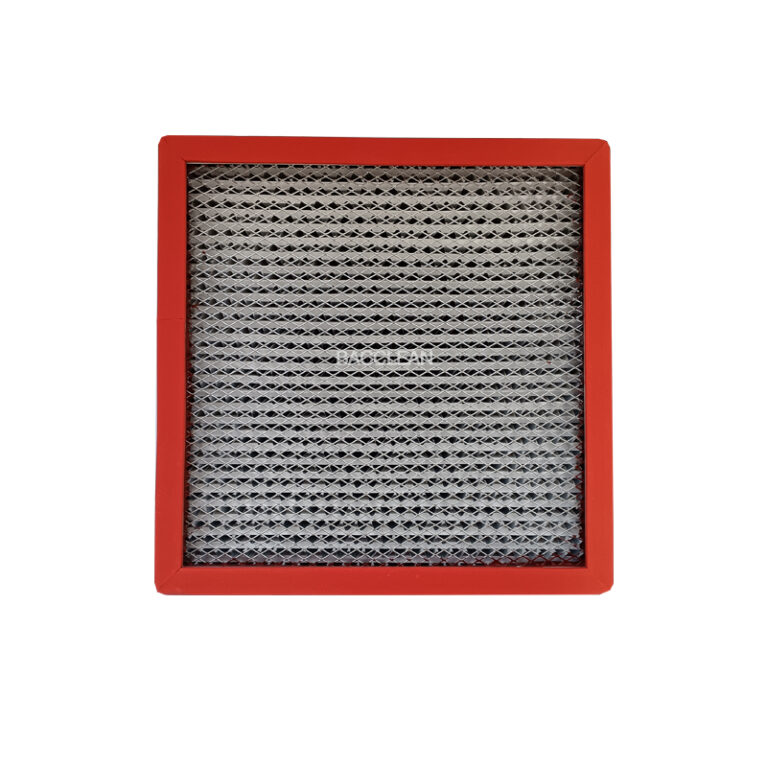
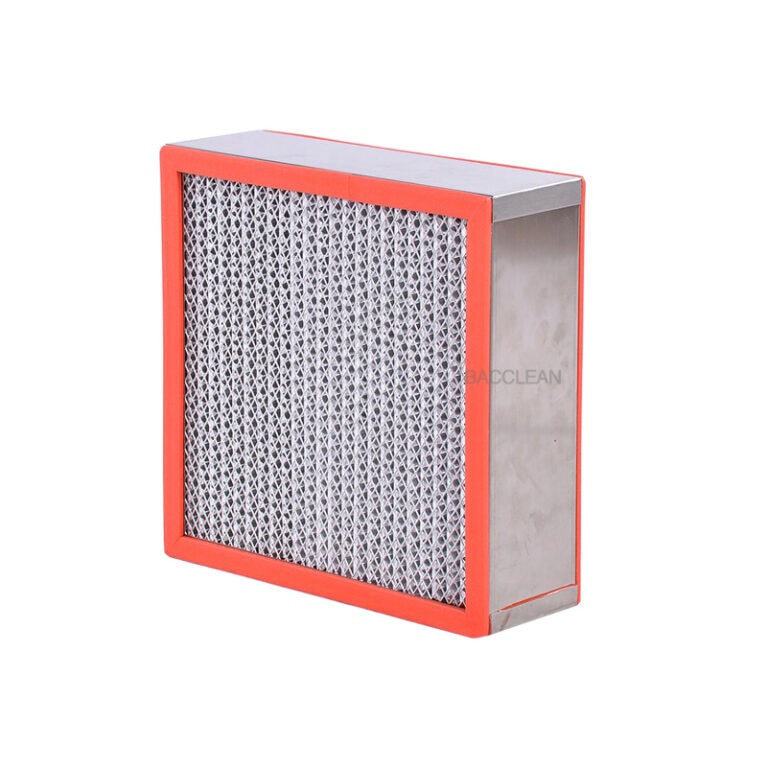
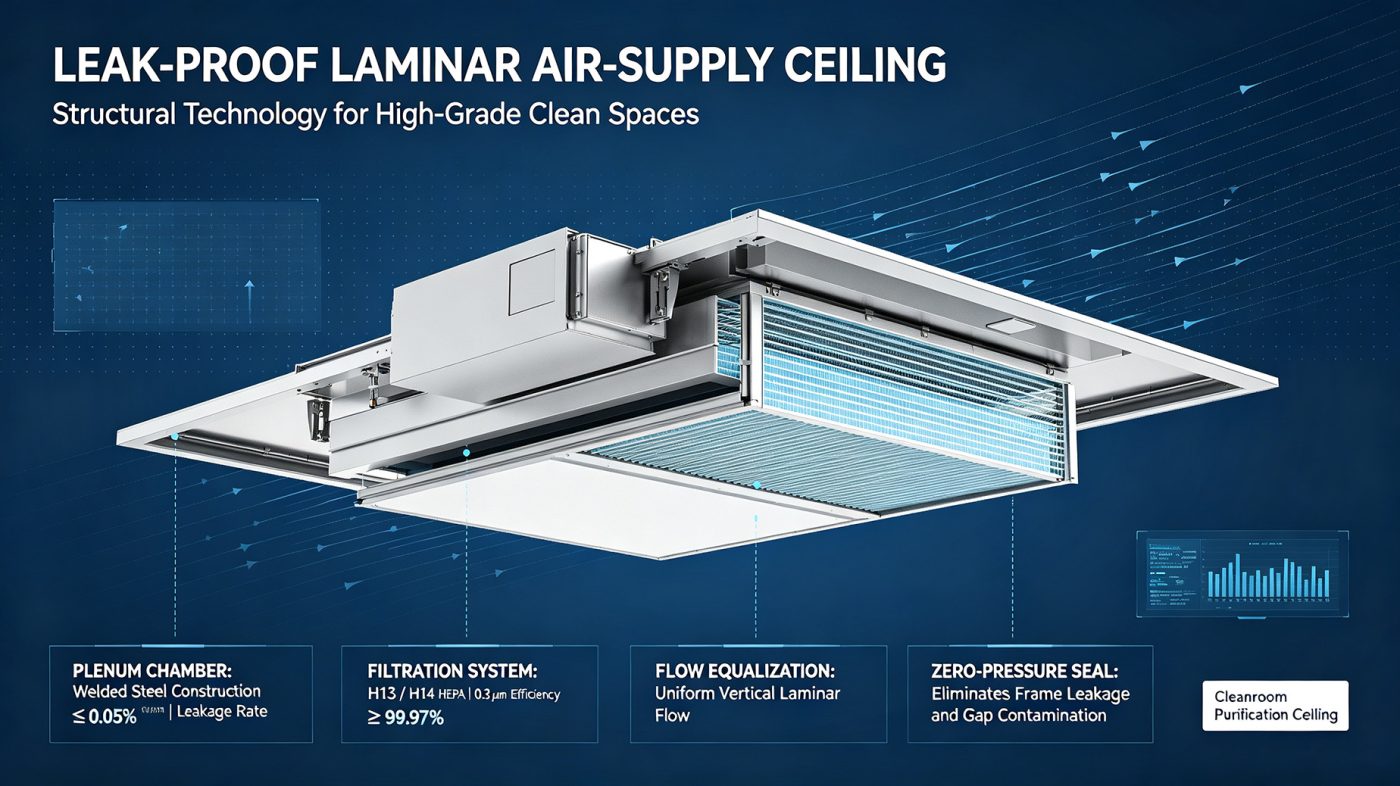
The complete assembly of the air‑supply ceiling consists of four core modules: plenum chamber, filtration system, flow‑equalizing system and sealing system. These modules work synergistically to deliver high‑efficiency filtration, uniform air supply and leak‑tight containment. The plenum chamber is integrally welded from high‑quality cold‑rolled steel plate or stainless‑steel material, with air‑tightness leakage rate ≤ 0.05 %. It stabilizes static pressure and balances airflow to prevent uneven air delivery induced by pressure fluctuation. Internal orifice baffles and knife‑edge frames eliminate dead‑zones of air distribution. The filtration system adopts H13 / H14 mini‑pleat HEPA filters, achieving ≥ 99.97 % removal efficiency for 0.3 μm particles and nearly 100 % interception efficiency against bacterial and viral aerosols, complying with cleanliness requirements for Class 100, Class 1000 and Class 10 000 clean zones. Equipped with dedicated flow‑equalizing membranes or plates, the flow‑equalizing system converts high‑pressure filtered airflow into stable vertical laminar flow, ensuring homogeneous air velocity and suppressing turbulence in the working zone. The upgraded leak‑proof sealing system applies zero‑pressure sealing technology, fundamentally resolving long‑standing industry pain points including frame‑edge air leakage and contaminant infiltration through gaps, and structurally blocking unfiltered air from mixing into supply airflow.
Laminar Flow Pass Box Selection Application Maintenance 6
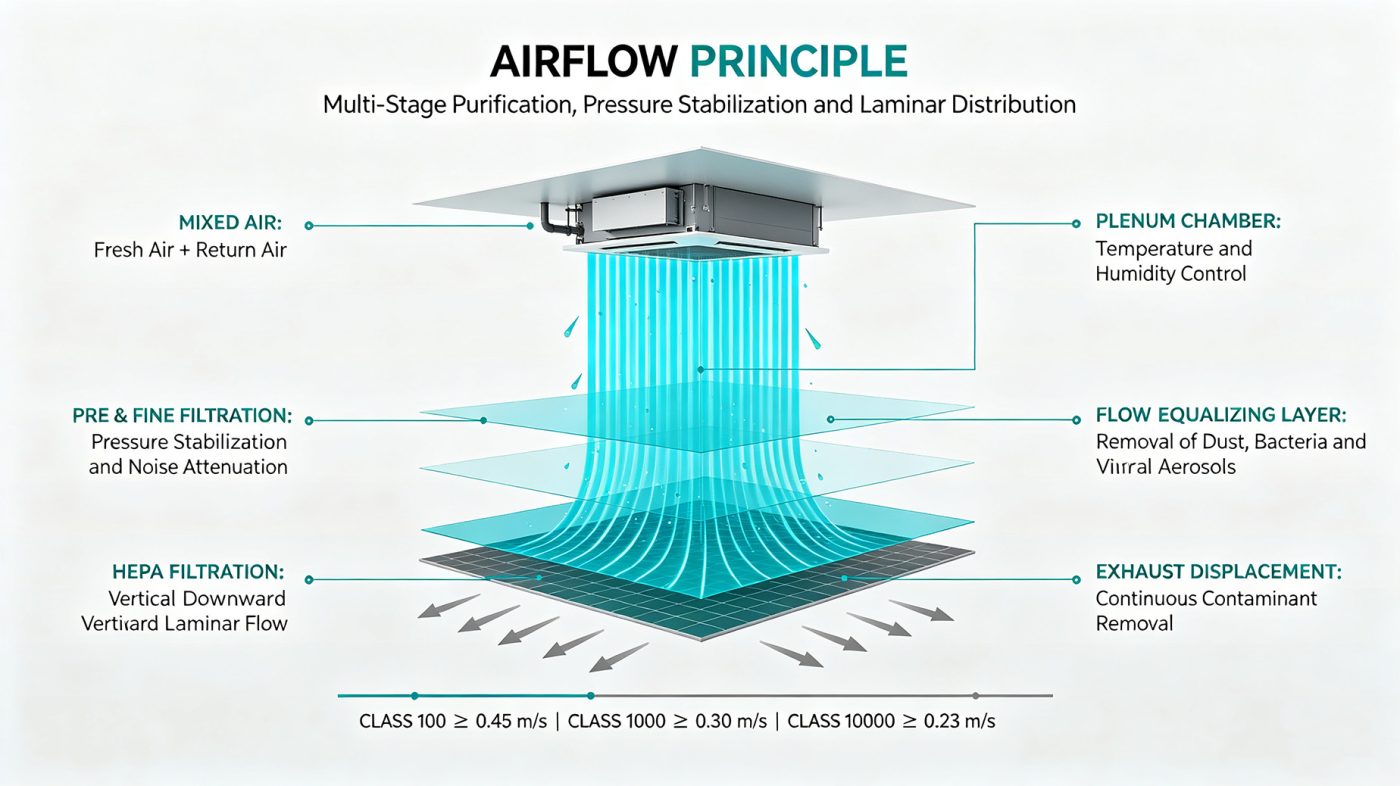
Its fundamental air‑flow mechanism follows multi‑stage purification, static‑pressure stabilization & flow equalization, and vertical laminar supply. Mixed fresh outdoor air and room return air undergo pre‑filtration, intermediate‑filtration and temperature‑humidity conditioning by the air‑handling unit before entering the plenum chamber of the air‑supply ceiling. Inside the plenum, airflow is fully pressure‑stabilized and attenuated to mitigate turbulence and pressure disparity. Air then passes homogeneously through HEPA filters for deep purification to remove fine dust and microbial particulates. Subsequent secondary rectification by the flow‑equalizing layer delivers vertically downward uniform laminar flow covering the critical clean working zone. Continuous air displacement exhausts contaminated air from the occupied area and sustains stable cleanliness classification. Air‑supply velocities are precisely graded for different cleanliness levels: ≥ 0.45 m/s for Grade‑Ⅰ (Class 100) applications, ≥ 0.30 m/s for Grade‑Ⅱ (Class 1000), and ≥ 0.23 m/s for Grade‑Ⅲ (Class 10 000), precisely matching purification demands of diverse operating conditions.
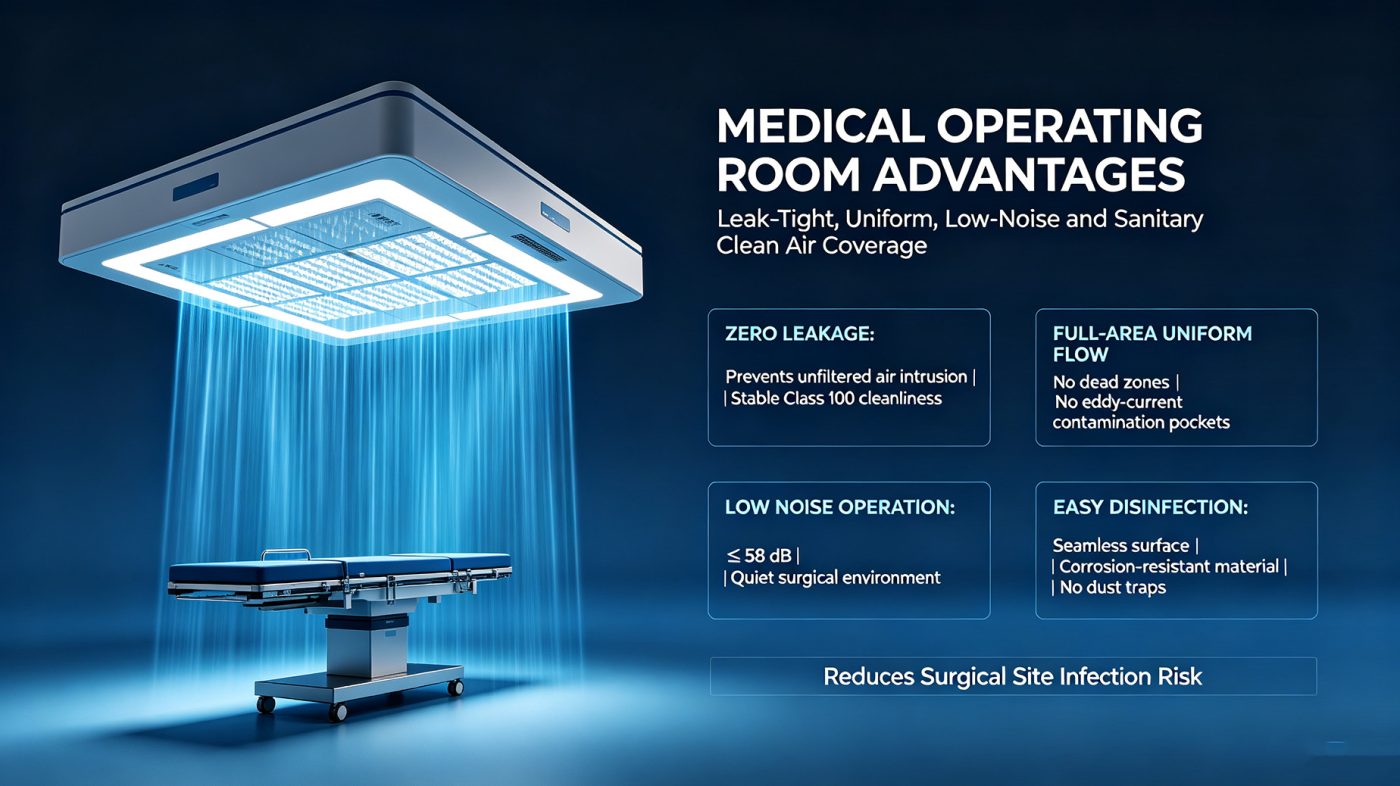
For medical clean operating‑room applications, leak‑proof air‑supply ceilings demonstrate four prominent technical advantages.

Laminar Flow Pass Box Selection Application Maintenance 7

First, zero‑leakage guarantees superior cleanliness. Conventional air‑supply ceilings suffer from air seepage through frame edges and assembly joints, allowing unfiltered air to intrude into critical surgical zones. The zero‑pressure leak‑proof construction eliminates such leakage, maintaining stable Class‑100 cleanliness within the core area and substantially lowering surgical‑site‑infection risks.
Second, full‑area uniform airflow without dead zones. Specially‑designed damping flow‑equalizing components distribute supply air evenly across both central surgical regions and peripheral zones, free of airflow blind spots and eddy‑current pockets that would cause localized contaminant accumulation.
Third, low‑noise stable operation. Integrated acoustic‑attenuation structures limit operational noise ≤ 58 dB, satisfying quiet‑working‑environment requirements in operating rooms without acoustic disturbance.

Laminar Flow Pass Box Selection Application Maintenance 8

Fourth, sanitary and easy‑to‑clean performance. The seamless monolithic structure features smooth corrosion‑resistant surfaces with no dust‑trapping crevices. It withstands repeated wiping and disinfection with sanitizing agents to inhibit bacterial colonization and meets stringent hygienic benchmarks for medical environments.

Compared with traditional air‑supply equipment, leak‑proof air‑supply ceilings deliver enhanced structural stability, superior purification accuracy and broader adaptability. Apart from satisfying graded cleanliness specifications for medical operating rooms, they are also applicable to large‑scale pharmaceutical clean workshops and precision‑electronics manufacturing facilities. They serve as pivotal equipment for upgrading contemporary clean‑engineering systems.

Deja una respuesta

Tu dirección de correo electrónico no será publicada. Los campos obligatorios están marcados con *

Compartir a...