
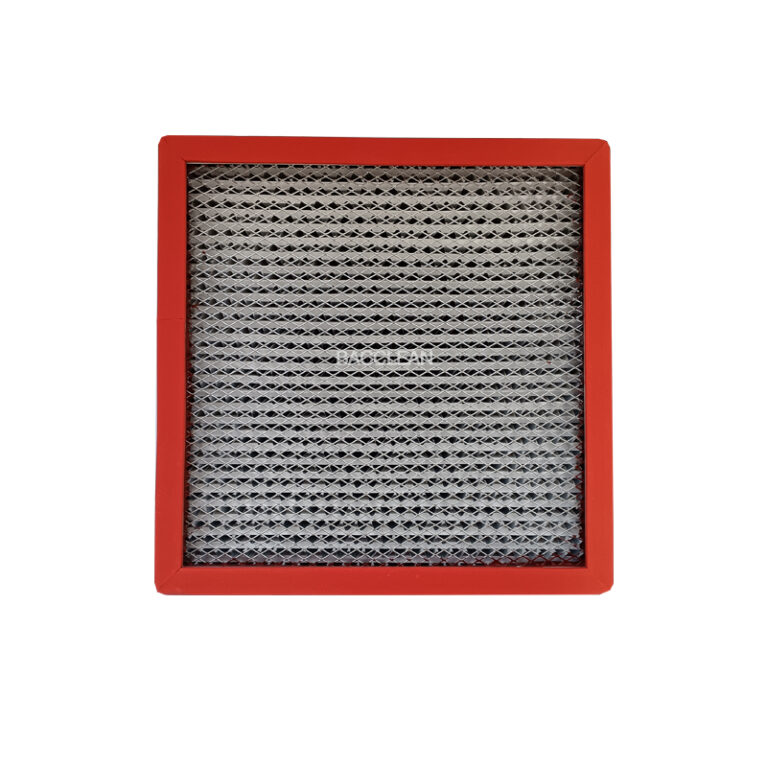
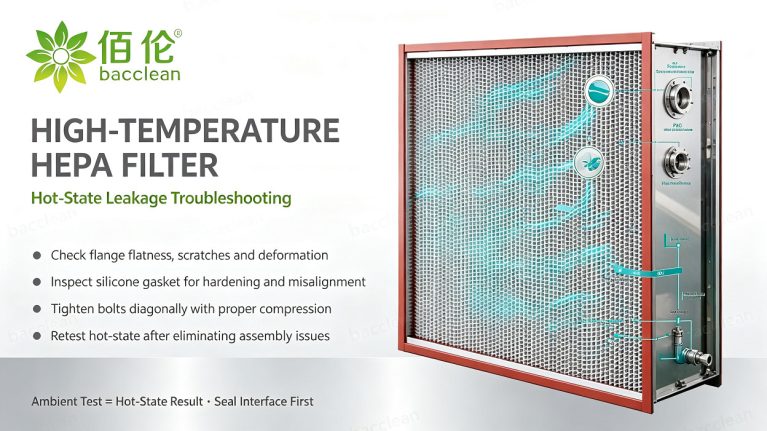
Fault 1: Passes PAO leak test at ambient temperature, yet leakage occurs in hot‑state leak test after reaching operating temperature
This fault is most frequently observed in pharmaceutical tunnel oven projects. Sealing gaps are closed under room‑temperature conditions. When heated, thermal expansion deformation occurs on stainless‑steel filter frames, flanges and silicone gaskets, forming tiny gaps that result in bypass leakage.
Troubleshooting Steps
- Inspect equipment mounting flange: check for deformation, warping, scratches and burrs on flange sealing surfaces. Repair the flange first if flatness fails to meet requirements.
- Inspect gaskets: check for distortion, misaligned joints and hardening‑aging. Replace with brand‑new pharmaceutical‑grade gaskets immediately if defects are found.
- Re‑verify bolt compression status: avoid over‑tightening at single points which causes local warping of the stainless‑steel filter frame. Tighten bolts diagonally and evenly to achieve proper compression. Both excessive and insufficient compression will trigger leakage.
- Retake hot‑state leak test after eliminating assembly issues. If leakage persists, lift out the filter and inspect for micro‑cracks on the perimeter sealing adhesive of the filter unit. Defects in sealing adhesive belong to filter‑body failure; replace the filter directly, on‑site repair is not permitted.
Fault 2: Leakage alarms in both ambient‑temperature and hot‑state leak tests, leakage originates from filter media
Root causes: inherent defects of filter media from production; filter media punctured by hard particles during installation or maintenance; damage caused by impact during transportation and handling.
Solución: Lift out the filter and visually check filter media for holes and scratches. Damaged filter media cannot be repaired; discard and replace the filter. Review transportation and chamber‑opening maintenance procedures to prevent filter‑media damage from metal chips and hard objects. Distinguish genuine leakage from transient false alarms triggered by excessively fast probe scanning speed. Slow down scanning speed and repeat the test for confirmation.
Fault 3: Short‑term sharp rise of filter pressure differential, insufficient equipment air volume
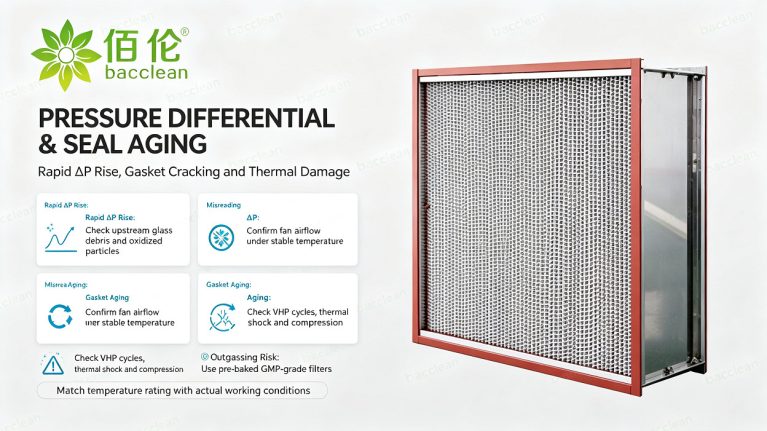
- For pharmaceutical tunnel oven applications: prioritize checking whether large‑volume glass debris enters the upstream chamber. Glass fragments adhering to filter media will cause rapid clogging. Optimize interception performance of the upstream bottle‑washing process to reduce glass residues entering the oven.
- Verify actual operating temperature and fan air volume of equipment to confirm no operation beyond design specifications.
- Check for flaked oxidized particles inside the chamber, which may be carried onto filter media by circulating airflow.
- Improper product selection: actual operating temperature exceeds the rated temperature resistance of the filter, accelerating material degradation and altering filter‑media performance. Confirm whether the temperature‑resistance rating matches on‑site working conditions.
Fault 4: Intermittent hot‑state leakage after a period of operation
Symptom: leak test passes occasionally yet fails on other occasions; leakage varies with temperature changes and start‑stop cycles.
Main causes: Multiple heating‑cooling cycles generate internal micro‑cracks and reduce elasticity of silicone gaskets; gasket deformation shifts along with temperature fluctuation, leading to intermittent leak points. In some cases, micro‑cracks occur on the filter’s own sealing adhesive.
Troubleshooting & Solution: Shut down equipment, cool down and open the chamber. Focus on visual inspection for aging and cracking of gaskets. Replace with brand‑new gaskets first and retake hot‑state leak test. If intermittent leakage remains after gasket replacement, replace the complete filter unit. Gaskets are consumable parts and cannot be reused indefinitely.
Fault 5: Silicone gaskets harden and crack far ahead of expected service life
Root causes
- Gaskets of inadequate material grade: industrial‑grade silicone rubber applied to pharmaceutical environments with frequent VHP fumigation.
- Long‑term equipment over‑temperature operation; actual temperature exceeds the maximum temperature tolerance of gaskets.
- Excessively fast temperature‑ramping & cooling rates, resulting in frequent severe thermal shock.
- Over‑high VHP fumigation concentration and excessive cycles accelerating silicone rubber aging.
Solución: Replace with pharmaceutical‑grade VHP‑resistant silicone gaskets matching working conditions. Control equipment operating temperature, limit temperature change rates, and optimize VHP fumigation procedures.
Fault 6: Volatile outgassing under high‑temperature operation contaminates products
Symptom: unidentified contaminants appear on pharmaceutical packaging materials during dry‑heat tunnel production.
Root causes: Inadequate curing of filter sealing adhesive without high‑temperature pre‑baking at factory; ordinary industrial‑grade sealing components release volatile substances under high‑temperature exposure.
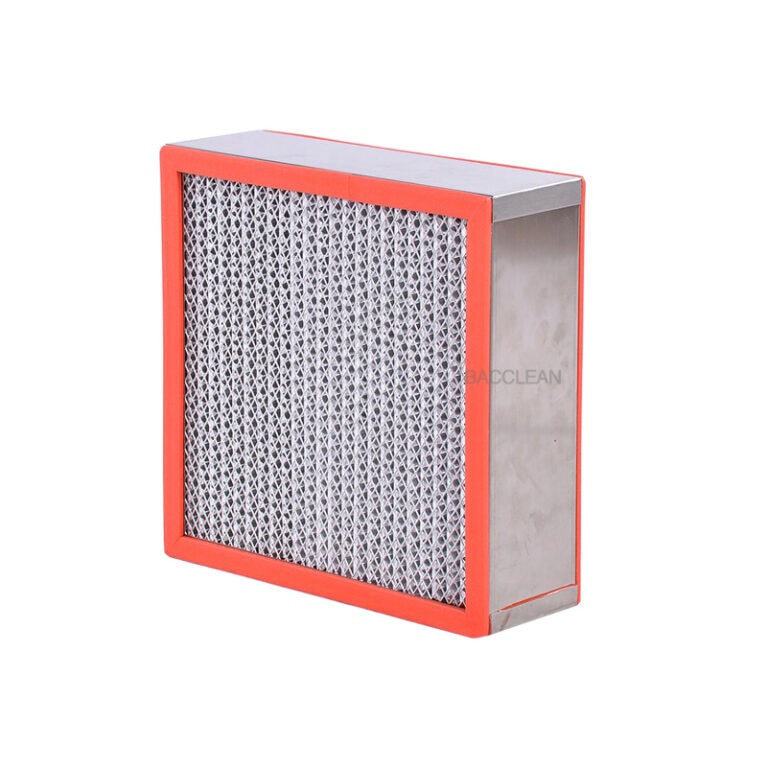
This issue cannot be fixed on‑site. Replace the complete filter with GMP‑compliant high‑temperature resistant HEPA filters which have undergone factory pre‑baking to remove volatile residues.
General Troubleshooting Principles
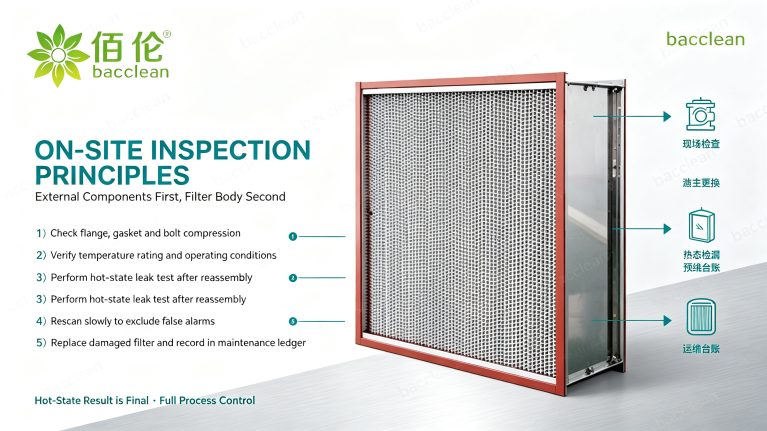
Inspect equipment flanges, gaskets, bolt compression status and process operating conditions first, then examine the filter body. Always differentiate ambient‑temperature performance from hot‑state performance. For high‑temperature processes, take hot‑state leak‑test results as the final judgment criterion, rather than relying solely on room‑temperature leak‑test data.
bacclean provides on‑site technical support for projects. The complete system of high‑temperature resistant HEPA filters consists of filter hardware, flanges, gaskets, equipment temperature‑cycling and disinfection processes. Failures will arise if any link is defective. Full‑process control ensures stable and compliant operation of high‑temperature production processes.
