
1. Difference in Door Structure & Passing Space
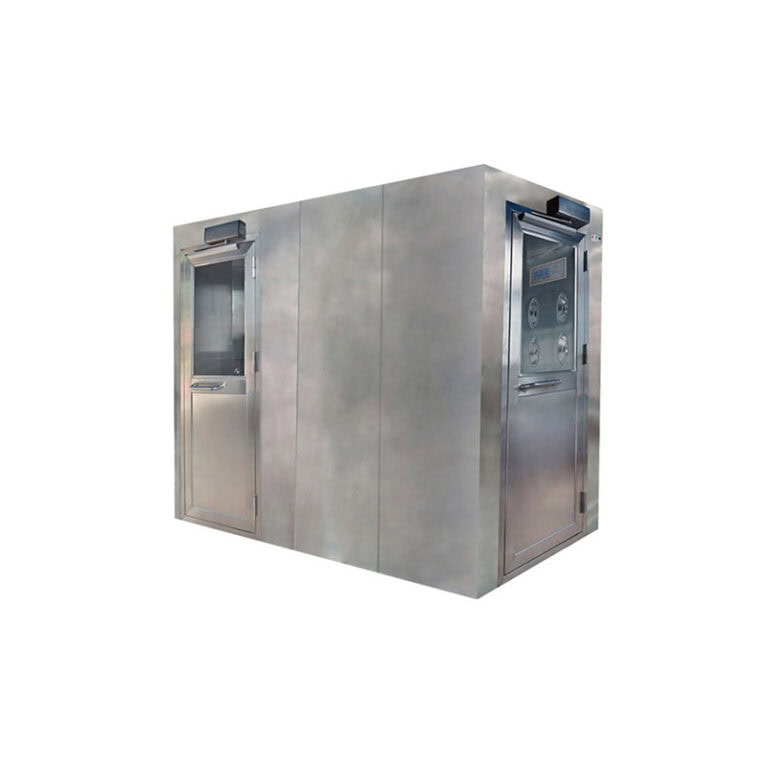
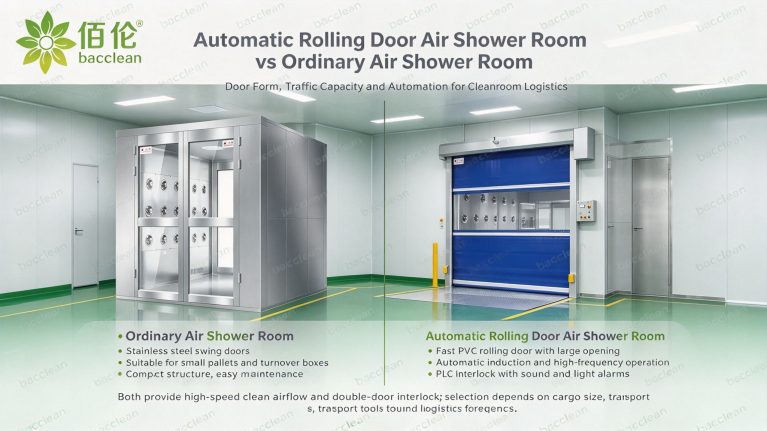
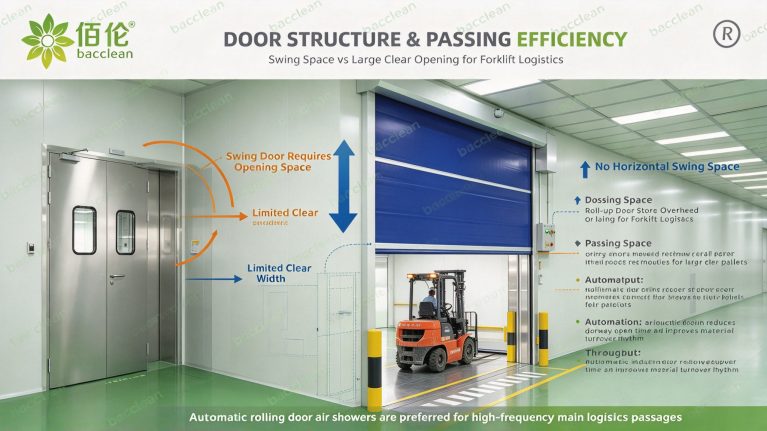
Ordinary Air Shower Room It adopts stainless steel swing doors that open inward or outward. Door swing space is required for opening, limiting the width and height of the door opening. Conventional sizes are suitable for small pallets and turnover boxes, and cannot accommodate forklifts carrying full-pallet large goods. The swing door features strong sealing performance and rigid door panel with good impact resistance, suitable for low-frequency transfer of small and medium-sized materials.
Automatic Rolling Door Air Shower Room It adopts fast PVC automatic rolling door. The door rolls upward for storage and requires no swing space. The width and height of door opening can be customized as required to create a larger passage space. Forklifts and pallet trucks can drive directly in, suitable for continuous passage of full-pallet large materials. The rolling door rises and falls at high speed and opens/closes via automatic induction, shortening the open duration of the doorway. The flexible door can rebound for protection when accidentally hit by forklifts. However, compared with stainless steel swing doors, its sealing performance and durability need to be carefully evaluated under long-term high-frequency impact.
Core Summary: The passage size of ordinary air shower rooms is limited by swing door movement space; rolling door air shower rooms roll upward to achieve large door openings for forklift and large cargo logistics.
2. Difference in Passing Efficiency & Automation Level
Ordinary Air Shower Room Most are manually operated doors, and some are equipped with electric swing doors, requiring manual opening and closing. A single material in-and-out cycle takes longer, suitable for scenarios with low material access frequency and small & medium batch transfer. The control system mainly includes basic double-door interlock and air shower timing with low automation, which highly relies on operators.
Automatic Rolling Door Air Shower Room Equipped with geomagnetic coils or infrared radar sensors. When a forklift drives in, it automatically triggers the rolling door to close. After air shower completion, the door rises automatically. No manual door operation is needed in the whole process. It has high automation and faster material turnover rhythm, suitable for high-volume and high-frequency logistics passages. The PLC control system integrates sound & light prompts and fault alarms. Some high-end models support operation data recording, which is more suitable for continuous production lines.
Core Summary: Ordinary air shower rooms are manually operated for low-volume transfer; rolling door air shower rooms adopt inductive automatic passage to meet high-frequency large cargo logistics.
3. Difference in Application Scenarios, Cost & Maintenance
Ordinary Air Shower Room Application scenarios: Transfer of small and medium turnover boxes and small pallets, secondary material passages of clean workshops; cross-zone dust removal for small materials in pharmaceutical, food and electronic workshops. Cost & Maintenance: Simple structure, mostly stainless steel plates with few accessories, lower procurement cost. Sturdy door panels, small daily maintenance workload and convenient inspection.
Automatic Rolling Door Air Shower Room Application scenarios: Main logistics passages, forklift transfer of full-pallet raw materials and semi-finished products; scenarios with frequent access of large materials in lithium battery and photovoltaic workshops. Cost & Maintenance: Higher overall equipment cost. Rolling door motors and door seals are wearing parts. Under high-frequency operation, regular inspection of door sealing and sensing devices is required. For GMP projects, PAO leak detection ports, differential pressure monitoring and other configurations can be optionally installed.
Core Summary: Ordinary air shower rooms are preferred for small-size, low-frequency material transfer; rolling door air shower rooms are preferred for logistics passages with forklifts and high-frequency full-pallet large cargo transfer.
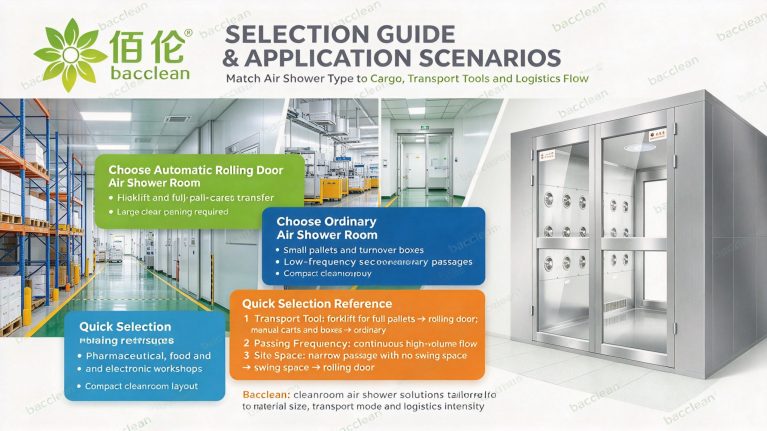
Quick Selection Reference
-
Transport tool: No forklift, only turnover boxes & small pallets → Ordinary Air Shower Room; Forklift required for full-pallet cargo → Automatic Rolling Door Air Shower Room
-
Passing frequency: Low daily material throughput → Ordinary Air Shower Room; Continuous production and frequent logistics access → Automatic Rolling Door Air Shower Room
-
On-site space: Narrow passage with no reserved space for swing door opening → Automatic Rolling Door Air Shower Room
Conclusion
Automatic rolling door air shower rooms and ordinary air shower rooms share basically the same purification principle. Both rely on high-speed clean airflow to strip dust from the surface of goods and adopt double-door interlock to isolate air between two zones. Their core differences lie in door form, traffic capacity and automation level, and neither type is absolutely superior. The selection focuses on material specifications, transport tools and workshop logistics flow, to match configurations properly and avoid excessive configuration or insufficient passage size.
