
DOP/PAO High-Efficiency Leak Detection Core Criteria (National Standard + Industry Practical Version)
The DOP high-efficiency leak detection criteria are fully applicable to mainstream PAO leak detection (medium substitution, with consistent detection rules), and the core basis is the national standard GB/T 13554-2023 “High-Efficiency Air Filters”, ISO 14644-3 “Cleanroom Testing Methods”, and the mandatory requirements of the pharmaceutical/electronic industry GMP. The detection is divided into pre-calibration standards, core detection limits (by method/filter type/detection location), on-site practical detection rules, and for small clean equipment such as DOP laminar transfer windows, special detection requirements for local sealing detection need to be adapted. All detections are based on real-time detection data from portable leak detectors/particle counters, without manual subjective determination.
Core Premise: Leak Detection Pre-Background Value Calibration Determination (If not met, the detection result is invalid)
Before formal leak detection, the downstream background concentration of the filter must be tested to ensure that background interference is excluded. The qualification standard for calibration is as follows:
Photometer method: Downstream background aerosol concentration ≤ 0.001 μg/m³, and ≤ 0.001% of the upstream proposed dust concentration;
Particle counter method: Downstream 0.3 μm particle background concentration ≤ 0.1 particles/L (100-level cleanroom) / ≤ 1 particle/L (1000-level / 100,000-level).
When the background value exceeds the standard, the detection area needs to be cleaned first, and the cleanroom/equipment laminar air supply needs to be turned on until the background value is reached. Then, the formal leak detection can be carried out.
I. Mainstream Method: Photometer Method Determination Criteria (Industry Standard, Applicable to 99% Cleanrooms/Equipment Practical Operations, Including DOP Laminar Transfer Windows)
The photometer method uses the aerosol penetration rate (downstream concentration / upstream concentration × 100%) as the core determination indicator. It is the legal basic method for high-efficiency filters (HEPA/ULPA) leak detection. The upstream aerosol concentration must first be stabilized at 20-80 μg/m³ (if the concentration exceeds this range, the detection data is invalid, and re-dusting is required). The core limit is divided by filter type + detection location, and the sealing area is the high-risk leakage area, with stricter determination requirements than the filter material itself.
1. High-efficiency Filters (HEPA) – Mainstream Use in Cleanrooms/Transfer Windows (H13/H14 grades, suitable for 100-level to 100,000-level cleanrooms)
| Filter grade | National standard basic filtration efficiency (@0.3μm) | GMP / Limitations on the penetration rate of the industry’s practical operation framework | Sealing area (frame / installation surface / joint) penetration rate limit value |
| H13 | ≥99.95% | ≤0.05% (National Standard) / ≤0.01% (GMP Practical Operation) | ≤ 0.005% (as mandated by GMP) |
| H14 | ≥99.995% | ≤ 0.005% (National Standard + GMP Practical Operation) | ≤ 0.005% (as mandated by GMP) |
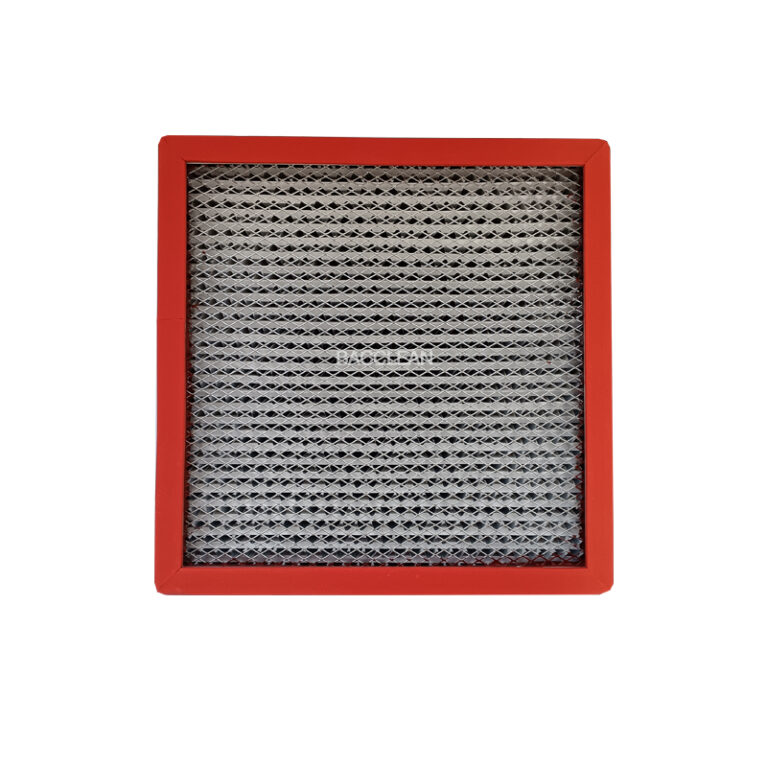
Practical Instruction: GMP for the pharmaceutical / electronics industries is a mandatory compliance requirement. Even though the H13 national standard limit is ≤0.05%, all on-site leak detection is judged as ≤0.01% (leaving a safety margin to avoid leakage attenuation of the filter during later operation); the built-in filters of the DOP laminar transfer cabinet are mostly of H14 grade, and the core is judged as ≤0.005% for the body and ≤0.005% for the seal.
| Filter grade | National standard basic filtration efficiency (@0.3μm) | Limit value of penetration rate of the object | Sealing area penetration rate limit value |
| U15 | ≥99.9995% | ≤0.0005% | ≤0.0005% |
| U16 | ≥99.99995% | ≤0.00005% | ≤0.00005% |
| U17 | ≥99.999995% | ≤0.000005% | ≤0.000005% |
3. On-site scanning determination rules for photometer method (Key practical requirements, applicable to small-sized filters of transfer windows)
The sampling probe must be closely attached to the downstream surface of the filter / seal joint for scanning. The scanning speed should be ≤ 5 cm/s (If the scanning speed is too fast, it is easy to miss detecting small leakage points).
During the scanning process, if the instantaneous penetration rate of any point exceeds the corresponding limit value, it is determined as a missed point (no average value is required; a single point exceeding the limit is considered unqualified).
If there are continuous areas of ≥2cm exceeding the standard on the filter material body of the filter, it is determined as severe leakage (single tiny leakage points can be filled with glue, while continuous leakage points need to directly replace the filter).
II. Supplementary method: Determination standard for particle counter method (Applicable to high cleanliness areas / equipment such as high-end DOP laminar transfer windows)
The particle counter method directly detects the concentration of 0.3 μm particle size, which is more in line with the core requirement of “particle count control” in the cleanroom. It is an upgraded compliance supplement to the photometer method, without “transmittance conversion”, and directly uses the absolute value / multiple of particle numbers as the indicator. The upstream needs to stabilize the dust emission to ≥ 10⁵ particles / L at 0.3 μm particle concentration.
Core determination standard (GMP practical version)
If the 0.3 μm particle concentration at any point downstream suddenly exceeds the background value by 10 times or more, it is determined as a leakage point;
For equipment in a 100-level cleanroom (such as 100-level transfer windows): If the 0.3 μm particle concentration at any point downstream during the scanning process is continuously ≥ 1 particle / L, it is determined as a leakage point;
For equipment in a 10,000-level / 100,000-level cleanroom: If the 0.3 μm particle concentration at any point downstream during the scanning process is continuously ≥ 5 particles / L, it is determined as a leakage point;
The determination requirements for the sealing part are stricter than those of the filter material body: The particle concentration at the seal joint must not exceed the background value by 5 times, and there must be no continuous increase in particle count.
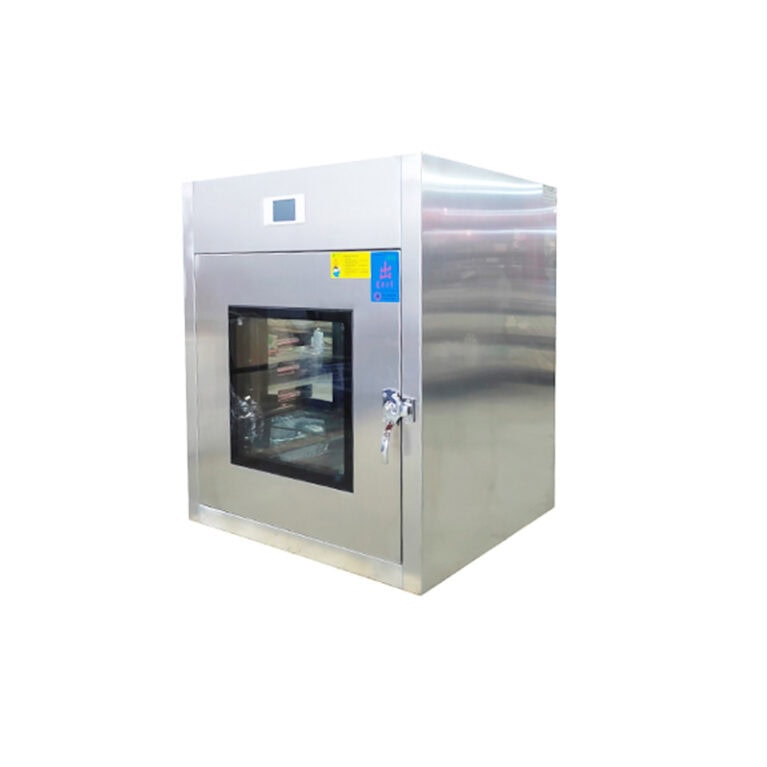
III. Special determination requirements for DOP laminar transfer windows (Complying with the practical operation of small built-in filters)
DOP laminar transfer windows are small sealed clean equipment with a compact installation of filters. Leak detection is local sealing detection. In addition to following the above general standards, it needs to meet 3 special determination requirements:
Coverage of detection areas: Except for the filter material body and the edge frame seal joint, the connection seams between the laminar box and the transfer window box, and the gaps between the air outlet protective net and the frame need to be included in the scanning range. The limit value is the same as “sealing part” (≤ 0.005% transmittance / particle number ≤ 5 times the background value);
Local dust emission concentration requirements: Due to the small internal space of the transfer window, portable dust emitters need to be sealed for dust emission. The upstream local concentration can be relaxed to 10 – 100 μg/m³ (No strict requirement of 20 – 80 μg/m³), but it is necessary to ensure stable and no fluctuation of the concentration;
Leak point re-inspection requirements: Due to the narrow internal space of the transfer window, after patching the leakage point, it is necessary to conduct 3 repeated scans at the patched point. The 3 detection data must be qualified to be determined as qualified, to avoid secondary leakage caused by non-compact patching.
IV. Industry compliance norms for leak point determination and handling
Leak point definition: Any point during the scanning process with instantaneous data exceeding the corresponding limit, or if it exceeds the limit for 3 consecutive scans at the same position, it is determined as an effective leak point (A single accidental surge can be excluded due to equipment interference, and re-scanning is required);
Mild leak point handling: Single-point minor leakage points in the filter material body (diameter ≤ 1 mm), and local leakage points at the seal joint. Cleanroom-specific silicone sealant / polyurethane sealant can be used for patching. After patching, let it stand for 24 hours to solidify, and re-inspect until it meets the standard;
Severe leakage determination: If the following situations occur, patching is prohibited and the filter needs to be replaced directly:
There are continuous areas of ≥2cm exceeding the standard on the filter material body, or multiple scattered leakage points (≥3).
The filter surface of the filter is damaged, wrinkled, deformed, or the sealing rubber strip has aged and fallen off.
After two re-inspections following the glue replenishment, the standard was still exceeded, or the leakage point occurred in the core filter material area of the filter.
Qualified record requirements: After leak detection is qualified, the “High Efficiency Filter DOP/PAO Leak Detection Record” must be filled out immediately. The record should include the equipment number, filter model/grade, detection method, upstream concentration, key point data, and leakage point handling situation. The record needs to be kept for at least 3 years (in accordance with GMP archive management requirements).
V. Core Determination Criteria for Industry Mandatory Compliance
Different industries have mandatory detailed requirements for DOP/PAO leak detection. They should be implemented according to the industry they belong to:
Pharmaceutical industry (GMP): Regardless of the cleanliness level, all HEPA filters are judged according to the H14 standard (body ≤ 0.005% penetration rate), and the sealing area requires zero leakage (penetration rate ≤ 0.005%, particle count does not surge);
Electronic semiconductor industry (ISO 14644): Judged according to the filter nominal grade. H13 grade can be implemented according to ≤ 0.05% penetration rate, but the hundred-level clean area still needs to be implemented according to ≤ 0.01% (actual operation);
Food industry (SC certification): Consistent with the GMP requirements of the pharmaceutical industry, the core is zero leakage at the sealing area, and the filter material body ≤ 0.01% penetration rate.
VI. Summary Table of Determination Criteria (DOP laminar transfer cabinet practical version, directly apply)
| Testing method | Filter grade (mainstream of transfer window) | Filter material body determination limit value | Sealing area (including connection seams / protective nets) limit values for determination | Core prerequisite requirements |
| Photometer method | H14 grade (mainstream) | Transmittance ≤ 0.005% | Transmittance ≤ 0.005% | Upstream concentration: 10 – 100 μg/m³, background value ≤ 0.001 μg/m³ |
| Particle counter method | H14 grade (100-level transfer window) | 0.3 micrometer particles ≤ 1 particle / L | 0.3 μm particles ≤ 5 times the background value | The upstream particles are ≥ 10⁵ particles per liter, and the background value is ≤ 0.1 particles per liter. |
Key Summary
The core of efficient leak detection using DOP/PAO lies in the principles of “differentiation of locations, adaptation of methods, and compliance with industry standards”. The laminar transfer window of DOP is the key practical aspect, and it only requires focusing on H14 grade filters + photometer method. Strictly adhering to the requirements of ≤0.005% permeability for the body and ≤0.005% permeability for the sealing parts, and ensuring complete coverage of the detection area, can meet the dual requirements of national standards and industry GMP.
