
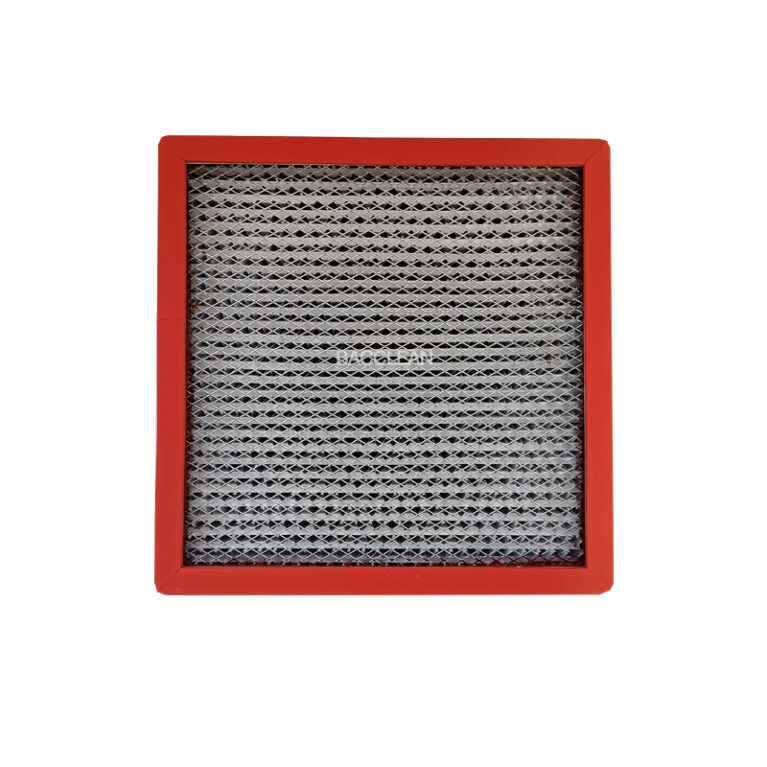
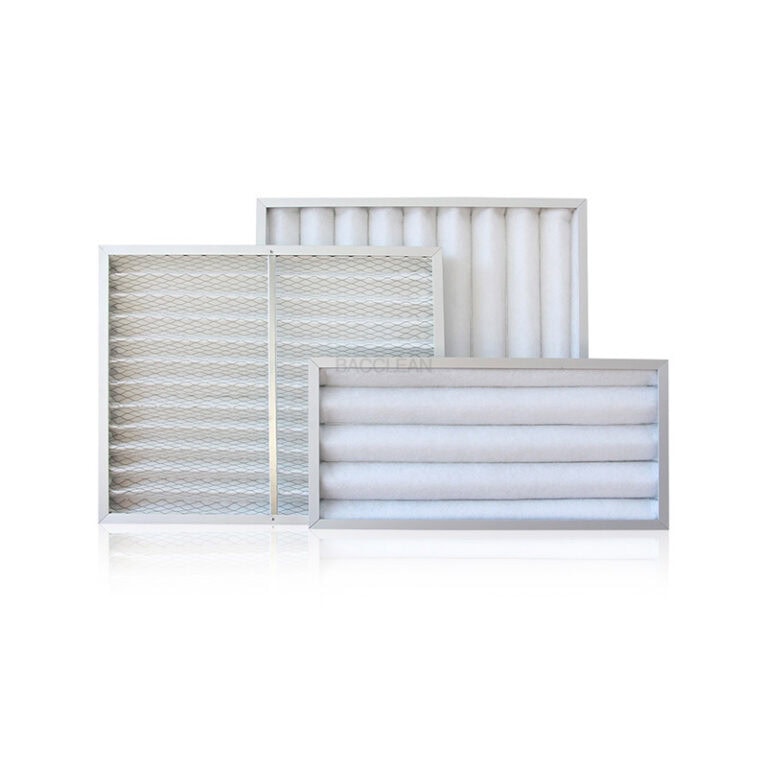
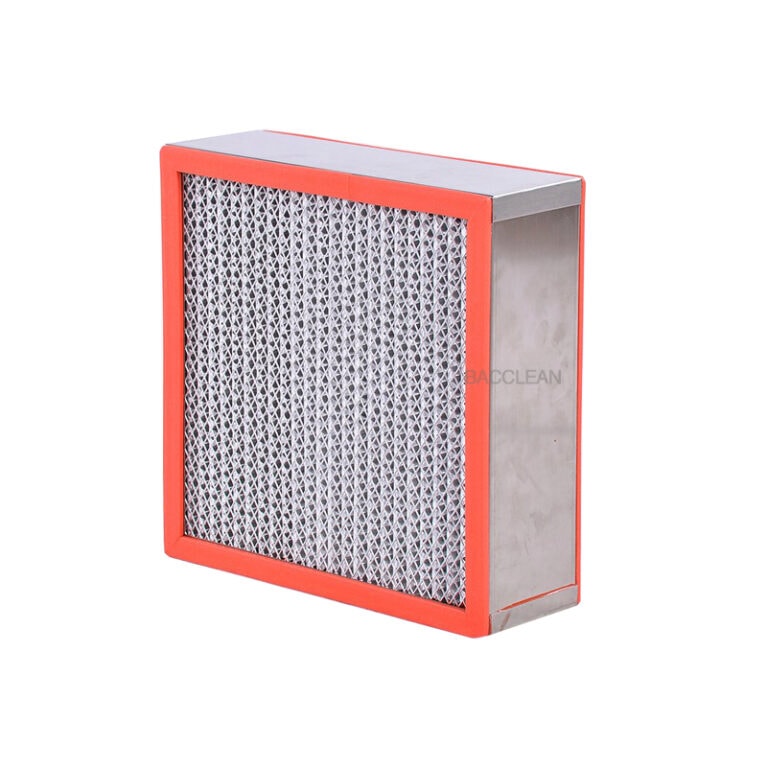
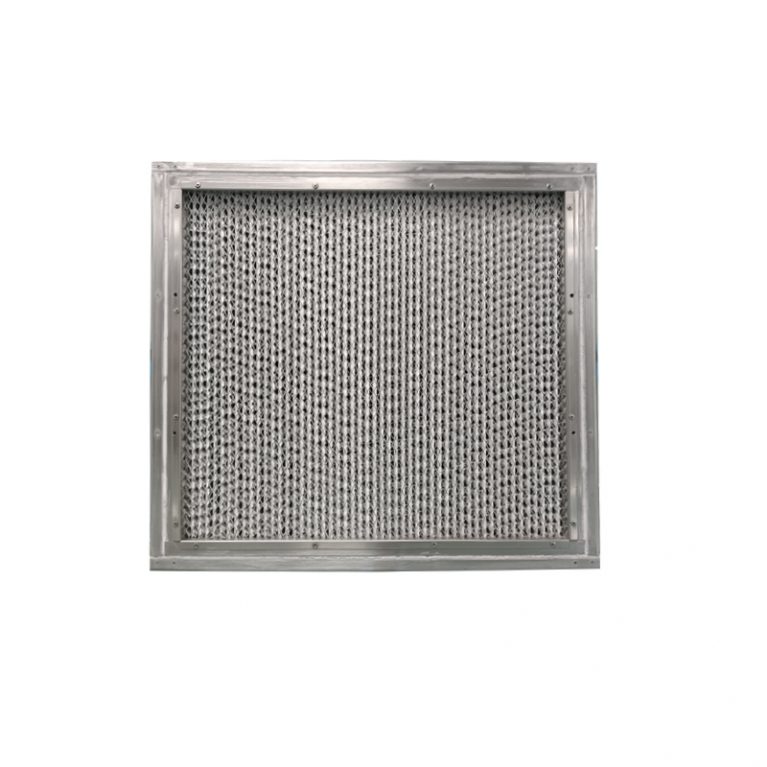
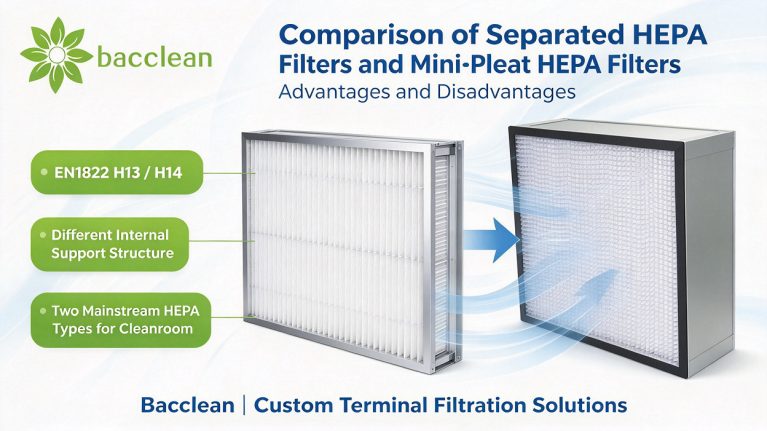
Separated HEPA filters rely on separators to prop up filter media with wide and unobstructed flow channels, showing obvious advantages under high‑airflow conditions. Under the same outer dimension and filtration class, they can bear higher rated airflow. The unfolded area of filter media can be made larger with strong dust holding capacity, suitable for end filtration or exhaust filtration scenarios with continuous high dust generation and high dust load. The separator structure features high rigidity and good resistance to airflow impact, with superior temperature and humidity resistance. Conventional aluminum foil separator models can operate stably in environments with high humidity and fluctuating temperatures for a long time. Specially modified high‑temperature resistant versions can also be used in high‑temperature exhaust systems. In terms of resistance characteristics, resistance rises gently during dust accumulation instead of spiking rapidly in a short period. The service life of the filter is longer, and the differential pressure alarm cycle is extended, which is suitable for core systems that are inconvenient to shut down frequently for filter replacement. A wide range of frame options are available, including aluminum alloy, galvanized steel and stainless steel frames. They are compatible with multiple installation forms such as compression sealing and liquid tank sealing. The structure is not easy to deform under negative pressure exhaust conditions, and the sealing reliability remains stable.
Its disadvantages also stem from the separator structure. Aluminum foil separators occupy internal space of the housing. Under the same outer frame size, the effective pleat count of filter media is less than that of mini‑pleat products. The overall filter is generally thicker, with common thicknesses of 150mm and 220mm, imposing higher requirements on the installation space of ceiling plenum boxes and equipment interiors. The bonding position between separators and filter media is a potential leakage point. If the production process control is inadequate, leakage is more likely to occur at the frame and separator bonding positions during PAO leak testing. The overall weight is heavier, so the hoisting structure for ceiling installation needs higher load‑bearing capacity. In addition, internal separators bring extra airflow friction loss, resulting in slightly higher initial resistance than mini‑pleat filters of the same class under the same airflow. Besides, paper separator versions are low‑cost but not resistant to moisture. They cannot be used in humid, cleaned or negative pressure exhaust conditions, so the separator material must be strictly distinguished during selection.
Mini‑pleat HEPA filters use continuous hot‑melt adhesive ribs instead of independent separators. The ribs are slender and occupy very little space. With the same outer dimension, more pleats of filter media can be arranged with higher filter media density and a more compact structure. Common thicknesses are 50mm, 70mm and 90mm, making them ideal for equipment with limited internal space such as FFUs, small laminar flow hoods and compact air supply outlets. The filter media is integrally formed with fewer bonding gaps. If the rib process is stable, the risk of filter surface leakage is lower and the one‑pass rate of factory PAO testing is higher. Under normal rated airflow, the airflow channel is smooth with lower initial resistance, less fan energy consumption and better noise control. It is suitable for clean air supply ends with stable airflow and low dust generation, such as electronic workshops and conventional air supply points in pharmaceutical clean areas. The product is lightweight for easy hoisting and construction, reducing the load on the ceiling and improving the efficiency of mass installation. It also has a concise appearance.
The drawbacks of mini‑pleat HEPA filters focus on dust holding capacity and environmental adaptability. The flow channels supported by adhesive ribs are narrow. After dust accumulation, the resistance rises rapidly, and the dust holding capacity is far lower than that of separated HEPA filters of the same size. In scenarios with high dust load such as exhaust, weighing booth exhaust and upstream process exhaust, the replacement cycle will be significantly shortened, increasing long‑term maintenance costs. Hot‑melt adhesive ribs have limited temperature and humidity resistance. In high‑temperature and high‑humidity environments, the adhesive layer tends to soften and detach, causing filter media collapse and flow channel blockage. Therefore, they are not suitable for high‑temperature exhaust or long‑term high‑humidity conditions. Facing negative pressure exhaust systems with large airflow fluctuation and frequent start‑stop impact, the supporting structure of adhesive ribs has weak rigidity, and filter media is more prone to deformation under repeated differential pressure changes. Meanwhile, most mini‑pleat products adopt thin aluminum alloy frames, and large‑size and high‑airflow models carry higher risk of frame deformation than separated HEPA filters, limiting their selection for large‑size working conditions.
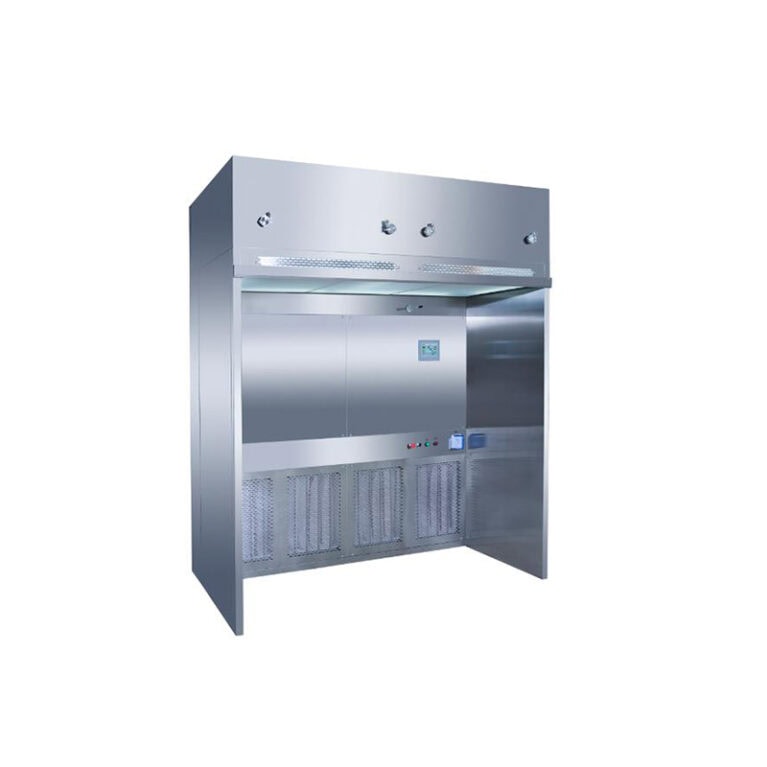
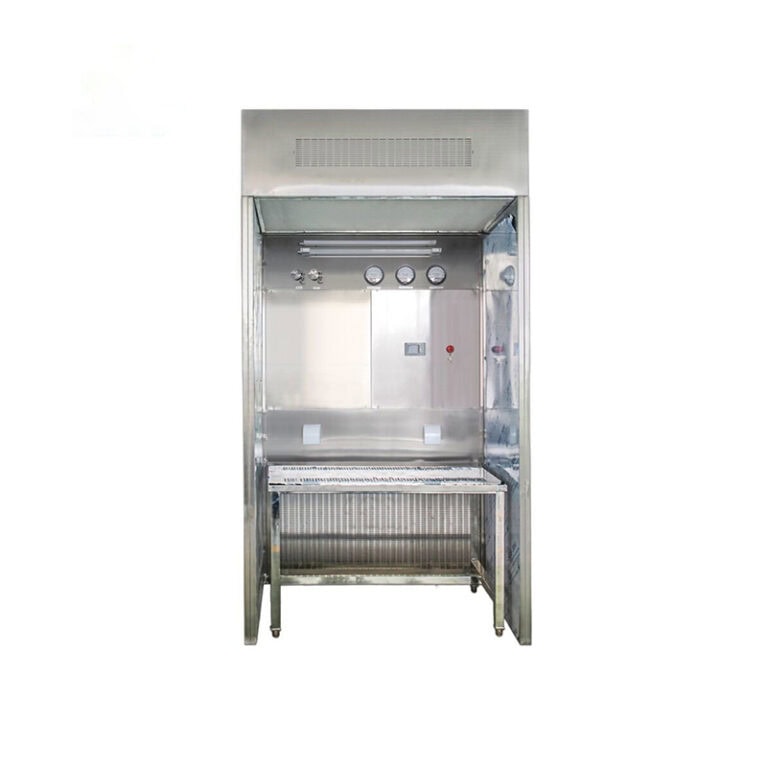
The applicable scenarios can be clearly divided. Separated HEPA filters are suitable for high‑airflow air supply, high dust load exhaust, negative pressure weighing booth exhaust, high‑humidity or high‑temperature conditions, locations where longer filter replacement cycles are expected and sufficient installation thickness is available. Mini‑pleat HEPA filters are preferred for conventional cleanroom terminal air supply, FFUs, small laminar flow hoods and compact air supply outlets with controllable dust sources, low dust generation and stable temperature and humidity under positive pressure air supply.
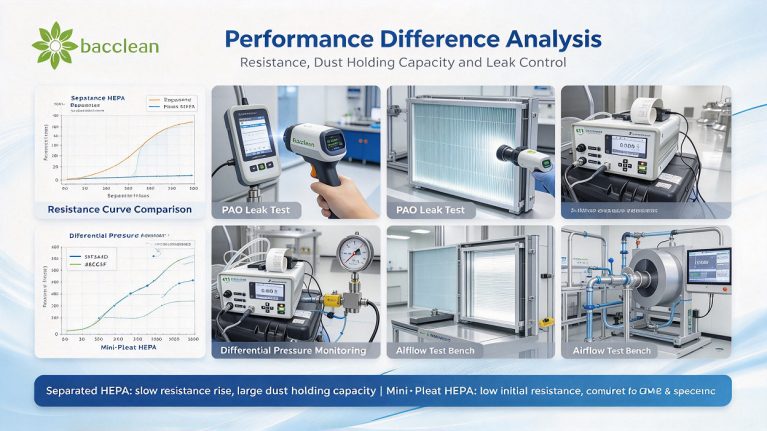
In terms of filtration efficiency, qualified products of the same class (H13 or H14) have no difference in particle filtration performance for 0.3μm particles. What differentiates them is the resistance curve, dust holding life and environmental tolerance. For ordinary clean air supply in the electronics industry and FFUs for optical assembly stations with compact space and low dust generation, mini‑pleat filters stand out for low resistance and compact size. For exhaust in GMP pharmaceutical negative pressure weighing booths, high‑activity material exhaust, high‑airflow laminar flow hoods and air supply in humid areas, aluminum foil separated HEPA filters are prioritized. Their high dust holding capacity and stable structure help reduce replacement frequency and contamination risks. For AMC control projects, both types can be customized with silicone‑free sealing solutions. The formula of gaskets and adhesive materials needs separate confirmation to avoid silicon precipitation that contaminates products.
Supporting verification requirements should also be considered during selection. For either type used in GMP and high‑end semiconductor clean areas, PAO leak testing for each unit is required with test reports retained. Do not simply judge quality by the level of initial resistance: mini‑pleat filters with low initial resistance save energy when clean, but resistance rises sharply after dust accumulation; separated HEPA filters have higher initial resistance but milder airflow attenuation throughout their service life with stronger overall stability. A set of clean system can also use a combination of the two types: mini‑pleat filters are adopted for conventional air supply ends to control resistance and space cost, while separated HEPA filters are used for exhaust and high‑dust stations to balance energy consumption, installation space and service life.
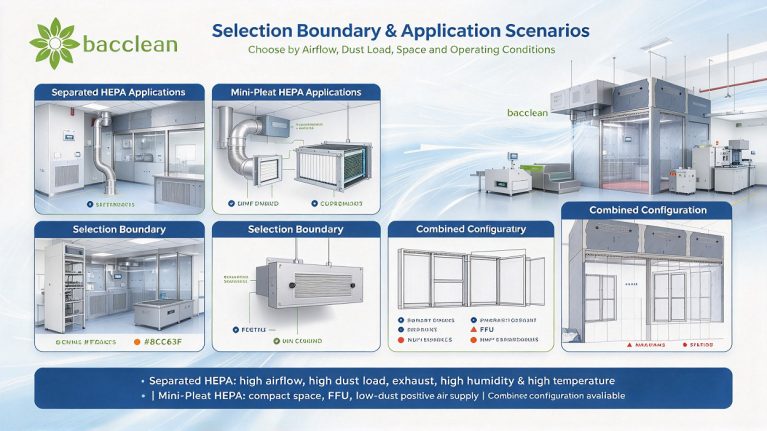
In summary, the core advantages of separated HEPA filters are large dust holding capacity, good structural rigidity and stable performance under fluctuating working conditions. Its disadvantages are large thickness and heavy weight. Mini‑pleat HEPA filters feature compact and thin structure and low initial resistance, suitable for narrow installation space, while its limitations are limited dust holding capacity and high sensitivity to temperature, humidity and airflow impact. Only by combining on‑site airflow, dust load, temperature and humidity, installation space and whether it is air supply or exhaust can the optimal solution with the best overall cost performance be selected. Bacclean provides both H13 and H14 separated HEPA filters and mini‑pleat HEPA filters, supporting customizations such as liquid tank sealing, silicone‑free sealing and stainless steel frames, along with PAO leak testing and airflow resistance testing services to meet the filtration demands of different clean processes.
