
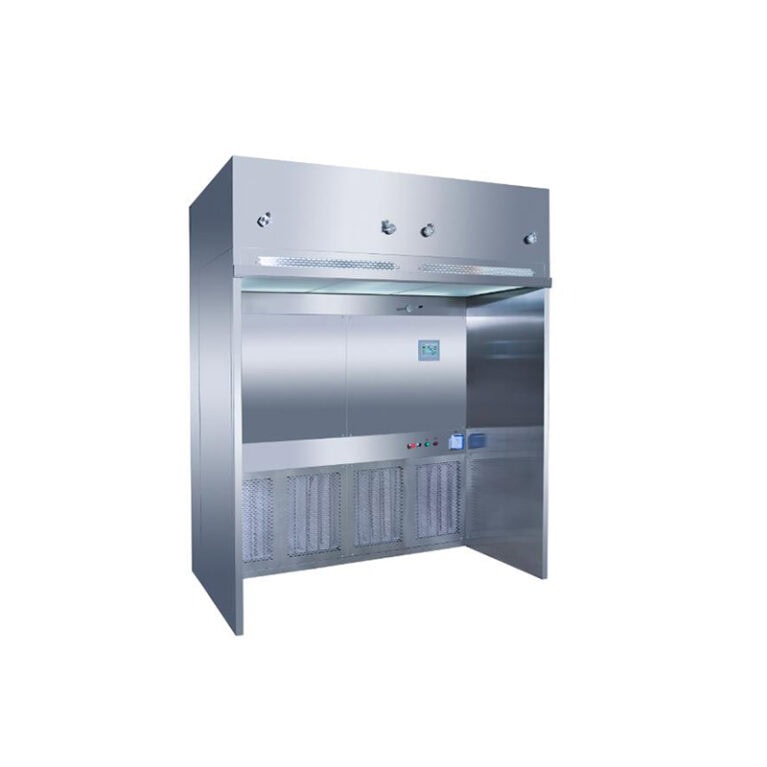
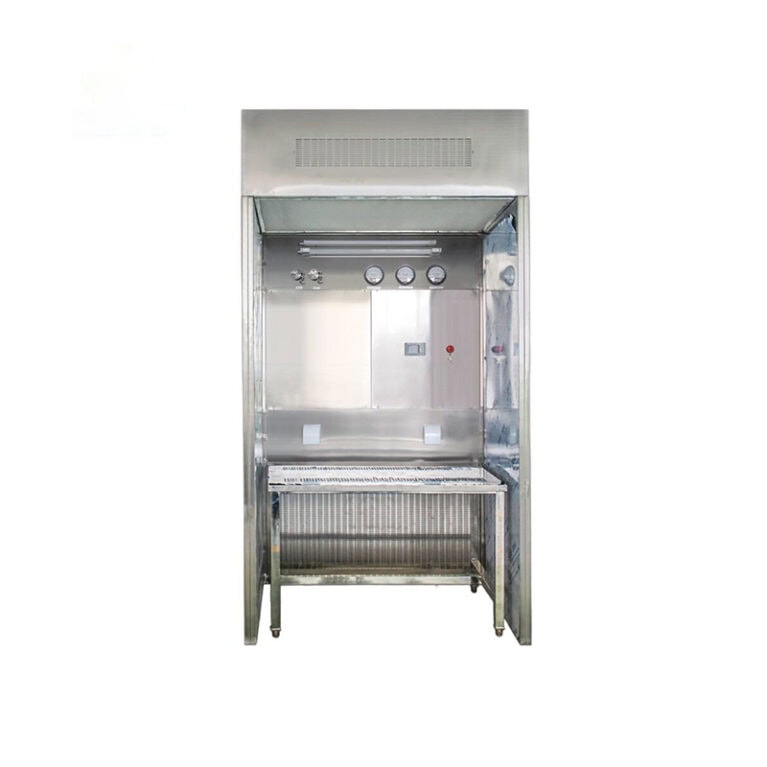
Material acceptance criteria for ultra-clean workbench (covering the countertop, cabinet, glass, and accessories)
The inspection process is divided into three parts: visual inspection and hand feel self-check, test for reagent corrosion, and verification of certificate materials. This is applicable for both laboratory and GMP inspections and can be directly used for product inspection.
1. Core material standards for partitions
1.1 Operating countertop (most critical, directly in contact with acids, alkalis, alcohol, and 84 disinfectant)
Acceptable mainstream: SUS304 stainless steel; for strong corrosive environments (acid washing, organic reagents, pharmaceutical factories), upgrade to SUS316 stainless steel
Prohibited: Painted iron sheet, 201 stainless iron, thin iron sheet with stainless steel skin
Quick judgment method
Thickness check
Standard for regular single-person workbench countertop ≥ 0.8mm, GMP for pharmaceutical factories recommends ≥ 1.0mm;
Pressing the corners with a coin, obvious softness and depression indicates a thin plate of inferior quality;
Poorly bonded surface of the laminate will peel and delaminate at the bending point.
Magnetic test (distinguishing 304/201/iron sheet)
Pure 304 stainless steel shows a normal weak magnetic attraction (due to processing and bending, martensite is produced), but it will not firmly hold the magnet and not fall off;
201 stainless iron, iron sheet: The magnet strongly attracts and cannot be removed;
Note: Do not rely solely on the magnet test; combined with corrosion test for accuracy.
Appearance weld process
Acceptable: Full welding, smooth polishing without burrs, flat seams, no weld holes (holes can harbor bacteria, not allowed in GMP);
Poor: Spot welding, large gaps, sharp burrs, dirt can be wiped off.
Identification of labels
The back of the regular sheet will have laser-engraved: SUS304 / SUS316; without engraving, it is likely to be a low-quality thin sheet.
Corrosion identification test on site (5-minute simple test)
Reagents: Diluted 84 disinfectant (effective chlorine 5%), 75% ethanol, dilute hydrochloric acid;
Operation: Wipe the countertop and let it stand for 30 minutes, then wipe clean with water;
304 is acceptable: No rust spots, no whitening corrosion, no color fading;
201 / iron sheet: Yellow spots, rust spots, blackening; Painted countertop will directly peel and flake off.
2. Cabinet shell (frame)
Two compliant solutions:
Regular laboratory: Cold-rolled steel plate + epoxy electrostatic spraying
Acceptance points: Uniform paint surface, no run-off, few scratches on磕碰露出铁皮; Hard objects can be lightly scraped without revealing iron sheet; Seams sealed adhesive is flat and prevents mold.
High humidity / corrosive laboratory (microbiology, chemistry, fumigation disinfection): Whole machine 304 stainless steel shell
Prohibited: Ordinary paint thin iron sheet, prone to rust and flake off under long-term ultraviolet and alcohol fumigation.
Poor cabinet characteristics
Thin iron sheet, pressing both sides of the cabinet body shows obvious deformation;
Rough paint, edge corners with iron leakage, rusting within 1-2 months.
3. Observation window glass
Strict standard: 5mm tempered float glass
Judgment method:
The corners of the glass must have 3C tempered marking; without 3C is ordinary glass, prone to cracking upon impact;
Knocking sound is clear; ordinary thin glass sounds dull;
Smooth up and down and push-pull, edges polished into rounded corners, no sharp edges to cut.
4. Internal return air duct, guide plate, support
Uniform requirement: 304 stainless steel integrated bending parts
Safety: Plastic guide plate, long-term ultraviolet exposure aging and cracking, releasing volatile substances to contaminate samples.
5. Sealant strips, disinfection accessories
Sealant: Food-grade anti-mold silicone rubber, white / semi-transparent, resistant to alcohol, ultraviolet without hardening;
Poor: Ordinary black rubber, 1-3 months harden and crack, damaging laminar flow;
Ultraviolet lamp bracket, water tray: 304 stainless steel, plastic water tray prone to aging and leakage.
2. Professional tools for precise differentiation between 304 and 316 stainless steel (high-precision acceptance)
1. Stainless steel detection liquid (commonly available on the market, low cost)
Drop the detection liquid on the countertop and let it stand for 10 seconds:
304: Light gray / pale brown;
316: Basically unchanged color; 201 Stainless Steel: Turns Red Instantly;
After the test, wipe it clean with water immediately to avoid corrosion of the countertop.
2. Portable Metal Spectrometer (Third-party acceptance standard for pharmaceutical factories)
Directly read the content of metal elements:
SUS304: Cr ≥ 18%, Ni ≥ 8%;
SUS316: Cr ≥ 16%, Ni ≥ 10%, Mo ≥ 2%;
Without molybdenum element, it is directly determined that it is not 316.
III. Data File Verification (Essential for bidding and GMP audits)
Just looking at the physical object is not enough; material certificates must be requested for archiving:
Original factory warranty certificate for stainless steel plates: indicates the grade 304/316, plate thickness, furnace number;
Spray coating test report: adhesion, alcohol resistance, disinfection corrosion resistance test;
3C certification certificate for tempered glass;
Material list of the entire machine, distinguishes the materials of the countertop, shell, and diversion plate, and refuses the oral promises of the merchants.
IV. Comparison Table of Material Compliance Thresholds in Different Scenarios
| Usage scenario | Minimum requirements for countertop | Recommended material for cabinet body | Prohibited materials |
| College ordinary cells, tissue culture | SUS304 ≥ 0.8mm | Cold rolling spraying | 201, paint tin mesa |
| Food / Pharmaceutical Sterility Testing GMP | SUS304 ≥ 1.0mm fully welded | Spraying / 100% 304 stainless steel | Spot welding table surface, plastic guide component |
| Chemical organic reagents, acid washing experiments | SUS316 stainless steel | The entire machine is made of 304 stainless steel. | Ordinary spray cabinet body |
| Fumigation disinfection, high-humidity microbiological laboratory | SUS316 | All stainless steel complete machine | Thin powder-coated body, prone to rusting |
V. Common Material Forgery Identification Tips to Avoid Pitfalls
Stainless Steel Laminate Forgery
The side and drainage hole cutting positions will have a layered structure. When tested with detection liquid, it turns red, indicating that the interior is iron sheet;
Thin 304 Impersonating Thickened Sheet
Weighing comparison: For the same size countertop, the thin sheet weighs significantly less and is soft when pressed;
Spray Cabinet Body Deceiving as Stainless Steel
The magnet has no strong adsorption, the paint surface is covered by a coating, and the edges and corners being bumped expose the gray iron sheet;
Recycling of Inferior Stainless Steel Sheets
The countertop is covered with tiny sand holes and dark rust spots. After disinfection, yellow spots quickly appear.
VI. Simple On-site Inspection Process (Quick Self-Check Steps)
Check the Label: The countertop material is engraved, and the glass has a 3C mark;
Feel the Weld Seam: No burrs, no gaps;
Coarse Screening with Magnet: Strong adsorption is likely for 201 / iron sheet;
Quickly Determine the Stainless Steel Grade with Detection Liquid;
Corrosion Test with 84 Disinfectant Liquid for Half an Hour to Observe Rust Spots;
Request the Sheet Material Report for Archiving and Retention.
