
Roll-up style cargo washing rooms are more suitable for large-sized goods, in scenarios with limited space and frequent passage; while automatic sliding door cargo washing rooms have better performance in terms of high cleanliness, sealing, and stability. Here is a detailed comparison:
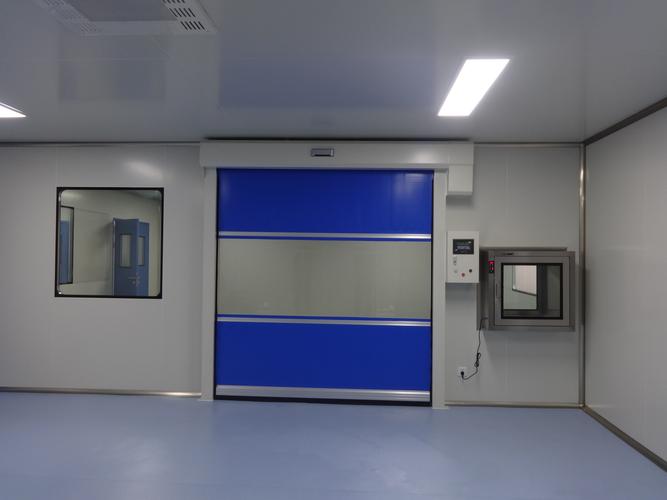
1. Roll-up style cargo washing room (quick roll-up door)
Advantages
High space utilization: Vertical lifting, no lateral space occupation, suitable for narrow passageways and goods that are too wide.
High passage efficiency: Switching speed is fast (0.8–1.2m/s), 1–2 seconds to complete the lifting, suitable for frequent entry and exit of forklifts / AGVs / large equipment.
Good impact resistance: PVC / wear-resistant curtain fabric material, less likely to be damaged by goods, suitable for heavy-load logistics.
Low maintenance cost: Simple structure (roller + curtain fabric), few wear parts, easy maintenance.
Suitable for large sizes: Can be made as ultra-wide / ultra-high door openings, no risk of cargo blocking.
Disadvantages
Poor sealing: There are gaps between curtain pieces and at the bottom, the wind leakage rate is higher than that of sliding doors, high cleanliness scenarios require enhanced sealing.
High noise: Loud when rapidly lifting.
Poor insulation / sound insulation: The curtain fabric is thin, the heat insulation and sound insulation effect is not as good as that of sliding doors.
Shorter lifespan: Frequent lifting can cause fatigue and aging of the curtain fabric and roller.
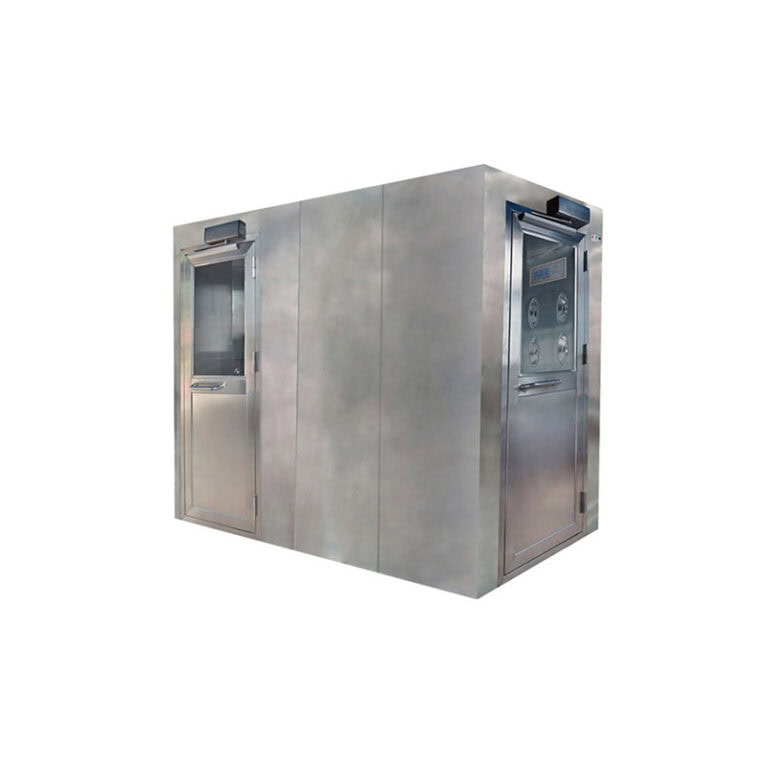
2. Automatic sliding door cargo washing room (automatic door)

Advantages
Excellent sealing: Door frame + rubber strips / brush sealing, less air leakage, more stable cleanliness.
Smooth and quiet operation: Motor + track drive, low noise, low vibration.
Durable: Stainless steel / cold-rolled steel door body, less prone to deformation, long-term use with slow decline in sealing performance.
More reliable interlock: PLC control, double door interlock stable, preventing unclean air from entering.
Aesthetically pleasing and easy to clean: Flat door body + glass window, in line with GMP / food-grade cleanliness requirements.
Disadvantages
Requires side space: The door body moves horizontally to both sides, requires sufficient width, not applicable when the passage is narrow.
Lower passage efficiency: Switching speed is slower than roll-up doors, prone to congestion for large flow / large-sized goods.
Poor impact resistance: Metal / glass door body is prone to collision, easily damaged, high maintenance cost.
Complex structure: Track, motor, sensors, etc., higher maintenance difficulty and cost.
3. Core comparison table
| Dimension de comparaison | Roll-up style cargo storage room | Automatic sliding door cargo washing room |
| Door opening method | Vertical ascent/descent | Horizontal translation |
| Space requirements | Only requires top space, no lateral occupation | Need to reserve space for opening doors on both sides |
| Throughput rate | Fast (0.8 – 1.2 m/s) | Slower |
| Sealing property | Generally (with a high air leakage rate) | Excellent (with low air leakage rate) |
| Impact resistance | Strong (resistant to impact) (of curtain fabric) | Weak (door structure is prone to damage) |
| Coût de la maintenance | Low (Simple structure) | High (with many components and complex maintenance) |
| Applicable goods | Large / Extra-wide / Forklift / AGV | Small turnover carts, standard pallets |
| Niveau de propreté | Mainly in the range of ten thousand / one hundred thousand. | General for hundreds, thousands, and ten thousands levels |
| Bruit | Large | Little |
IV. Selection Suggestions
For roller shutter doors: Suitable for large / extremely wide goods, narrow passageways, frequent opening and closing, priority given to logistics efficiency, and cleanliness levels of 10,000 or below.
For automatic sliding doors: Suitable for high cleanliness levels (100-level / 1,000-level), strict sealing requirements, quiet environment, standard goods size, and sufficient budget.
