
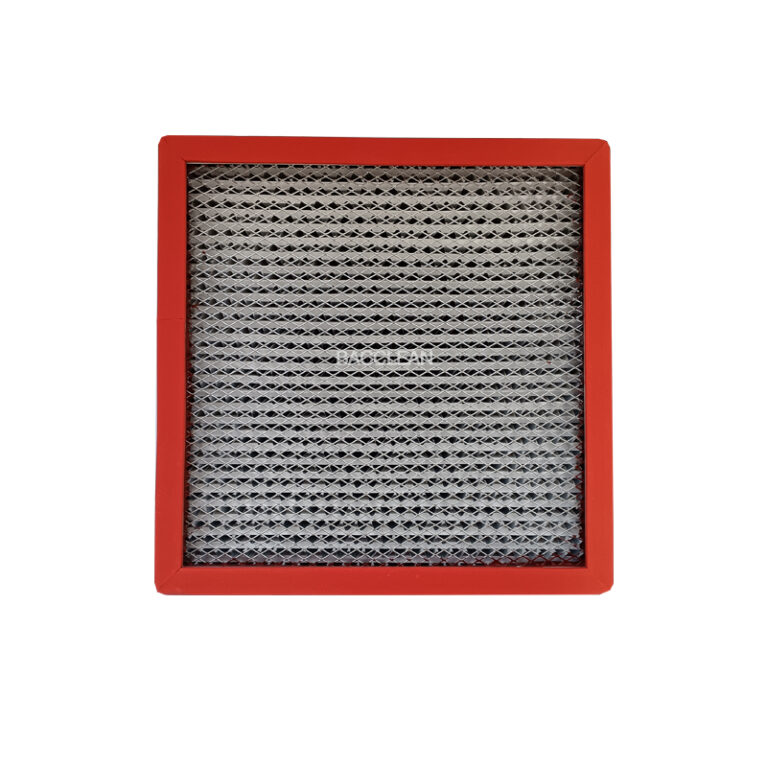
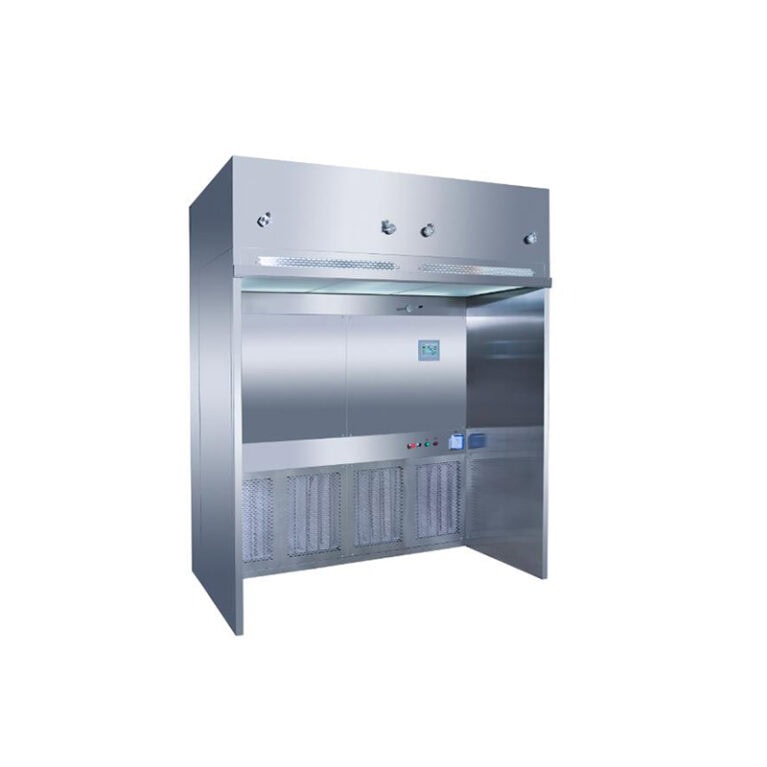
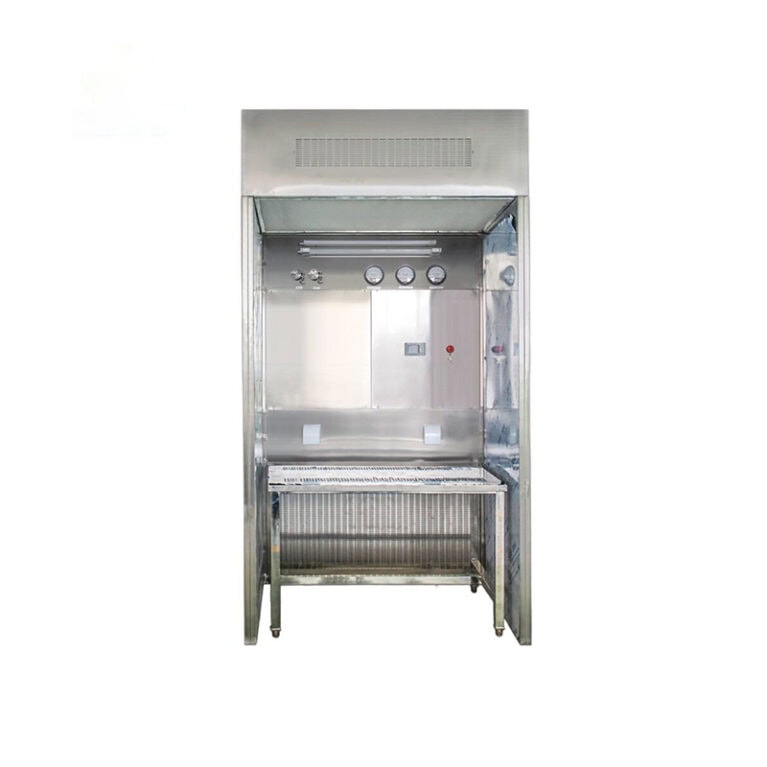
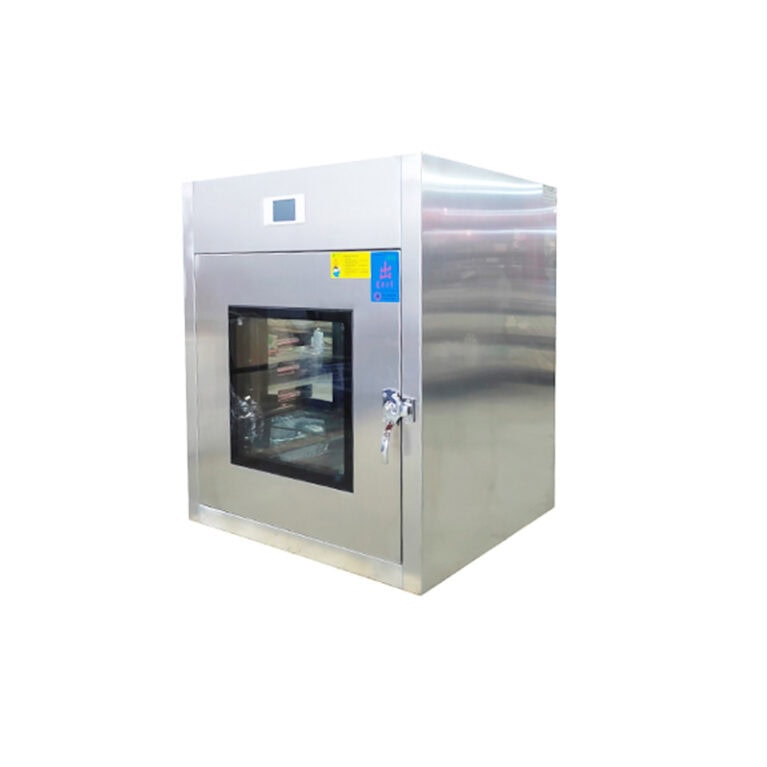
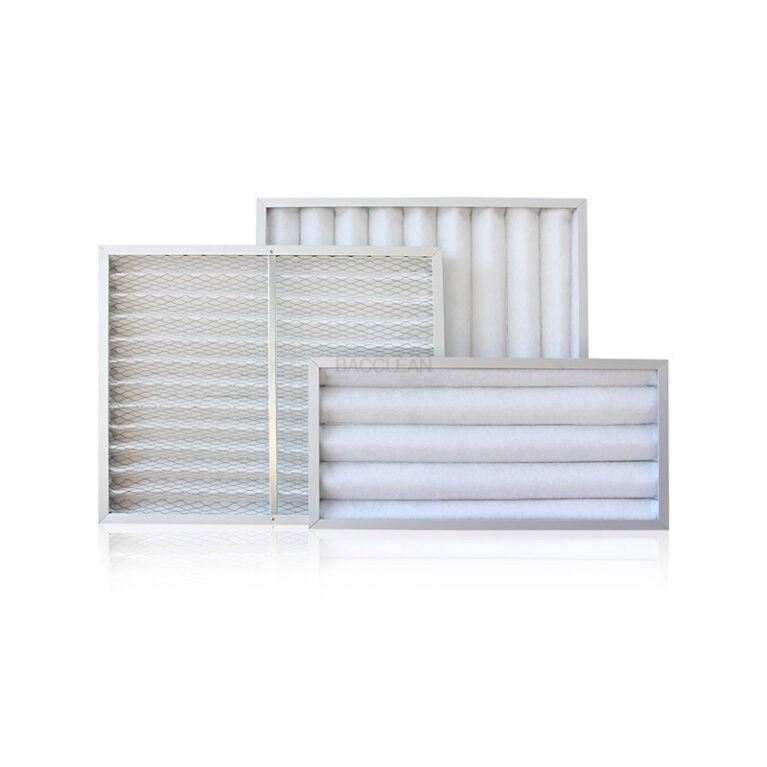
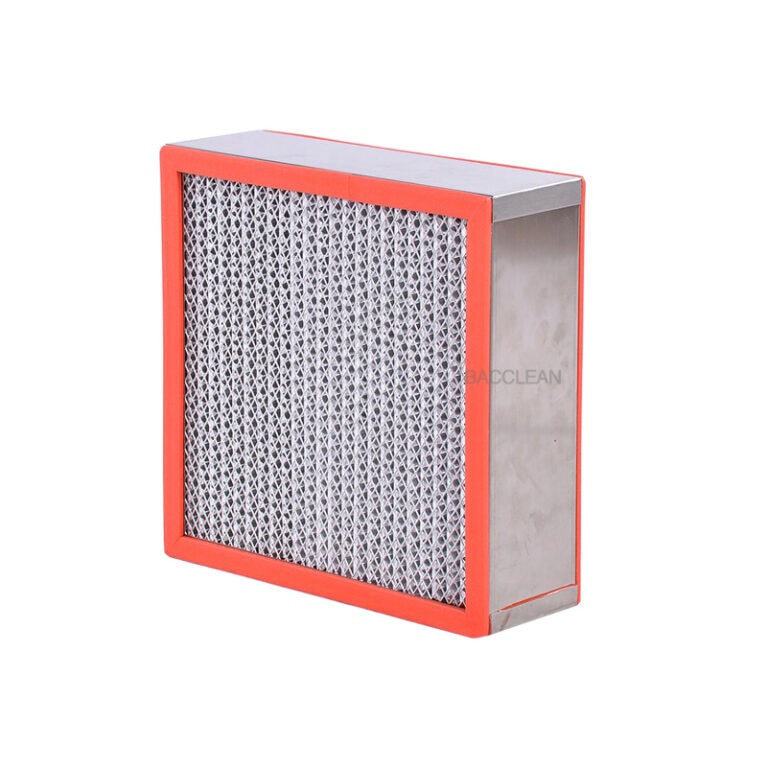
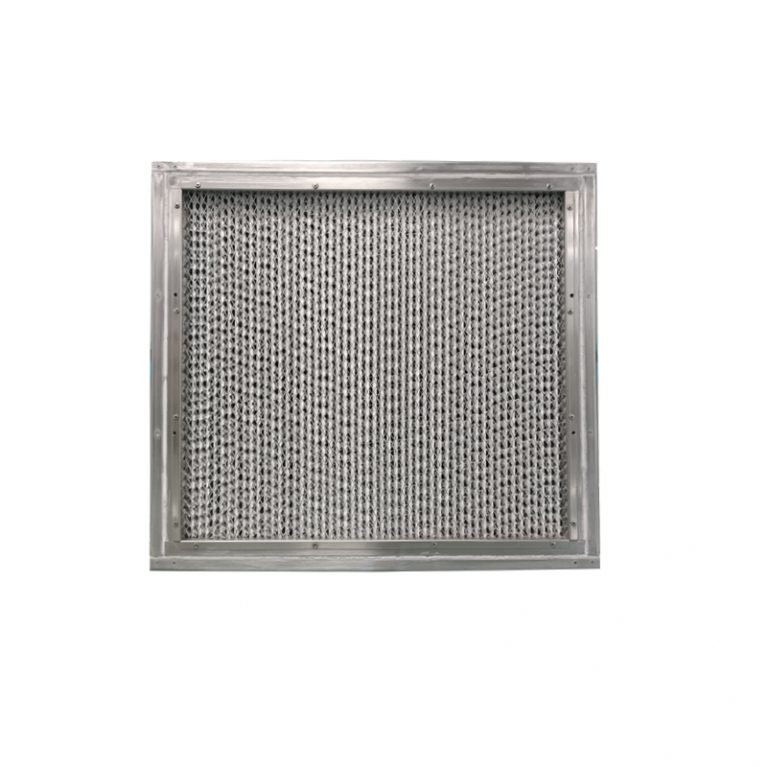
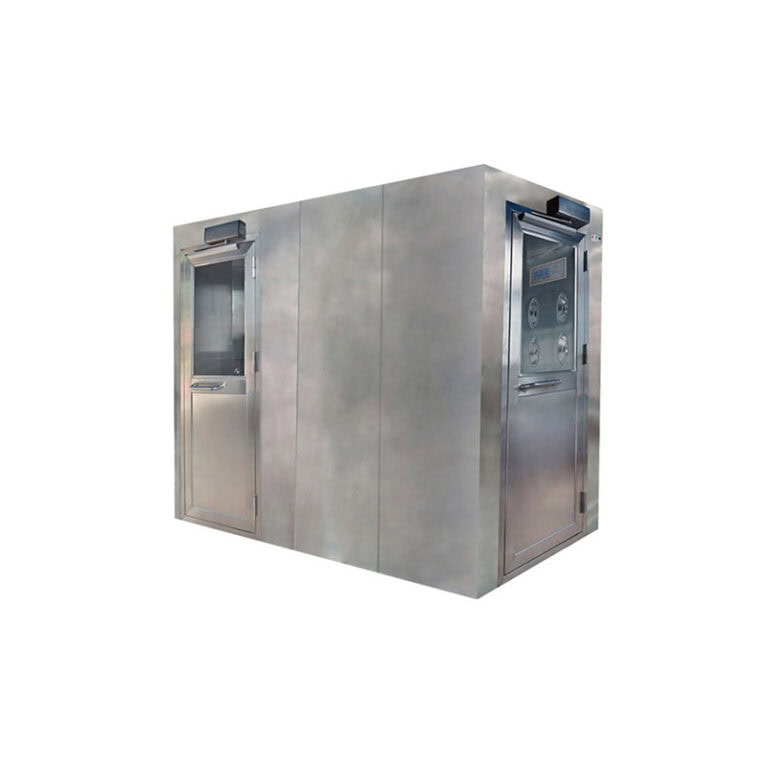
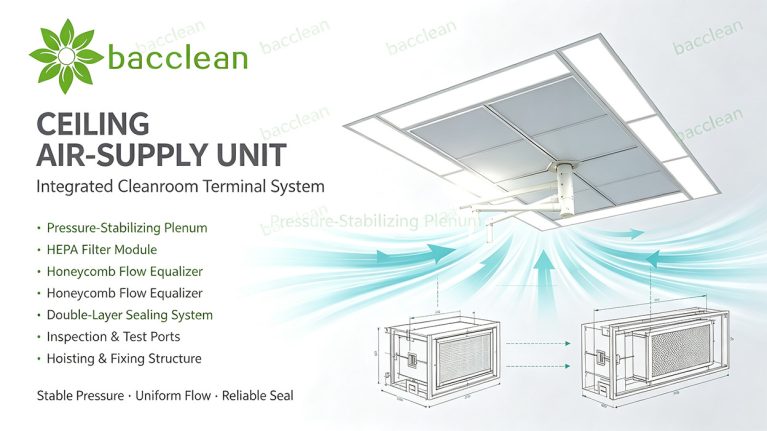
The ceiling air‑supply unit adopts an integrated cabinet structure. Its core components consist of six parts: pressure‑stabilizing plenum, HEPA filter module, flow‑equalizing air‑supply module, sealing system, inspection & test ports, and hoisting & fixing structure. The pressure‑stabilizing plenum is the main load‑bearing body, integrally formed from steel plate with outstanding air‑tightness. It buffers high‑pressure airflow coming from air ducts and stabilizes internal air pressure, preventing uneven air supply and eddy currents triggered by pressure fluctuation, so as to lay a pressure foundation for uniform air delivery. As the core purification component, the HEPA filter module is compatible with both gel‑seal and paper‑separated HEPA filters. H13 / H14 high‑efficiency filtration captures fine dust, bacteria and contaminants to ensure cleanliness of supply air.
The flow‑equalizing air‑supply module, composed of high‑precision honeycomb flow equalizer and protective grille, is critical for achieving uniform airflow. After pressure stabilization and filtration, clean air undergoes secondary splitting and homogenization via the honeycomb flow equalizer. Turbulent high‑pressure airflow is converted into low‑speed, steady, vertical laminar flow, which evenly covers the working zone of workshops. It thoroughly solves common drawbacks of traditional air supply, such as excessive local wind speed, supply‑air dead corners and airflow turbulence. The sealing system adopts double‑layer sealing design. All gaps at cabinet joints and equipment mounting positions are fully sealed to eliminate risks of air leakage and contamination. Inspection and test ports support on‑site PAO leak testing and equipment service; maintenance and inspection can be completed without unit disassembly.
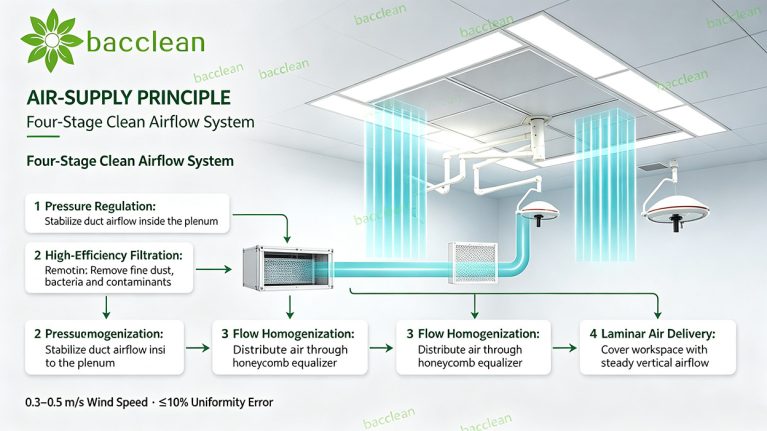
Its core air‑supply principle follows four sequential stages: pressure stabilization, filtration, flow equalization and air delivery, forming a closed‑loop clean air‑supply system.
- Pressure Regulation: High‑pressure duct airflow enters the pressure‑stabilizing plenum. The enclosed chamber buffers and stabilizes air pressure and flow velocity.
- High‑efficiency Filtration: Air passes through high‑performance HEPA filters for comprehensive removal of fine particles and microorganisms to purify the airflow.
- Flow Homogenization: Clean air is evenly distributed by honeycomb flow equalizer to unify airflow direction and wind speed.
- Laminar Air Delivery: Uniform vertical laminar flow covers the workshop, carrying away dust and pollutants in working areas and sustaining clean indoor conditions. The whole process features stable airflow without turbulence or dead zones, perfectly meeting requirements for high‑grade clean environments.
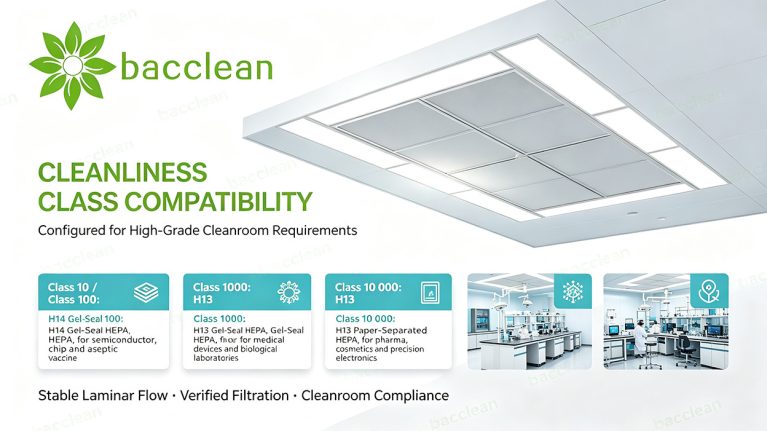
For cleanliness‑grade compatibility, ceiling air‑supply units adapt to diverse scenarios according to different configurations:
- Equipped with H14 gel‑seal HEPA filters: applicable for Class 100 / Class 10 ultra‑high‑grade cleanrooms, for semiconductor, precision chip and aseptic vaccine manufacturing.
- Equipped with H13 gel‑seal HEPA filters: applicable for Class 1000 cleanrooms, widely used for medical devices and biological laboratories.
- Equipped with H13 paper‑separated HEPA filters: applicable for Class 10 000 cleanrooms, for cosmetics, general pharmaceutical and precision‑electronics production.
Normal operating wind speed ranges from 0.3‑0.5 m/s with uniformity error ≤ 10 %, fully complying with clean‑room airflow design standards.
In summary, with integrated structural design and multi‑layer airflow‑optimization technology, ceiling air‑supply units realize standardized, uniform and stable clean air supply, overcoming performance deficiencies of traditional air‑supply equipment. They are indispensable core air‑purification & air‑supply devices for high‑grade cleanrooms.
