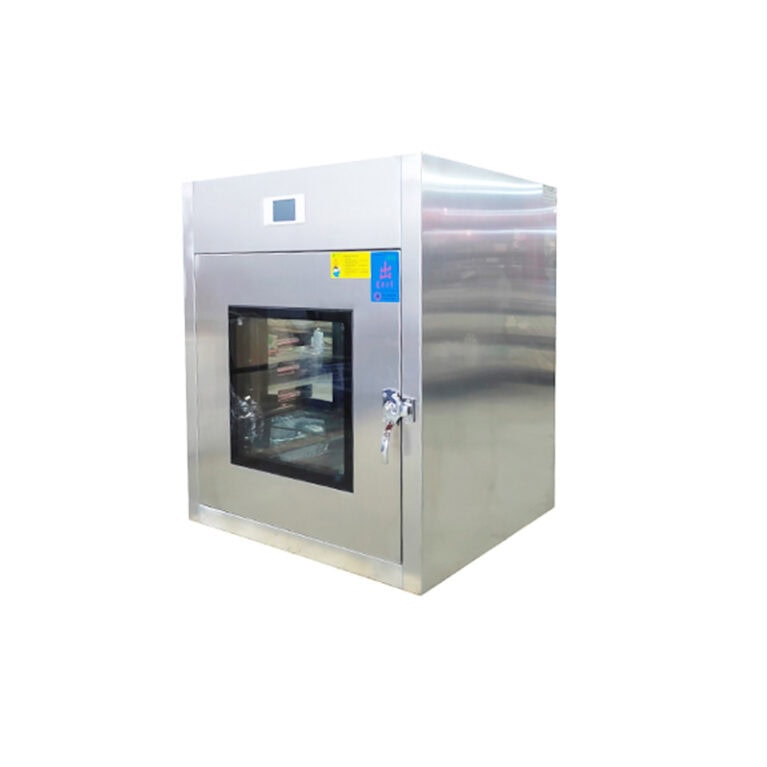
VHP transfer Window Sterilization Effect Verification Scheme (in compliance with GMP/ISO Standards)
The verification of the sterilization effect of VHP transfer Windows is a core link to ensure the compliance of aseptic environments. It is necessary to confirm through quantitative index detection and process verification that its ability to kill microorganisms meets industry standards (such as aseptic requirements in the medical, pharmaceutical, food and other fields). The following is a systematic verification plan based on industry norms, including verification indicators, processes, methods and judgment criteria:
I. Core Verification Indicators (Quantifying Sterilization Effects
Verification should focus on three key indicators to ensure data traceability and repeatability:
Microbial killing rate: ≥99.99% (i.e., 4-log level killing, targeting bacteria, fungi, viruses and other target microorganisms);
Survival status of biological indicator (BI) : After verification, the biological indicator shows no survival (core determination basis).
Sterilization uniformity: The sterilization effect at each key point within the transfer window (dead corners, areas blocked by materials) is consistent, with no sterilization blind spots.
Ii. Preparations Before Verification
1. Verify tools and consumables
Biological indicator (BI) : Geobacillus stearothermophilus spore strips/tablets are preferred (with strong resistance, D value 1.5-3.0 minutes, suitable for VHP sterilization verification), and the spore quantity is 10⁶-10⁷ CFU/unit;
Chemical indicator (CI) : VHP-specific chemical indicator card/strip (Visually determine whether exposure to effective VHP concentration through color change);
Sampling tools: Sterile cotton swabs, nutrient AGAR medium, sterile sampling bags, biosafety cabinets, incubators (55-60℃);
Environmental monitoring equipment: VHP concentration detector (range 0-1000 ppm), hygrometer (for recording environmental temperature and humidity during sterilization).
2. Verify environmental conditions
The no-load/full-load state of the transfer window (when fully loaded, simulate the actual material placement and select materials consistent with those used in production/research or equivalent substitutes).
Environmental temperature and humidity: 20-25℃, relative humidity 40%-60% (Humidity affects the vaporization effect of VHP and must meet the equipment operation requirements).
Clean environment: The area where the transfer window is located must meet the corresponding clean level (such as ISO 7/8 grade) to avoid external contamination from interfering with the verification results.
Iii. Core Verification Process and Methods
Biological indicator (BI) Verification Method (Gold Standard)
(1) Principle of point layout
Number of distribution points: ≥5 points, covering sterilization blind spots within the transfer window (such as corners, door gaps, under material racks, near fans) and core areas (commonly used material placement locations).
Deployment method: Fix the biological indicator on a sterile stand to avoid direct contact with the VHP nozzle, ensuring that the spores are fully exposed to the VHP atmosphere. When conducting full-load verification, the BI should be placed in the material gap to simulate the actual transfer scenario.
(2) Sterilization operation
Start VHP sterilization in accordance with the standard procedures of the equipment (such as vaporization time, maintenance time, and ventilation time, which should be consistent with the actual usage parameters);
During the sterilization process, record the VHP concentration curve (the concentration during the maintenance stage should be ≥600 ppm, and the duration should be ≥30 minutes. For specific details, please refer to the equipment manual).
(3) Cultivation and assessment
After sterilization is completed, take out BI from the biosafety cabinet and immediately place it in the neutralizing medium (neutralize the residual VHP to avoid inhibiting spore germination).
At the same time, positive controls (unsterilized BI from the same batch) and negative controls (containing only the culture medium but no BI) were set up.
All samples were placed in an incubator at 55-60℃ for 7 days to observe whether any colonies grew.
Judgment criteria: The positive control grows normally, and the negative control has no colonies. No colony growth was observed in the BI verification group, indicating that the sterilization effect was qualified (killing rate ≥99.99%). If there is colony growth in the verification group, the VHP concentration, sterilization time or the rationality of the point layout need to be investigated and re-verified.
2. Chemical Indicator (CI) Verification Method (Rapid Screening)
Point distribution method: Consistent with the BI point distribution position, covering the key areas within the transfer window.
Verification process: After initiating the sterilization program, CI will undergo a color change (such as from yellow to purple) due to contact with the effective concentration of VHP.
Judgment criterion: After sterilization is completed, all CI meet the preset color standard, indicating that the VHP distribution within the transfer window is uniform without obvious blind spots. If some CI do not change color, the layout points or equipment parameters need to be adjusted and re-verified.
3. Environmental Microbial sampling verification Method (Auxiliary confirmation)
(1) Sampling timing
Before sterilization: Sample the inner surface of the transfer window as baseline data;
After sterilization: Sample immediately after the ventilation procedure is completed (to avoid external contamination).
(2) Sampling method
Surface sampling: Wipe the inner surface of the transfer window with a sterile cotton swab (the wiping area for each point is 10cm×10cm), place the swab in a sterile sampling bag, and take it back to the laboratory for inoculation into the nutrient AGAR medium.
Air sampling: Use a airborne bacteria sampler to evenly distribute sampling points within the transfer window (sampling time ≥10 minutes), and count after culture.
(3) Criteria for judgment
The total number of surface microorganisms after sterilization is ≤1 CFU/100cm², and the airborne bacteria are ≤10 CFU/m³ (specific standards must comply with industry norms, such as GMP requirements in the pharmaceutical industry).
Compared with the baseline data before sterilization, the microbial quantity decreased by ≥4-log grade, indicating that the sterilization effect met the standard.
4. Challenging Tests (Verification under Harsh conditions)
Applicable scenarios: High-risk industries (such as biopharmaceuticals, operating rooms), where it is necessary to verify the sterilization capability of the equipment under extreme conditions;
Test method: Select microorganisms with stronger resistance (such as spores of Bacillus subtilis var. Niger), or shorten the sterilization time, reduce the VHP concentration, and repeat the BI verification process;
The criterion for judgment: If BI still does not survive in the challenging test, it indicates that the sterilization effect of the equipment is stable and reliable, and it has the ability to resist interference.
Iv. Verification Cycle and Maintenance Requirements
First verification: After the equipment is installed and debugged, no-load and full-load verification must be completed. Only after passing the verification can it be put into use.
Regular verification: At least one full-process verification per year; After equipment maintenance (such as replacing VHP generators or nozzles) or process changes (such as adjusting sterilization parameters), re-verification is required.
Daily monitoring: Before each use, the effectiveness of VHP can be quickly confirmed through CI. BI is randomly sampled once a month for inspection to ensure the long-term stable operation of the equipment.
V. bacclean VHP Transfer Window Verification Support
The bacclean VHP transfer window is equipped with a precise VHP concentration control system and a uniform air supply module, which can ensure the stability and uniform distribution of VHP concentration during the sterilization process and reduce the risk of validation. Also provided:
Customized verification solution: Based on the customer’s industry standards (such as GMP, HACCP, ISO 14644) and usage scenarios, design exclusive site layout and verification processes;
Professional technical support: Assist customers in completing BI selection, sampling operations, and data interpretation to ensure that the verification results meet compliance requirements.
Equipment optimization suggestions: If problems occur during the verification process, provide solutions such as parameter adjustment and equipment renovation to ensure that the sterilization effect continuously meets the standards.
Through the above systematic verification, the sterilization effect of the VHP transfer window can be fully confirmed, ensuring that there is no microbial contamination during the cross-regional transfer of materials and meeting the strict requirements of various industries for aseptic environments.