
1. Core Working Principle: Unidirectional Laminar Circulation Inside the Cavity
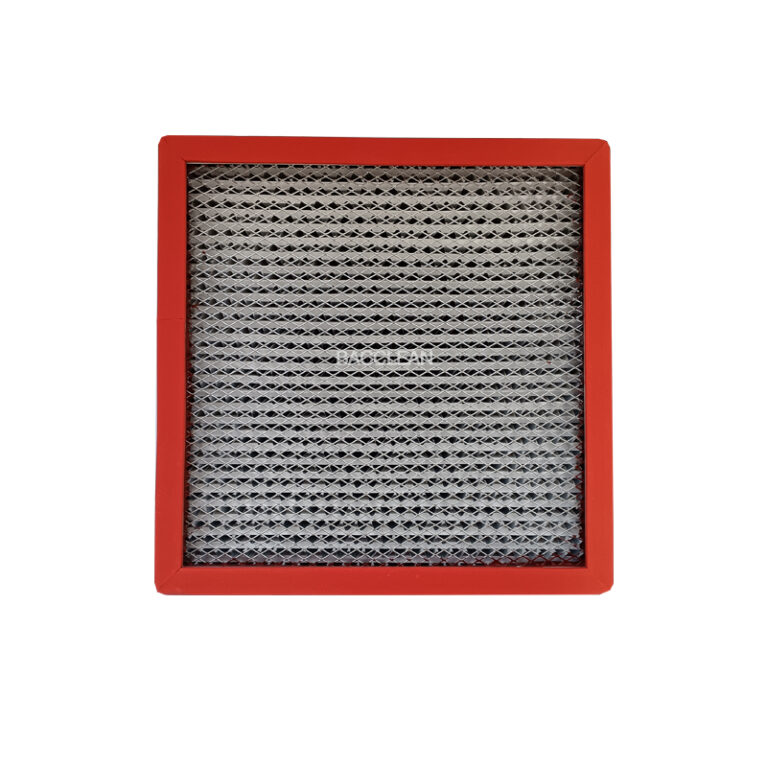
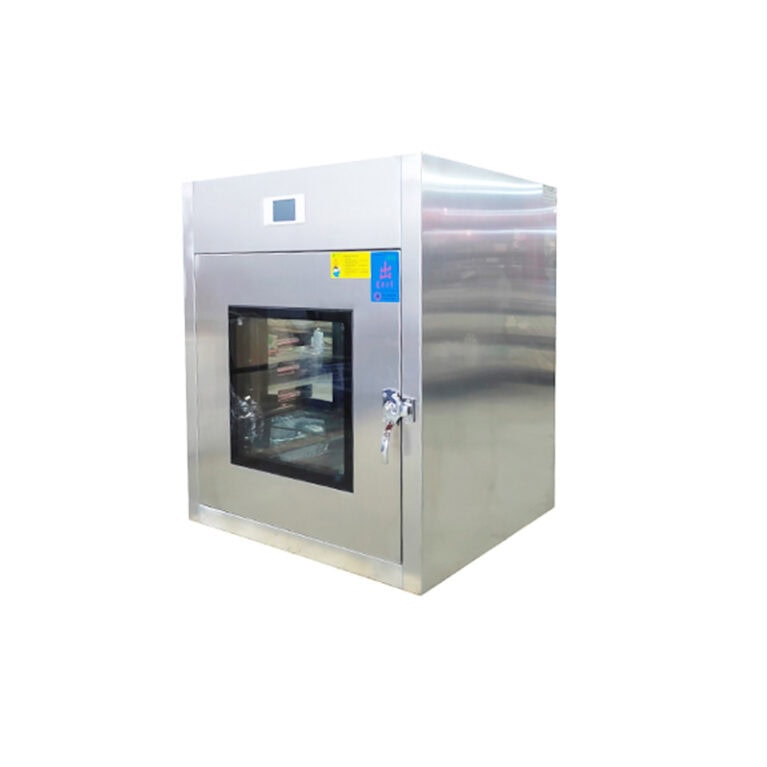
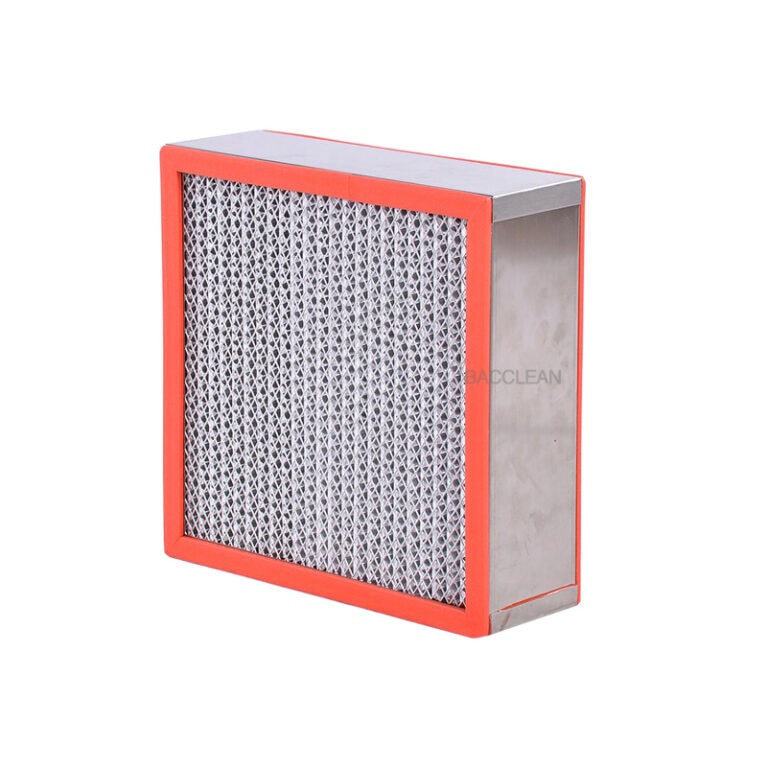
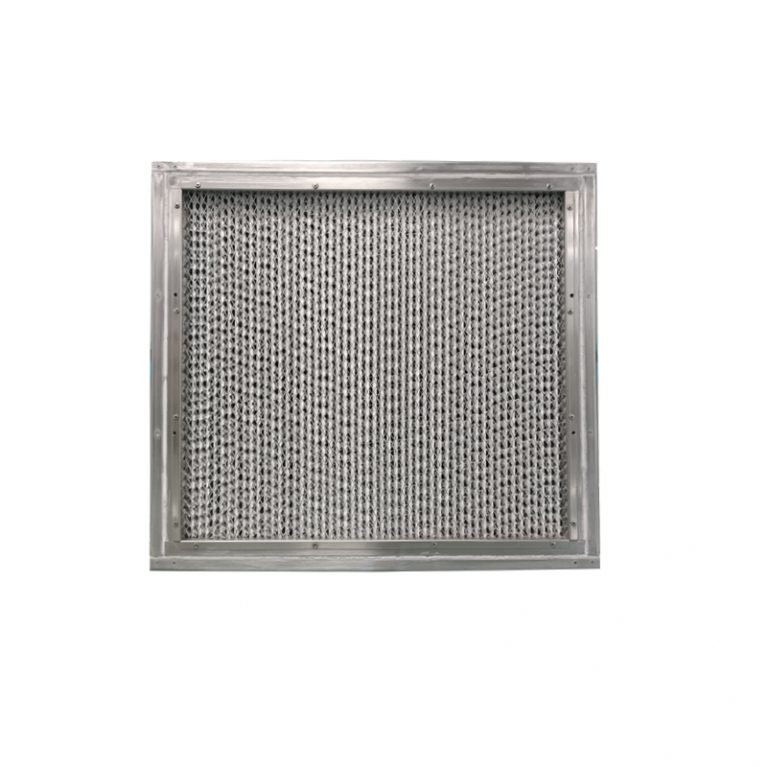
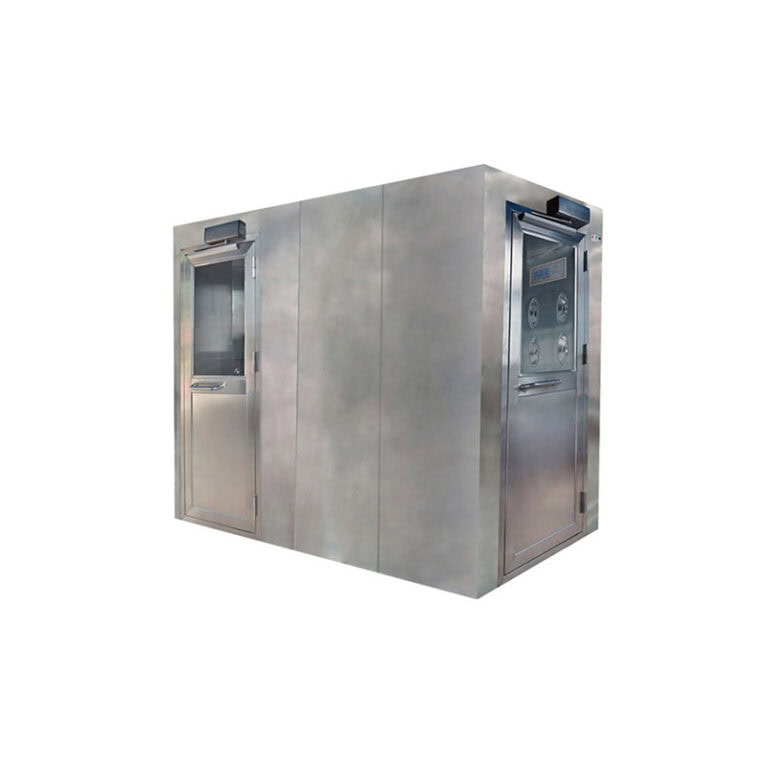
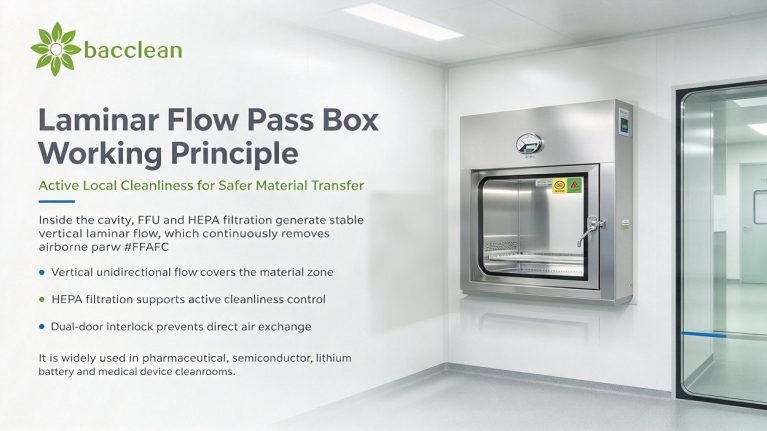
The laminar flow pass box is equipped with built-in FFU fan filter units and HEPA filters. After the equipment starts, the fan draws air from the top of the cavity. The air passes through the HEPA filter to remove airborne suspended particles and forms vertical unidirectional laminar airflow, which flows evenly from top to bottom through the entire inner cavity of the pass box.
The stable laminar airflow features uniform velocity and no eddy currents. It can continuously carry away suspended particles on the surface of materials and in the air inside the cavity. During the whole transfer process when materials are placed inside the cavity, the materials are always wrapped in local clean airflow. When one side door is opened, the unidirectional laminar flow can prevent backflow of air from the non-clean side into the clean area and reduce contaminant intrusion caused by airflow disturbance while opening doors. The air returns to the FFU through the air return area at the bottom of the cavity to form continuous circulating purification.
Key Principle Summary: It does not rely on passive protection from room pressure difference, but independently builds a Grade A local clean environment inside the pass box cavity to actively control the air quality within the cavity.
2. Three Protection Mechanisms to Reduce Cross-Area Cross-Contamination
-
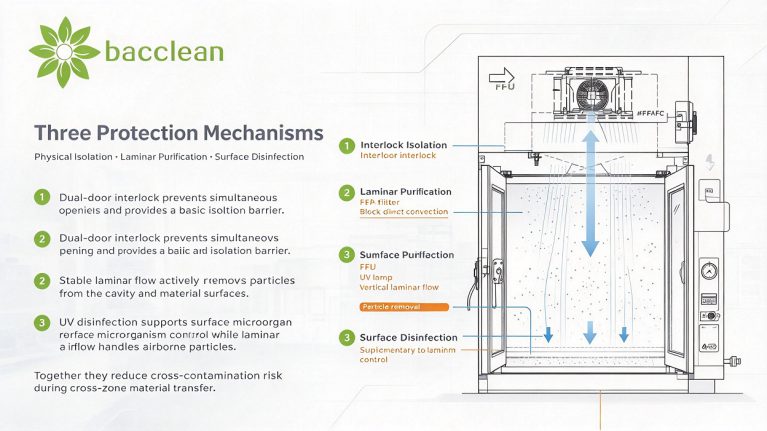
Mechanical & Electrical Interlock to Prevent Both Doors Opening Simultaneously Laminar flow pass boxes are standard-fitted with dual-door interlock devices. When either door is open, the other door remains locked and cannot be opened. It fundamentally prevents direct connection between clean and non-clean areas and cuts off the path for direct air convection between the two spaces. After materials are loaded, doors closed and purification & disinfection procedures completed, the opposite door can be unlocked for opening. This is the basic isolation guarantee and also a fundamental verification item for cleanroom equipment.
-
Continuous Laminar Purification to Control Airborne Suspended Contaminants After materials are placed in the cavity and the door is closed, the laminar flow system keeps running to continuously blow the material surface and trap suspended particles inside the HEPA filter. Even if the materials carry a small amount of particles, they will be carried away by unidirectional airflow and will not diffuse into the clean area with door-opening airflow. The equipment is generally equipped with a differential pressure gauge to monitor the resistance change of HEPA filters, helping maintenance personnel judge filter clogging and perform PAO leak testing in accordance with specifications to ensure stable filtration performance. Some models support VHP (vaporized hydrogen peroxide) compatible ports for microbial inactivation, suitable for high-demand scenarios such as aseptic workshops.
-
Auxiliary Disinfection to Control Surface Microorganisms UV germicidal lamps are installed inside the cavity. During intervals between material transfers, they can disinfect the inner cavity and outer surfaces of materials. UV disinfection serves as a supplementary measure for laminar purification. It mainly acts on microorganisms on object surfaces and cannot replace laminar airflow for controlling airborne suspended particles. Operators shall take personnel protection during operation to avoid direct UV exposure to human bodies.
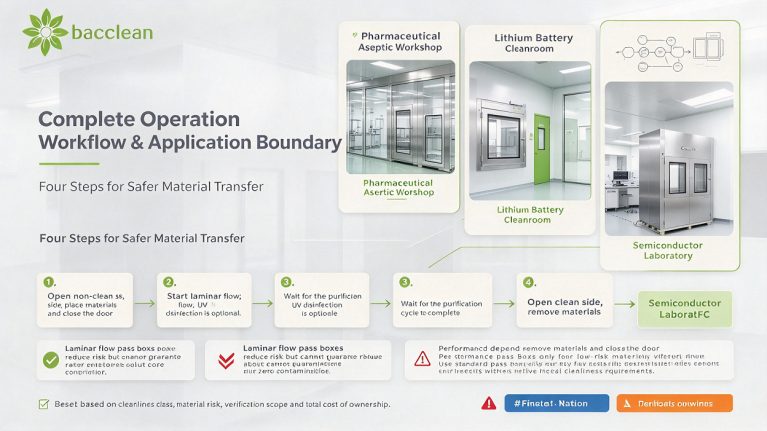
3. Complete Operation Workflow
-
Open the door on the non-clean side, place materials to be transferred inside, then close this door, and the interlock takes effect.
-
Start the laminar flow system. Unidirectional clean airflow continuously purges the cavity and materials to remove suspended particles. UV disinfection can be activated on demand for surface treatment.
-
Once the purification cycle is completed, the door on the clean area side is unlocked.
-
Personnel in the clean area open the door, take out materials and close the door to finish this transfer cycle. The two doors can never be opened at the same time to avoid air exchange between the two zones throughout the process.
4. Application Boundary Description
The laminar flow pass box can greatly reduce cross-contamination risks in material transfer, but it cannot achieve absolute zero contamination. The contamination control effect is closely related to laminar airflow velocity, airflow pattern, filter integrity and standardization of operation. During selection, comprehensive evaluation shall be carried out combined with workshop cleanliness grade, material properties and verification requirements. If only ordinary outer-packaged materials are transferred across zones without the need for a local high-clean environment, a standard pass box is sufficient, and there is no need to configure an extra laminar flow system.
Conclusion
The core logic of laminar flow pass boxes is the synergy of physical isolation, unidirectional laminar purification and auxiliary disinfection. The stable laminar flow generated by FFU and HEPA converts the transfer cavity into an independently controllable local clean space. Combined with dual-door interlock to block air convection between two zones, it controls the migration of particles and microorganisms during material transfer and meets the verification requirements of GMP and other cleanroom projects.
