Sealant strip replacement criteria (General + Special for VHP models)
I. Visual appearance inspection (Quick daily pre-shift judgment)
Any one of the following conditions met suggests replacement is recommended:
Hardening, loss of elasticity
Press the rubber strip with your finger, and it won’t rebound quickly when released; the pressed area is permanently concave; it feels hard and lacks the soft rubber texture, and the effect is more obvious at low temperatures.
Cracking, fracture, chipping
Minor fine lines and cracks appear on the surface of the rubber strip; the edges and door corners are the most prone to breakage; VHP models may develop fine cracks due to long-term oxidation.
Color change, powdering, chipping
The silicone strip turns yellow, white, or gray; when rubbed with your hand, white powder falls off; VHP hydrogen peroxide corrosion easily causes powdering.
Detachment, falling off, displacement
The rubber strip separates from the door frame, local warping, or the entire strip becomes loose; the door cannot fully close and fit the cavity.
Deformation, flattening, permanent inability to recover
Permanent flattening occurs due to long-term closing pressure, and there are gaps at the door seam.
Mold growth, blackening, bacterial colonies
The stubborn mold stains cannot be removed by cleaning; mold penetrates the rubber, posing a risk of microbial contamination.
II. Door closure sealing test (Key determination method)
Light transmission test (Simple on-site method)
Close the door body, turn off the lights, and observe the door seam from the inside of the cavity;
If any position can see external light → Sealing failure, must be replaced.
Paper test
Take an A4 thin paper and place it at any position in the door seam; close the door and pull the paper:
Uniform resistance in all areas, unable to pull out → Good sealing;
Local easy pull-out, no gripping force: Failure of this area’s rubber strip;
Multiple leakage areas suggest a complete set replacement.
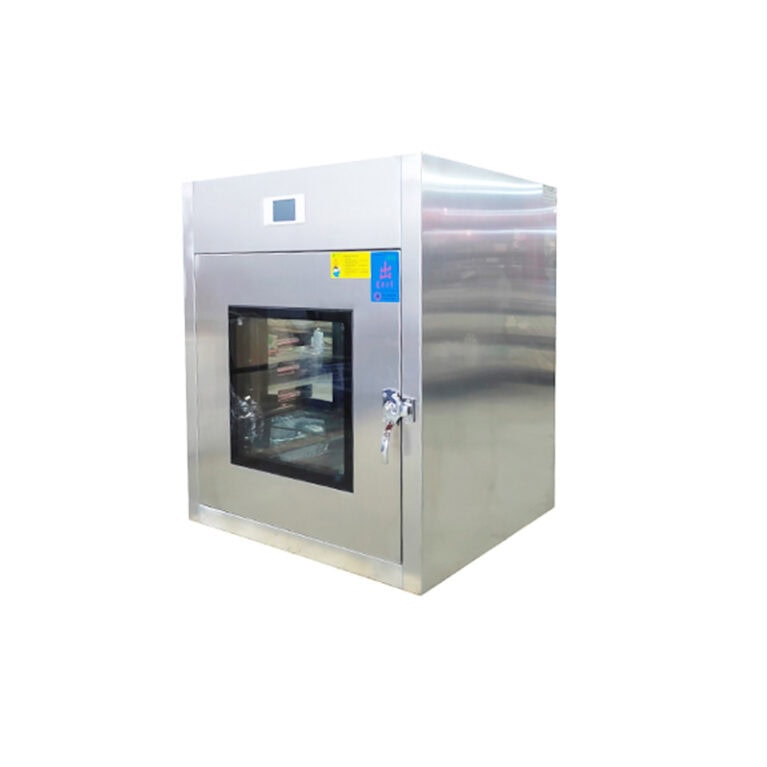
Wind pressure / negative pressure test (For mandatory inspection of VHP transfer windows)
When the equipment is running under sterilization negative pressure (-5 to -10 Pa), the pressure drops rapidly and cannot maintain the set negative pressure. After troubleshooting the air duct and fan faults, it is mostly leakage of the sealing strip.
During the VHP process, the workshop smells hydrogen peroxide, which is a typical signal of rubber strip leakage.
III. Supporting evidence for functional and usage abnormalities
Interlock components fail
After closing the door, the magnetic sensor is unstable; it sometimes shows the door is open and sometimes closed; mostly caused by the thinning of the rubber strip, resulting in the door not closing properly.
Cavity internal accumulation of dust and abnormal humidity
External air continuously infiltrates, dust and water vapor enter the cavity; VHP models have a significantly longer dehumidification time and reduced sterilization effect.
Energy consumption and consumables abnormality
VHP models continuously increase hydrogen peroxide concentration to maintain the concentration; the catalytic decomposition time is prolonged due to leakage; the root cause is usually sealing leakage.
IV. Time period replacement criteria (Preventive replacement, GMP compliance)
Silicone sealing strips for ordinary ultraviolet / air shower transfer windows
General environment: Replace the entire set every 12 months; in humid and frequently disinfected environments, replace every 6 to 9 months.
Silicone sealing strips for VHP hydrogen peroxide transfer windows
VHP has strong oxidizing properties; rubber accelerates aging, recommend replacing the entire set every 6 months; even if the appearance is intact, mandatory replacement is required to verify compliance.
V. Details for replacement and supplementation
It is not recommended to only replace small sections that are damaged: The thickness and hardness of the new and old rubber strips are inconsistent, and the connection area will inevitably leak; a complete set replacement ensures airtightness;
For VHP equipment, choose food-grade silicone rubber sealing strips that are resistant to oxidation; ordinary rubber will powderize in a short period of time;
After replacement, a paper test for light transmission and VHP negative pressure pressure maintenance verification must be conducted, and the records should be archived for GMP audits.